What Is HBM (High Bandwidth Memory)? The Real Bottleneck Behind the AI Chip Boom
TL;DR — HBM (High Bandwidth Memory) is a stack of memory chips wired straight into an AI processor, built to solve the one thing raw compute power can't fix on its own: getting data to the chip fast enough. Every major AI accelerator depends on it, only three companies make it at scale, and as of mid-2026 it's reportedly sold out through the year with 2027 already being allocated. If you've read about AI stock selloffs, chip shortages running past 2027, or record Dow closes tied to AI — HBM is the component quietly underneath all three stories.
What HBM Actually Is
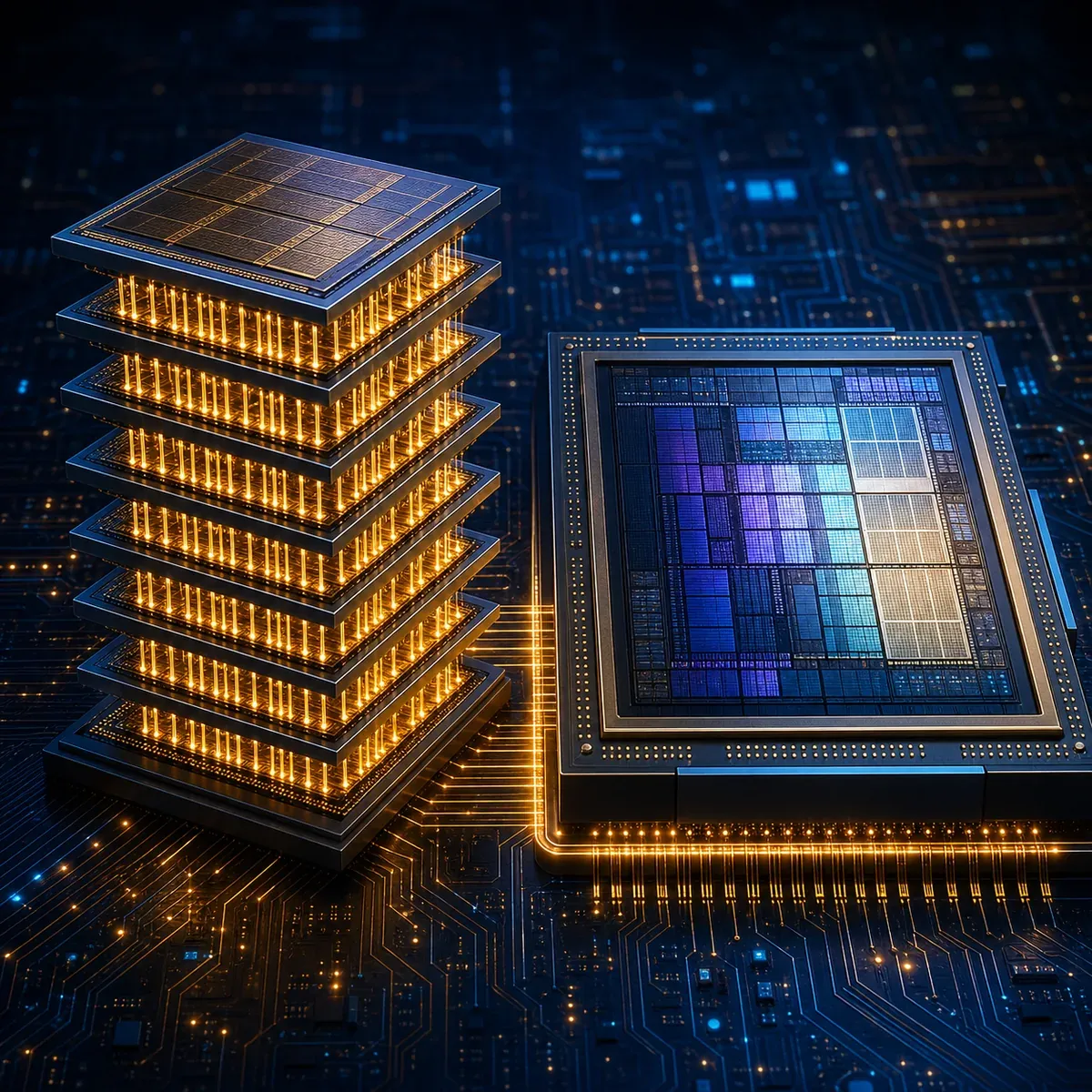
Normal computer memory (DDR5, the kind in a laptop) sits spread out on a circuit board, wired to the processor over a relatively narrow, long connection. HBM does the opposite: it stacks multiple DRAM chips vertically, right next to the processor, connected by short vertical wires called through-silicon vias (TSVs) — like a high-rise building with elevators running through every floor.¹ That physical shortcut is the whole point. A wide, short connection moves far more data per second than a long, narrow one.
The difference in numbers is large. Standard DDR5 tops out around 50–100 GB/s. HBM delivers roughly 3–5 TB/s — an order of magnitude more.¹ Micron's HBM4, aimed at Nvidia's next-generation "Vera Rubin" GPUs, is designed to exceed 2.8 TB/s per stack.¹
Why This Matters for AI Specifically
Every AI chip headline focuses on raw compute — TFLOPS, cores, clock speed. But for large language models, that's increasingly the wrong number to watch. The actual constraint is memory bandwidth: how fast a chip can pull model weights out of memory to do the next calculation. Engineers call this the "memory wall."² Without enough HBM feeding it, the fastest GPU in the world just sits there waiting for data — its compute cores idle.
That's why HBM shows up in every serious AI accelerator: Nvidia's H100 and successors, AMD's MI300X, and Google's TPUs are all built around it.¹ None of them work without it.
The 2026 Supply Crunch, By the Numbers
This is the part that turns a hardware detail into a market story. As of 2026:
| Metric | 2026 status |
|---|---|
| HBM allocation | Reportedly sold out through 2026; 2027 supply already being negotiated¹ |
| DRAM prices (general) | Compounded increases exceeding 200% since early 2025² |
| Companies producing HBM at scale | Just three: SK Hynix, Samsung, Micron³ |
| Advanced packaging capacity | Bottlenecked — CoWoS/EMIB lines run separately from chip fabs and can't be scaled as fast as demand⁴ |
The packaging step — bonding the stacked dies to the processor — turns out to be as much of a constraint as making the memory chips themselves. TSMC's newest advanced-packaging fab is aimed at roughly a million wafers a year of capacity, and even that may not fully close the gap against AI demand.⁴
Who Actually Makes It (and Who's Gaining)
Only three companies build HBM at meaningful scale, and the pecking order has been moving fast:
| Company | HBM market share (Q2 2026)³ | Trend |
|---|---|---|
| SK Hynix | ~62% | Dominant leader; ~90% of its HBM output reportedly goes to Nvidia³ |
| Micron | ~21% | Biggest share gainer — up from ~9% in Q4 2024³ |
| Samsung | ~17% | Slipped to third; targeting recovery above 30% as HBM4 ramps in 2026–2027³ |
The capital being committed here is not small. SK Hynix alone has flagged roughly $29 billion in 2026 capital expenditure, with SK Hynix and Samsung together committing more than $54 billion combined.³ In 2025, SK Hynix overtook Samsung in operating profit for the first time in the companies' history — a milestone directly tied to HBM demand.³
What This Means If You're Watching Chip Stocks
Here's the part that ties back to why this matters beyond the spec sheet. Two stories about AI hardware have been running in parallel, and on the surface they sound contradictory: one says AI infrastructure spending is overbuilt and due for a correction — the anxiety behind the AI trade selloff and the no-catalyst selloff that hit Korea hardest. The other says the actual physical bottleneck — memory — is running short well past 2027, which is exactly what Micron told investors.
Both can be true at once, because they're describing different layers of the stack. A bubble is capacity racing ahead of demand. A multi-year shortage is demand racing ahead of capacity. HBM sits squarely in the second camp: three suppliers, sold out, raising prices, and still not able to keep up. That's also part of the story behind broader AI-driven market records — the underlying hardware economics have stayed tight even when sentiment swings.
The standard caution applies: shortages are what trigger the next wave of factory investment, and semiconductors have a long history of shortage-to-glut cycles. Today's tight HBM market is genuinely bullish for the three companies that make it — but it's also planting the seed of tomorrow's oversupply, once all that new packaging capacity comes online.
FAQ
What does HBM stand for? High Bandwidth Memory — DRAM chips stacked vertically and connected to a processor with short, wide wiring (TSVs) instead of the long, narrow connections used by standard memory.
Why can't regular memory do the same job as HBM? Standard DDR5 tops out around 50–100 GB/s. HBM delivers roughly 3–5 TB/s by stacking dies vertically right next to the processor instead of spreading them across a circuit board. AI accelerators are limited by how fast they can pull data from memory, not just by raw compute — that gap is why HBM exists.
Who actually manufactures HBM? Only three companies build it at scale: SK Hynix (roughly 62% share as of Q2 2026), Micron (~21%), and Samsung (~17%).
Is the HBM shortage going to end soon? Not based on current allocation patterns — HBM has been reported as sold out through 2026, with 2027 supply already being negotiated. That points to a multi-year imbalance rather than a short-term blip, though semiconductor shortages have historically resolved into gluts once new capacity comes online.
Why should someone who doesn't trade chip stocks care about HBM? Because it's the hardware fact underneath two market narratives that otherwise look contradictory — "AI is overbuilt" and "chipmakers are sold out for years." Understanding HBM is what lets you tell which layer of the AI stack a given headline is actually about.
Key Takeaways
- HBM (High Bandwidth Memory) solves AI's "memory wall" — bandwidth, not raw compute, is the binding constraint for most AI workloads today.
- Supply is severely constrained: reportedly sold out through 2026, with 2027 allocations already being negotiated.
- Only three companies build HBM at scale — SK Hynix (~62%), Micron (~21%), Samsung (~17%) — and the ranking has shifted fast in the last two years.
- The packaging step (CoWoS/EMIB), not just chip design, is the tightest link in the supply chain.
- A "chipmakers are sold out for years" story and an "AI trade is overbuilt" story can both be true — they describe different parts of the same stack.
Sources 1. Scientific American: Why high-bandwidth memory is a bottleneck for AI chips 2. Wikipedia: High Bandwidth Memory 3. Astute Group: SK hynix holds 62% of HBM, Micron overtakes Samsung, 2026 battle pivots to HBM4 4. Data Center Dynamics: Samsung and SK Hynix to scale up memory production capacity in 2026 to meet AI demand
Tags: #AI #Semiconductors #HBM #Investing #Explainer



Comments ()