
Can Custom AI Chips Dethrone Nvidia? The 80% Empire vs the 44% ASIC Surge
Nvidia still owns roughly 80–85% of the data-center AI chip market — but that's down from about 92% in 2023, and custom chips built by Google, Amazon, Microsoft, and Meta are growing about three times faster than merchant GPUs. This is the real "can anyone beat Nvidia" question, and the answer is more interesting than yes or no. Here's what the numbers say about who wins which workload.
Every few months a headline declares Nvidia's reign over. Then Nvidia reports another blowout quarter. Both things can be true. The AI-chip market isn't a single race — it's splitting into two, and the challengers aren't rival GPU makers but the cloud giants designing their own silicon. This piece breaks down Nvidia's real market share, who the challengers actually are, and where custom chips win versus where Nvidia's moat still holds.
Nvidia's empire is huge — and slowly shrinking
Start with the number that matters: Nvidia holds an estimated 80–85% of the data-center AI accelerator market by revenue in 2026. That is still overwhelming dominance. But the trend line is the story — it's down from roughly 92% in 2023.
The pressure isn't mainly from other GPU vendors. AMD has climbed to a respectable but modest ~5–7% on its MI300-series inference adoption. The bigger threat is a different kind of chip entirely: the custom ASIC.
The challengers: hyperscalers designing their own silicon
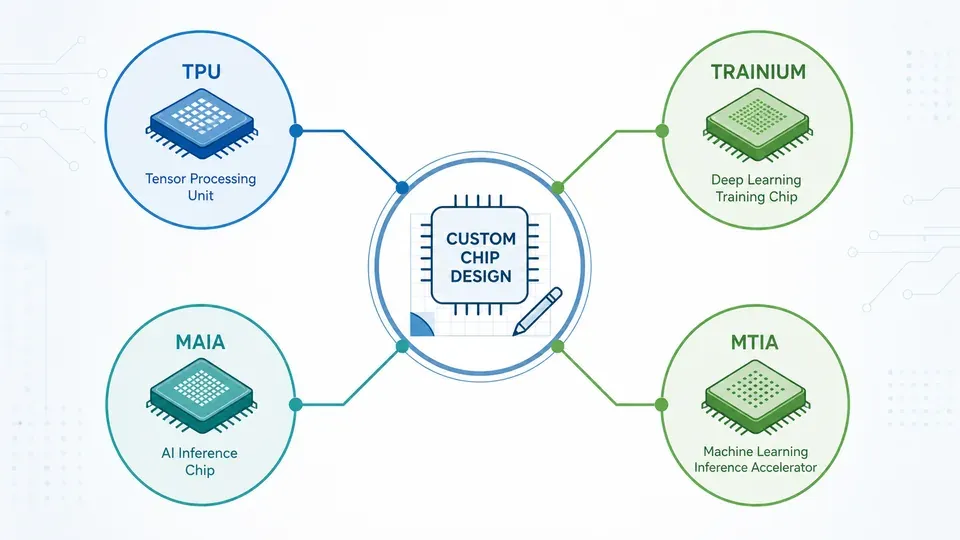
Instead of buying every chip from Nvidia, the largest cloud companies now design application-specific integrated circuits (ASICs) tuned to their own AI workloads:
- Google — TPU (Tensor Processing Unit), now on its seventh generation ("Ironwood")
- Amazon — Trainium (training) and Inferentia (inference)
- Microsoft — Maia
- Meta — MTIA (Meta Training and Inference Accelerator)
- OpenAI — a custom program (reported codename "Titan") in development
And the quiet giant behind many of these: Broadcom, which co-designs the custom silicon. Broadcom holds an estimated ~60% share of AI compute ASIC design partnerships, carries a reported $73 billion AI backlog, and its CEO has told investors the company has "line of sight" to over $100 billion in AI revenue in 2027. When people say "custom chips," a large slice of that money flows through Broadcom.
## GPU vs. ASIC: why hyperscalers build their own
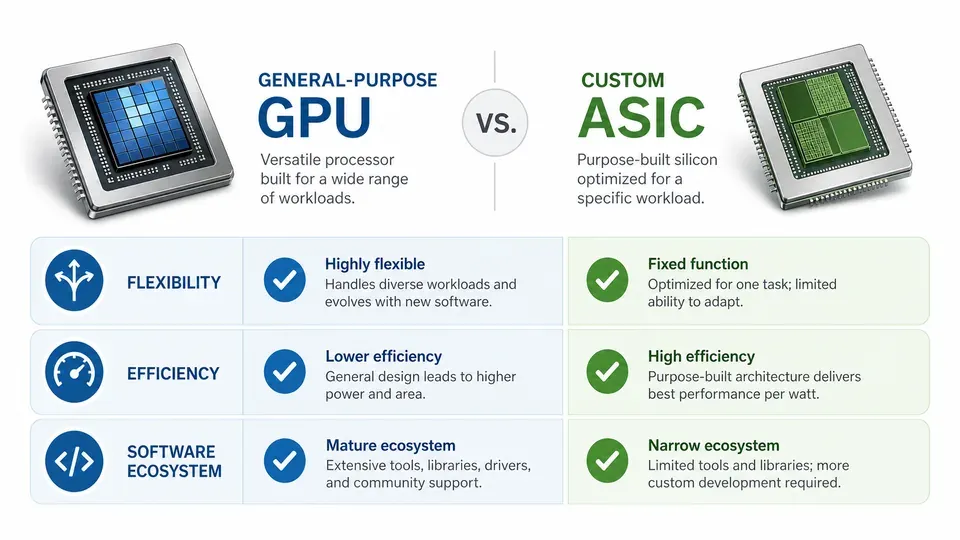
Nvidia GPUs and custom ASICs are good at different things. This is the core trade-off:
| Nvidia GPU (e.g. Blackwell) | Custom ASIC (TPU, Trainium, MTIA) | |
|---|---|---|
| Flexibility | High — runs any AI model/framework | Low — tuned to specific workloads |
| Peak efficiency on target task | Good | Higher — optimized for one job |
| Software ecosystem | CUDA — deep, mature, sticky | Narrower, owner-specific |
| Availability to outside buyers | Sold to everyone | Mostly internal to the hyperscaler |
| Best for | Cutting-edge training, broad flexibility | High-volume, stable inference at scale |
| Cost control | You pay Nvidia's margin | Design cost upfront, cheaper at scale |
The logic is straightforward: once a workload is huge and stable — like serving inference for a mature model billions of times — a purpose-built chip can be cheaper and more power-efficient than a general-purpose GPU, and it frees the hyperscaler from paying Nvidia's famous margins. That's why custom silicon targets inference, which now represents roughly two-thirds of AI compute.
## The numbers behind the shift
The growth rates are where the challenge shows up. Custom ASIC-based AI server shipments are projected to grow ~44.6% in 2026 — nearly triple the ~16.1% growth of merchant GPUs, and to reach around 27.8% of the market this year. Bloomberg Intelligence projects the overall AI accelerator market exceeding $600 billion by 2033, driven substantially by ASIC adoption. Some analysts argue Nvidia's share of the inference market specifically could fall from 90%+ toward 20–30% by 2028.
But there's a crucial caveat that "Nvidia is doomed" takes ignore: this diversification is largely additive, not substitutive. Hyperscalers building their own chips for internal use is different from Nvidia losing its external customers — the thousands of enterprises and AI startups locked into the CUDA software ecosystem. The pie is growing so fast that Nvidia can lose share percentage while still growing revenue in absolute dollars.
So — dethroned or not?
The honest verdict: Nvidia won't be dethroned as a company; it will be dethroned in specific workloads.
- Where Nvidia holds: frontier training, maximum flexibility, and the vast external market glued to CUDA. This moat is deep and not eroding quickly.
- Where ASICs win: large-scale, stable inference inside the hyperscalers that can afford to design their own chips. This is exactly where the fastest growth — and the ~44% ASIC surge — is happening.
For anyone watching the industry (or the stocks), the takeaway is to stop asking "who beats Nvidia" and start asking "which workload." The most likely 2028 picture isn't Nvidia toppled — it's a market where Nvidia is still the biggest single player but shares a much larger pie with Broadcom-enabled custom silicon. The interesting money isn't only on the king; it's on the picks-and-shovels players arming the challengers.
Frequently Asked Questions (FAQ)
What share of the AI chip market does Nvidia have? An estimated 80–85% of the data-center AI accelerator market by revenue in 2026 — still dominant, but down from about 92% in 2023.
What is a custom AI ASIC? An application-specific integrated circuit designed for a particular AI workload, like Google's TPU or Amazon's Trainium. It trades the flexibility of a GPU for higher efficiency and lower cost on the specific job it's built for.
Why is Broadcom important here? Broadcom co-designs much of the custom silicon for hyperscalers and holds an estimated ~60% of AI ASIC design partnerships, with a reported $73B AI backlog. It's a major beneficiary of the shift away from buying only Nvidia GPUs.
Are custom chips going to replace Nvidia? Mostly no — they're largely additive. They target internal, high-volume inference, while Nvidia keeps frontier training and the huge external market locked into its CUDA software ecosystem.
Where do ASICs actually win against GPUs? In large-scale, stable inference workloads run by hyperscalers big enough to justify designing their own chips — cheaper and more power-efficient at that scale than general-purpose GPUs.
Key Takeaways
- Nvidia still holds ~80–85% of the data-center AI chip market in 2026, but that's down from ~92% in 2023.
- The real challengers are hyperscaler custom ASICs — Google TPU, Amazon Trainium, Microsoft Maia, Meta MTIA — often co-designed by Broadcom (~60% of ASIC design partnerships).
- ASIC AI-server shipments are growing ~44.6% in 2026, ~3x faster than GPUs, and target inference (about two-thirds of AI compute).
- The shift is additive, not substitutive: Nvidia's CUDA moat and external customer base keep it dominant even as its share slips.
- Verdict: Nvidia gets dethroned in specific workloads, not as a company — the smart lens is "which workload," not "who wins."
How this was written AI helped research this piece, but every source, fact, and sentence was checked and finalized by hand.
References
Tom's Hardware: "The custom AI ASIC state of play (May 2026) — Broadcom deals, Google TPUs, Meta MTIA & beyond" — https://www.tomshardware.com/tech-industry/semiconductors/custom-ai-asics-examined-from-broadcom-to-mtia - Bloomberg (press): "AI Accelerator Market Looks Set to Exceed $600 Billion by 2033, Driven by Hyperscale Spending and ASIC Adoption, According to Bloomberg Intelligence" — https://www.bloomberg.com/company/press/ai-accelerator-market-looks-set-to-exceed-600-billion-by-2033-driven-by-hyperscale-spending-and-asic-adoption-according-to-bloomberg-intelligence/ - Introl: "Custom Silicon Inflection 2026 — Hyperscaler ASICs vs Nvidia GPU" — https://introl.com/blog/custom-silicon-inflection-2026-hyperscaler-asics-nvidia-gpu - The Motley Fool: "This AI Chip Stock Just Signed Massive Deals With 3 Hyperscalers (Hint: Not Nvidia or Intel)" — https://www.fool.com/investing/2026/07/05/ai-chip-stock-massive-deals-hyperscale-qcom/

Comments ()