Why AI Is Reviving Nuclear Power: The 945 TWh Data-Center Surge Behind Big Tech's Reactor Deals
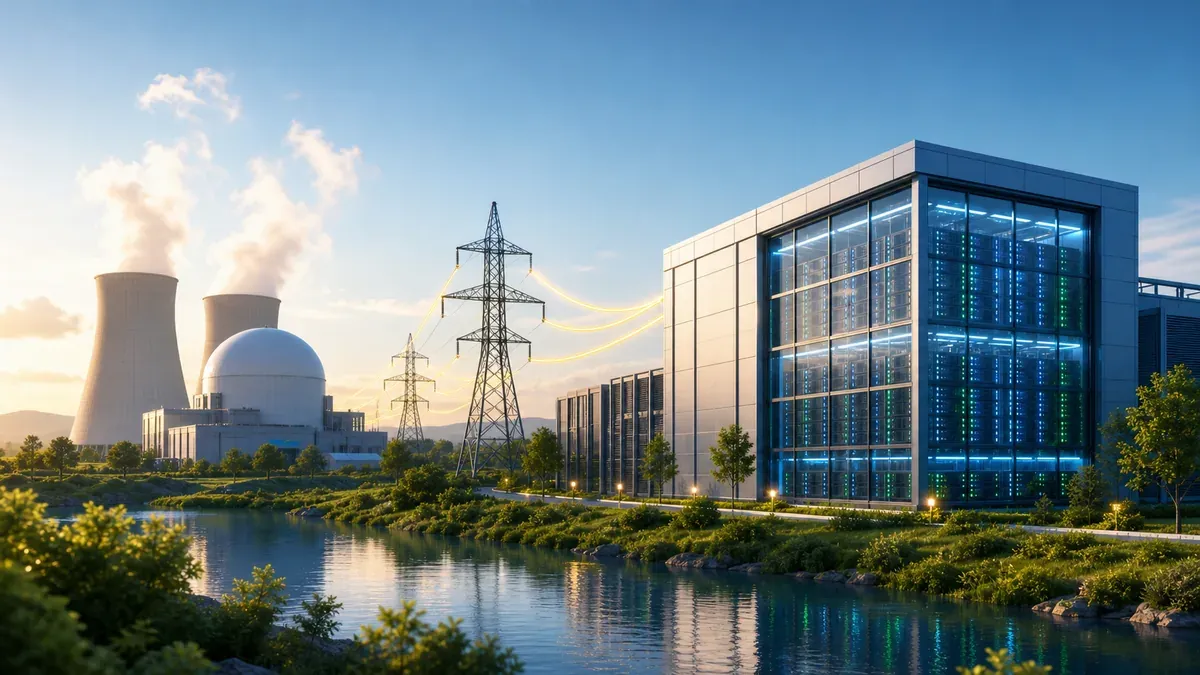
On July 1, 2026, a startup reactor powered live Nvidia AI chips in Utah — a US first. It's the flashiest sign of a bigger shift: global data-center electricity use is projected to roughly double to about 945 TWh by 2030, and AI is the main driver. That's why Microsoft, Amazon, and Google have signed multi-gigawatt nuclear deals. This piece lays out the numbers behind the trend and what's actually locked in versus still on paper.
For decades, nuclear power in the US was a story of closures. In 2026 it flipped. The reason is simple and enormous: AI needs staggering amounts of always-on electricity, and nuclear is one of the few carbon-free sources that can deliver it around the clock. Below is the real math on the demand, the specific deals big tech has signed, and an honest read on how much is real today.
The demand problem, in one number: 945 TWh
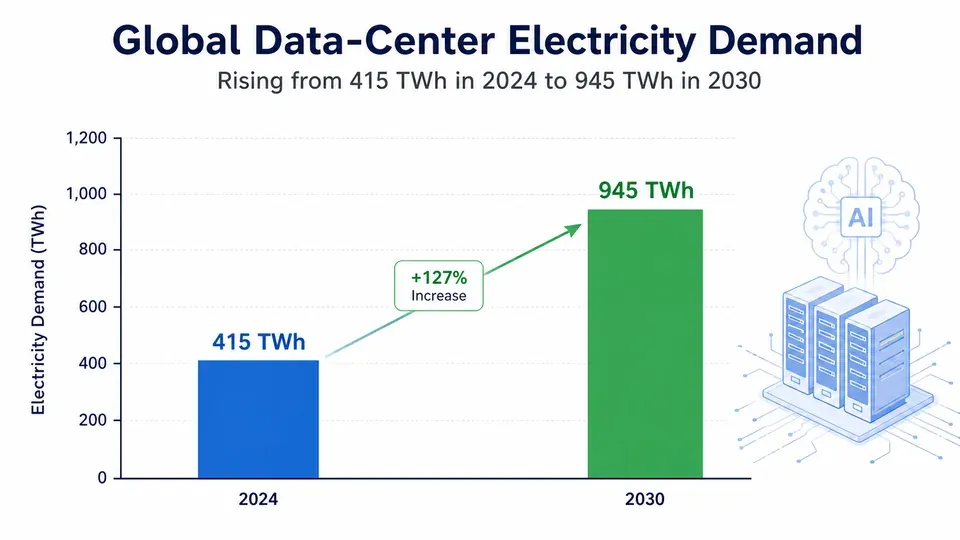
The International Energy Agency projects that global electricity consumption by data centers will roughly double to around 945 TWh by 2030 — just under 3% of all global electricity, up from about 415 TWh (≈1.5%) in 2024. AI is the sharpest edge of that curve: electricity demand from AI-optimized data centers is projected to more than quadruple by 2030.
The concentration makes it harder. The US already accounts for roughly 45% of global data-center electricity use, and the IEA estimates US data-center demand could rise about 130% by 2030. You can't meet that with intermittent power alone — data centers run 24/7, and AI training clusters can't pause when the wind drops. That's the gap nuclear is being pulled in to fill: high capacity factor, carbon-free, always on.
## The Utah first: a reactor powering live AI chips
On July 1, 2026, Valar Atomics said its microreactor produced live power for Nvidia's Blackwell-architecture chips at a small data center in Utah — the first known case of a next-generation reactor directly supplying US AI compute. The demo used its Ward250 design, which is helium-cooled rather than water-cooled, targeting near-zero water use — a pointed answer to the water-consumption criticism aimed at AI data centers.
Valar, founded in 2023 by 27-year-old Isaiah Taylor, has raised aggressively: a $450 million round in 2026 valued it at $2 billion. The companies floated a future 30-megawatt, nearly waterless data center in Utah. Worth being clear: this was a demonstration at small scale, not a grid-scale plant. It's a milestone, not yet an industry.
The deals that are actually signed
Behind the headline demo sit much larger, more concrete commitments from the biggest names in tech. Here's the comparison:
| Deal | Source | Capacity | Timeline | Notable terms |
|---|---|---|---|---|
| Microsoft – Constellation (Three Mile Island Unit 1, rebranded Crane Clean Energy Center) | Restarting a retired reactor | 835 MW | Restart targeted 2028 | 20-year PPA; ~$1.6B restart cost; ~800,000 homes' worth of power, dedicated to Microsoft |
| Amazon – Talen Energy (Susquehanna, PA) | Existing plant + campus | Up to 1,920 MW | Full volume by ~2032, contract to 2042 | $650M data-center campus buy; exploring new SMRs |
| Google – Kairos Power | New small modular reactors (SMRs) | 500 MW (≈ half a dozen reactors) | First site by 2030 | First US corporate SMR fleet deal |
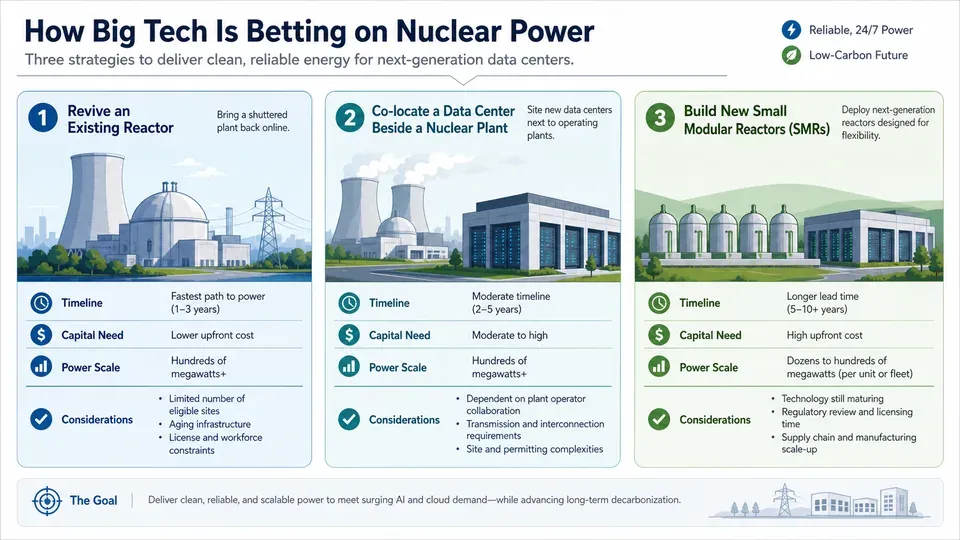
Three different strategies sit in that table. Microsoft is reviving a dead reactor. Amazon is co-locating compute next to an existing nuclear plant and buying its output. Google is betting on new SMRs — smaller, factory-built reactors that don't exist at commercial scale yet. Together they signal that hyperscalers now treat power procurement as a strategic bottleneck, not a utility bill.
## Real today vs. still on paper
It's easy to read "big tech goes nuclear" as done. It isn't — the timelines tell you why:
- Nearest-term and most certain: restarting Three Mile Island Unit 1 (2028) and Amazon's Susquehanna co-location. These use existing reactors — the lowest-risk path, because the hard part (building the plant) is already done.
- Medium-term and less certain: SMRs from Kairos and microreactors from Valar. These are genuinely new technology. First sites are targeted for 2030 and beyond, and new nuclear has a long history of delays and cost overruns.
- The timing mismatch: AI's demand curve steepens now (945 TWh by 2030), while most new nuclear capacity arrives 2028–2035+. In the gap, data centers will still lean heavily on gas and the existing grid. Nuclear is a structural answer to a long-run problem, not a switch that flips this year.
So the honest summary: the demand is real and huge, the marquee deals are real, but the "AI runs on clean nuclear" future is a decade-long build-out — with the safest bets being old reactors brought back to life, and the exciting-but-unproven bets being the small reactors still working toward their first commercial sites.
Frequently Asked Questions (FAQ)
Why does AI need so much power? AI data centers run compute-heavy training and inference 24/7. The IEA projects data-center electricity use will roughly double to ~945 TWh by 2030, with AI as the fastest-growing driver.
Why nuclear specifically, and not just solar or wind? Data centers need constant, round-the-clock power. Nuclear runs at a high capacity factor and is carbon-free, making it a strong fit for always-on AI loads that intermittent renewables can't cover alone.
What happened in Utah on July 1, 2026? Valar Atomics said its Ward250 microreactor produced live power for Nvidia AI chips at a small Utah data center — the first known US case of a next-gen reactor directly powering AI compute. It was a small-scale demonstration.
Which big tech nuclear deal is furthest along? The Microsoft–Constellation restart of Three Mile Island Unit 1 (835 MW, targeted 2028) and Amazon's Susquehanna deal with Talen are nearest-term because they use existing reactors rather than new builds.
Will nuclear actually cover AI's power needs soon? Not immediately. Most new capacity arrives 2028–2035+, while AI demand rises now. Nuclear is a long-run structural fix; near-term data centers still rely heavily on the existing grid and gas.
Key Takeaways
- Global data-center electricity use is projected to roughly double to ~945 TWh by 2030 (from ~415 TWh in 2024), with AI the main driver.
- On July 1, 2026, Valar Atomics powered live Nvidia AI chips with a microreactor in Utah — a US first, but a small-scale demo.
- The big, concrete deals: Microsoft–Constellation (835 MW, 2028), Amazon–Talen (up to 1,920 MW to 2042), Google–Kairos (500 MW SMRs by 2030).
- Restarting existing reactors is the low-risk near-term path; new SMRs and microreactors are promising but unproven at scale.
- Expect a decade-long build-out — AI demand rises now, most new nuclear arrives 2028–2035+, so the grid and gas fill the gap meanwhile.
How this was written AI helped research this piece, but every source, fact, and sentence was checked and finalized by hand.
References
IEA: "Energy and AI — Energy demand from AI" — https://www.iea.org/reports/energy-and-ai/energy-demand-from-ai - S&P Global: "Global data center power demand to double by 2030 on AI surge: IEA" — https://www.spglobal.com/energy/en/news-research/latest-news/electric-power/041025-global-data-center-power-demand-to-double-by-2030-on-ai-surge-iea - Cryptobriefing: "Valar Atomics powers Nvidia AI chip with nuclear microreactor in US first" — https://cryptobriefing.com/valar-atomics-nuclear-reactor-nvidia-ai-chip/ - Utility Dive: "Constellation plans 2028 restart of Three Mile Island unit 1, spurred by Microsoft PPA" — https://www.utilitydive.com/news/constellation-three-mile-island-nuclear-power-plant-microsoft-data-center-ppa/727652/ - World Nuclear News: "New supply agreement expands Talen-Amazon partnership" — https://www.world-nuclear-news.org/articles/new-supply-agreement-expands-talen-amazon-partnership - DCD: "Google signs nuclear SMR deal with Kairos for data center power" — https://www.datacenterdynamics.com/en/news/google-signs-nuclear-smr-deal-with-kairos-for-data-center-power/

Comments ()