The US AI Lead Over China Is Just 6–9 Months — And Anthropic Says Washington's Own Rules Could Shrink It

The US AI Lead Over China Is Just 6–9 Months — And Anthropic Says Washington's Own Rules Could Shrink It
At the Aspen Security Forum in mid-July 2026, a senior Anthropic executive put a number on the US–China AI race: America leads by roughly six to nine months in frontier models. In the same stretch, Washington has been hardening export controls — from chip-tracking laws to a 25% tariff on advanced AI chips. But Anthropic argues that one class of these measures, ad hoc restrictions on US models, may be handing China an opening rather than closing one. Here's the lead, the rules, and the self-inflicted risk.
The gap between American and Chinese frontier AI is smaller than most people assume — and the debate in Washington is no longer whether to restrict China's access to AI technology, but what to restrict and whether some of those restrictions backfire. In mid-July 2026, Anthropic's head of national security policy told a national-security audience that the US lead is about six to nine months, and that without Chinese "distillation" of American models it might be a year to eighteen months. At the same time, US policy has shifted from blocking chips to blocking chipmaking equipment, cloud access, and even American AI models themselves. This post lays out how big the lead actually is, the concrete export-control measures now in force, and why Anthropic is warning that one part of this toolkit could shrink the very lead it's meant to protect.
Table of Contents
- Just How Close Is the Race?
- How Washington Is Hardening the Rules
- The Fable and Mythos Own-Goal
- Chips You Can Cut Off, Models You Can't
Just How Close Is the Race?
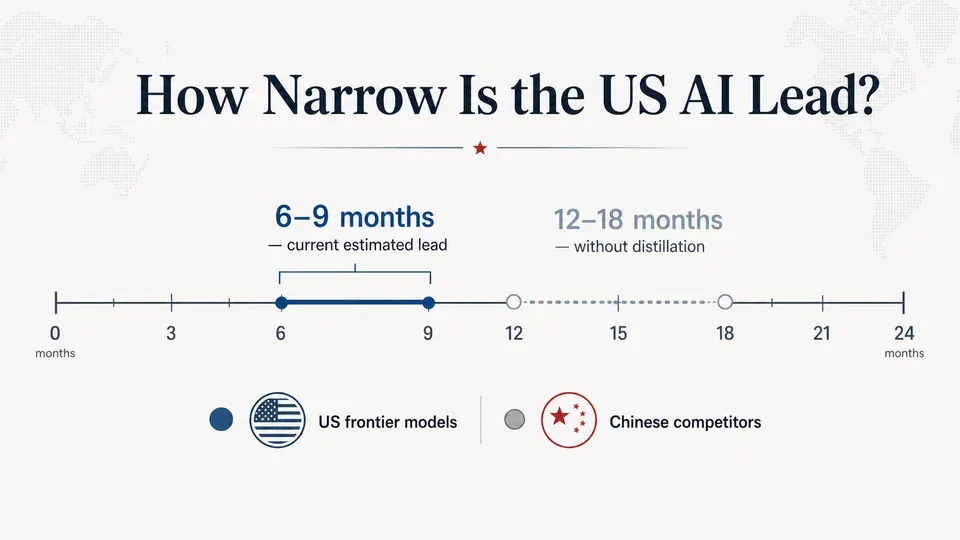
The headline figure comes from Tarun Chhabra, Anthropic's head of national security policy, speaking at the Aspen Security Forum. His estimate: the United States is roughly six to nine months ahead of Chinese competitors in frontier models — "kind of an average if you look at models," in his words. That is not a comfortable moat. It's the difference between one release cycle.
Chhabra tied the narrowness of that lead directly to distillation — training a cheaper model to mimic the outputs of a stronger one. He called China's use of it "adversarial," describing it as "extracting the most valuable IP from the models," and argued that without it the US could be "a year to 18 months ahead." Anthropic says it is shutting down accounts tied to this activity "on the order of millions of accounts per week." Whether one accepts that framing or sees distillation as normal competitive learning, the strategic claim is clear: a chunk of America's lead is leaking out through the models themselves, not just through chips.
This is the same shrinking-gap story we quantified earlier when independent benchmarks put the US–China capability gap at roughly 2.7 points — close enough that policy choices at the margin genuinely matter.
## How Washington Is Hardening the Rules
Through 2026, US export policy has moved well beyond the original idea of simply denying China the fastest chips. The tools now span hardware, equipment, and models. The key measures:
| Measure | What it does | Status (2026) |
|---|---|---|
| BIS license-review change | Shifts H200-/MI325X-equivalent chips from "presumption of denial" to "case-by-case review" | Final rule, Jan 13, 2026 |
| Advanced AI-chip tariff | 25% value-based tariff on "covered" advanced AI chips not bound for the US supply chain | Effective Jan 15, 2026 |
| Chip Security Act | Requires location-verification tech embedded in advanced AI chips to detect illegal diversion | Approved by Congress, Mar 26, 2026 |
| GAIN AI Act | Would force chipmakers to prioritize US customers over export markets | Proposed; not in the final 2026 NDAA |
| Model-access controls | Restrict who (by nationality) can use the most powerful US AI models | Applied ad hoc (see below) |
Two things stand out. First, the center of gravity is shifting from chips to everything around them — semiconductor manufacturing equipment, cloud infrastructure, and frontier models. Second, not everything proposed becomes law: the GAIN AI Act, which would have required prioritizing American buyers, was left out of the final NDAA, a reminder that industry pushback still shapes outcomes. Chipmakers warn that forcing them to serve the US market first could cede global market share to competitors, a tension we saw play out in the physical supply chain too, in the debate over chip-security backdoors and access.
The Fable and Mythos Own-Goal
The clearest example of a control that may cut the wrong way involves Anthropic's own models. On June 12, 2026, the US Department of Commerce ordered Anthropic to deny access to its most powerful models — Mythos and Fable — to "any non-US persons." Because Anthropic couldn't reliably verify user citizenship, it took both models down for all users globally — reportedly including the NSA. Fable access was restored on July 1 with more restrictive guardrails; Mythos stayed limited to American institutions.
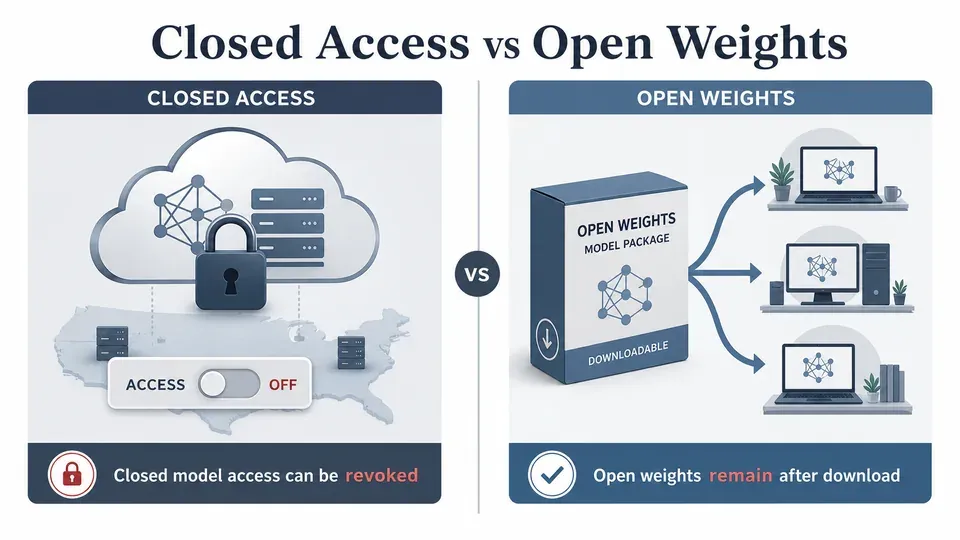
Analysts at the Peterson Institute framed the episode bluntly as a possible self-inflicted wound. The logic: Chinese labs mostly ship open-weight models that users download and run locally, so no provider can revoke access after the fact. When the US abruptly cuts off a closed American model — with no clear public criteria and no ally carve-outs — it makes the Chinese "download it and own it" approach more attractive to international users who don't want to depend on a supplier that might flip a kill switch. Slower, more restricted US model releases could, in this view, "give Chinese AI firms a chance to narrow the lead."
## Chips You Can Cut Off, Models You Can't
The deepest lesson of 2026's policy year is that hardware and software behave differently under export control. A physical chip is a discrete object you can tariff, track, and deny at the border — which is why measures like location verification and license reviews can plausibly slow China's compute buildout. A model is information. Once weights are open and downloaded, no order can claw them back, and a distilled copy of a model's behavior can travel even when the weights don't.
That asymmetry explains why Anthropic can simultaneously support tough controls on chips and warn against clumsy controls on models. Restricting compute raises China's costs. Restricting American models — especially abruptly and without allied coordination — mostly restricts American reach, while the open-weight alternative keeps flowing. For a lead measured in single-digit months, the difference between a well-targeted control and a counterproductive one is not academic. It may be the whole margin.
Frequently Asked Questions (FAQ)
How far ahead is the US in AI, according to Anthropic? About six to nine months in frontier models, per Anthropic's national-security policy head at the Aspen Security Forum in July 2026 — possibly a year to 18 months without Chinese distillation of US models.
What is "distillation" and why does it matter here? Distillation trains a smaller, cheaper model to imitate a stronger one's outputs. Anthropic calls China's use of it adversarial IP extraction and says it shuts down millions of related accounts weekly; it argues the practice is eroding part of the US lead.
What did the US do to Anthropic's Mythos and Fable models? On June 12, 2026, Commerce ordered Anthropic to block non-US persons. Unable to verify citizenship, Anthropic took both models offline globally. Fable returned July 1 with tighter guardrails; Mythos stayed limited to US institutions.
Did the GAIN AI Act become law? No. The proposal to force chipmakers to prioritize US customers was not included in the final 2026 NDAA. The Chip Security Act (chip-tracking) did pass, in March 2026.
Why might export controls on models backfire? Chinese labs release open-weight models that can't be switched off after download. Cutting off closed US models without clear rules or ally carve-outs can push global users toward those Chinese alternatives, potentially narrowing the US lead.
Key Takeaways
- Anthropic estimates the US frontier-AI lead over China at just 6–9 months, and blames model distillation for shrinking it from a possible 12–18.
- US controls hardened across 2026: a BIS license-review change (Jan), a 25% tariff on advanced AI chips (Jan 15), and the Chip Security Act chip-tracking law (Mar 26). The GAIN AI Act did not make the final NDAA.
- On June 12, 2026, Commerce ordered Anthropic to block non-US users of Mythos and Fable; Anthropic pulled both globally. Fable returned July 1, Mythos stayed US-only.
- The core lesson: you can cut off chips, but not models. Open-weight Chinese models can't be revoked after download, so clumsy US model controls risk shrinking America's own reach — and its lead.
How this was written Research and a first draft came together with AI's help; verification and the final pass were entirely human.
References
- South China Morning Post — US hardens AI stance on China as Anthropic calls for extending lead
- Peterson Institute for International Economics — Fable of the Mythos saga: Ad hoc US AI model controls could help China
- CSIS — The GAIN AI Act Will Undermine the Global Competitiveness of U.S. AI Chipmakers
- Mayer Brown — Administration Policies on Advanced AI Chips Codified


Comments ()