IBM's 25% Crash Explained: A $660M Miss and the AI Hardware Squeeze on Software
IBM's 25% Crash Explained: A $660M Miss and the AI Hardware Squeeze on Software
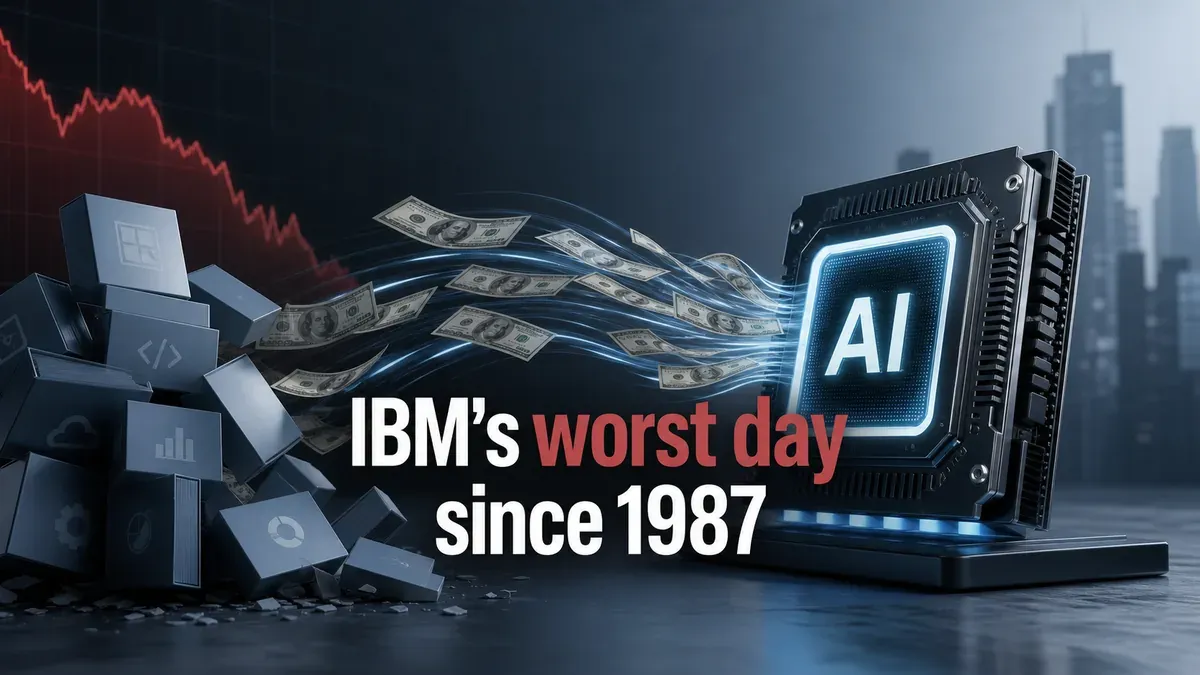
On July 14, 2026, IBM fell about 25% — its worst single day on record — after warning that Q2 revenue would land near $17.2 billion against a $17.86 billion consensus. The reason wasn't weak demand for technology; it was the opposite. Clients are diverting IT budgets toward supply-constrained AI hardware and delaying software deals. Here is exactly what IBM said, why it dragged down Microsoft, ServiceNow and the wider software sector, and whether this is an IBM stumble or a structural warning.
IBM just had the worst trading day in its 115-year history. On July 14, 2026 the stock cratered about 25%, blowing past its previous record loss — a 23.7% drop on October 19, 1987, "Black Monday." What makes this remarkable is the cause: not a collapse in tech spending, but a reallocation of it. IBM's own customers are pouring money into AI compute, storage and memory — often to lock in supply before prices rise — and pushing software and infrastructure purchases to the back of the line. The result was a preliminary quarter that missed by roughly $660 million and wiped out an estimated $65 billion in market value in a session. This post breaks down the numbers, the mechanism behind them, the contagion into other software names, and whether the sell-off is IBM-specific or a signal for the whole sector.
Table of Contents
- What Actually Happened to IBM
- Why Clients Chose Hardware Over Software
- The Contagion Across Software Stocks
- IBM Problem or Software Problem
What Actually Happened to IBM
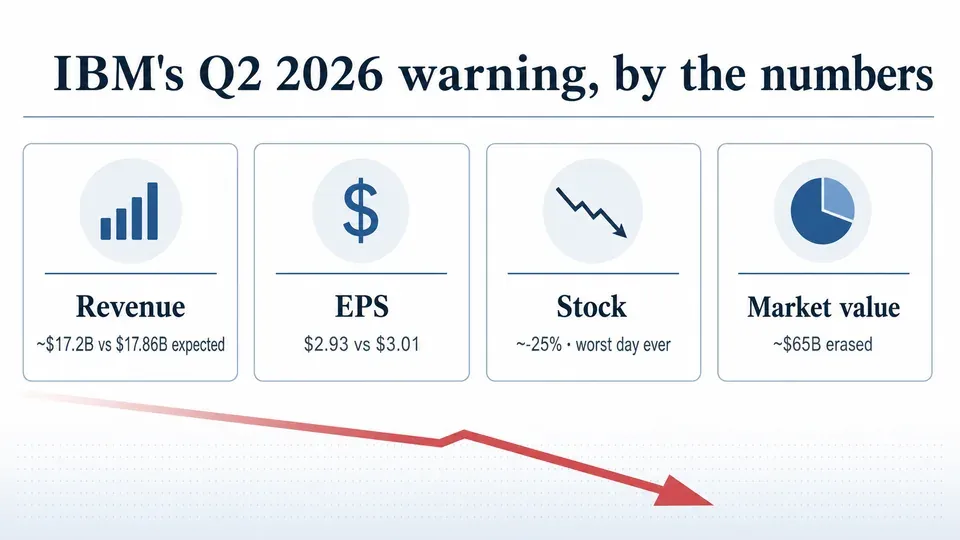
IBM pre-announced preliminary second-quarter results ahead of its official report scheduled for July 22, 2026 — a move companies usually make only when the news is bad enough that they'd rather not let it leak. The figures:
| Metric | IBM Q2 2026 (preliminary) | Consensus | Gap |
|---|---|---|---|
| Revenue | ~$17.2B (up ~1% YoY) | $17.86B (LSEG) | ~ -$660M |
| Non-GAAP EPS | $2.93 | $3.01 | -$0.08 |
| GAAP EPS | $2.27 | — | — |
| Stock reaction | ~ -25% (worst day ever) | — | prior worst: -23.7% (Oct 19, 1987) |
A revenue miss of roughly $660 million doesn't sound catastrophic on a $17 billion base — it's under 4%. But markets punish surprise and direction, not just magnitude. IBM had positioned itself as a steady AI-and-hybrid-cloud compounder; a preannounced miss shatters that narrative and forces a re-rating. The single-session loss erased around $65 billion in market capitalization.
## Why Clients Chose Hardware Over Software
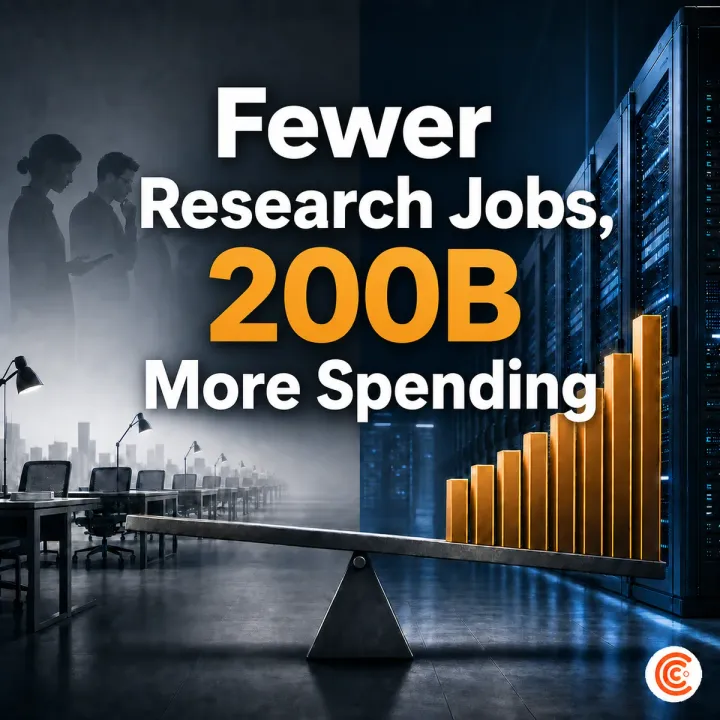
Here's the part that matters far beyond IBM. Management said large corporate customers are reprioritizing capital toward AI infrastructure — compute, storage and especially memory — much of which is supply-constrained. Buyers are rushing to secure hardware ahead of expected price increases, and to do that they're delaying higher-margin software and mainframe deals. IBM's infrastructure revenue fell about 7% as this played out, and, in its words, "numerous large deals failed to close."
CEO Arvind Krishna notably refused to blame customers alone. He admitted IBM "faltered" by failing to "anticipate the magnitude of the capex reprioritization." That's an unusually direct concession, and it frames the problem precisely: the money didn't leave the technology budget — it moved within it, from software licenses to GPUs and memory. Cybersecurity worries also distracted some clients mid-cycle, further slowing deal closure.
This is the same current we mapped when AI money rotated from chipmakers to hyperscalers — capital chasing whichever layer of the AI stack looks scarcest right now. In mid-2026 that layer is physical: chips and high-bandwidth memory. Software, which can usually be bought any time, loses the queue to hardware that might not be available next quarter.
The Contagion Across Software Stocks
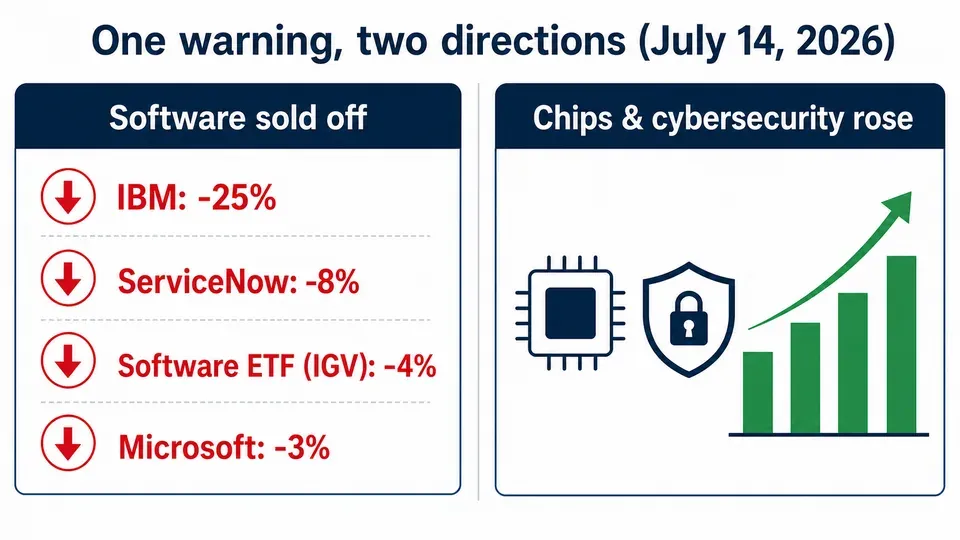
If a budget shift from software to hardware is real, it shouldn't hit only IBM. It didn't. On the same day, investors sold enterprise-software names and rotated into the hardware and security beneficiaries.
| Stock / ETF | Move on July 14 | Category |
|---|---|---|
| IBM | ~ -25% | Software + infrastructure |
| ServiceNow (NOW) | ~ -8% (to ~$102) | Enterprise SaaS |
| iShares Expanded Tech-Software ETF (IGV) | ~ -4% (to ~$89) | Software basket |
| Microsoft (MSFT) | ~ -3% (to ~$380) | Software + cloud |
| Salesforce (CRM), Intuit (INTU) | Lower in sympathy | Enterprise SaaS |
| AI chip & cybersecurity names | Higher | Hardware / security |
The split is the tell. On a day the software basket fell about 4%, AI-chip and cybersecurity stocks rose — the market treating IBM's warning as evidence that spending is flowing toward silicon and security and away from conventional software licenses. That's not a risk-off panic; it's a rotation with a clear thesis.
## IBM Problem or Software Problem
This is the question that decides whether July 14 was a one-day event or a turning point, and the honest answer is: both, in different proportions.
The IBM-specific part is real. Krishna's "we faltered" admission concedes execution failures — deals that slipped, a forecast that missed the capex shift, a product mix (mainframes, on-prem software) that is more exposed than most to clients pausing to buy GPUs. A better-positioned or better-hedged vendor would have taken a smaller hit.
But the structural part is real too, and it's the more important half. If enterprises are genuinely capping total IT budgets and letting AI hardware crowd out software, then every company selling licenses into the same budget faces a timing problem — not necessarily lost demand, but demand deferred while buyers digest a hardware bill. The bullish reading is that this is a pull-forward: once the AI build-out normalizes and memory supply loosens, the delayed software deals return, and the software sell-off looks like an overreaction. The bearish reading is that AI tools themselves start replacing seats of traditional software, turning "deferred" into "gone."
My read: treat IBM's magnitude as company-specific and its direction as sector-wide. The 25% is about IBM's mix and miss. The rotation underneath it — hardware scarcity pulling budget away from software — is the signal worth watching across every enterprise-software earnings call this season, starting with IBM's full report on July 22.
Frequently Asked Questions
How much did IBM stock fall, and was it a record? About 25% on July 14, 2026 — the worst single-day drop in IBM's history, exceeding its 23.7% fall on Black Monday, October 19, 1987.
Why did IBM miss if tech spending is strong? Because spending shifted within IT budgets. Clients prioritized supply-constrained AI hardware (compute, storage, memory) to lock in supply ahead of price hikes, delaying software and infrastructure deals. Revenue came in near $17.2B versus $17.86B expected.
Did IBM blame its customers? No. CEO Arvind Krishna said IBM "faltered" by failing to anticipate the scale of the "capex reprioritization," and acknowledged that numerous large deals didn't close.
Why did Microsoft and ServiceNow fall too? Investors extrapolated IBM's warning to the whole software sector. ServiceNow fell about 8%, the IGV software ETF about 4%, and Microsoft about 3%, while AI-chip and cybersecurity stocks rose.
When are IBM's full results out? IBM's official second-quarter earnings report is scheduled for July 22, 2026. The July 14 figures were a preliminary preannouncement.
Key Takeaways
- IBM fell about 25% on July 14, 2026 — its worst day on record, past the 23.7% Black Monday drop of 1987.
- The cause was a preliminary Q2 miss: ~$17.2B revenue vs $17.86B expected (~$660M short), erasing roughly $65B in market value.
- Clients are reprioritizing budgets toward supply-constrained AI hardware, delaying software and infrastructure deals; infrastructure revenue fell ~7%.
- The warning spread: ServiceNow -8%, software ETF -4%, Microsoft -3%, while AI chip and cybersecurity stocks rose — a rotation, not a panic.
- The 25% is IBM-specific (mix and execution); the budget shift is sector-wide — the real thing to watch this earnings season.
How this was written This piece was drafted with AI's research help; a human verified every fact and polished the final wording.
References
- CNBC, "IBM stock craters 25%, the worst day on record, after company issues second-quarter earnings warning": https://www.cnbc.com/2026/07/14/ibm-warns-second-quarter-earnings-fell-short-of-expectations.html
- The Motley Fool, "Stock Market Today, July 14: IBM Plunges on Second-Quarter Warning as AI Shifts Enterprise Spending": https://www.fool.com/coverage/stock-market-today/2026/07/14/stock-market-today-july-14-ibm-plunges-on-second-quarter-warning-as-enterprise-spending-shifts/
- Yahoo Finance, "IBM stock closes down more than 25% after preannounced earnings results": https://finance.yahoo.com/news/ibm-stock-plummets-more-than-25-on-q2-earnings-warning-150605880.html
- Yahoo Finance, "IBM Warning Hits Software Stocks": https://finance.yahoo.com/markets/stocks/articles/ibm-warning-hits-software-stocks-192217475.html
- The Motley Fool, "Cybersecurity and AI Chip Stocks Are Soaring, While Software Stocks Are Crashing. Blame IBM.": https://www.fool.com/investing/2026/07/14/cybersecurity-and-ai-chip-stocks-are-soaring-while/
- Forbes, "What IBM's Revenue Miss Tells CIOs About AI Spending": https://www.forbes.com/sites/davidchou/2026/07/14/what-ibms-revenue-miss-tells-cios-about-ai-spending/


Comments ()