
Microsoft Is Quietly Swapping OpenAI and Anthropic Out of Excel and Outlook — Why 'Eliminate That Cost' Is the Real Headline
Bloomberg reported on July 7, 2026 that Microsoft has begun routing AI prompts inside Excel and Outlook to its own in-house MAI models instead of OpenAI's and Anthropic's — tens of thousands of requests a week, and climbing. The number that actually matters isn't the request count. It's the quote from Microsoft's AI chief Mustafa Suleyman: the goal is to "reduce and ultimately eliminate" what Microsoft pays Anthropic. This is the moment the biggest customer of frontier AI labs openly became their competitor — and it changes the economics of the whole model business. Here's what's happening and why it matters more than the app it started in.
For two years the assumption was simple: the AI labs build the models, everyone else rents them. Microsoft was the ultimate renter — pouring money into OpenAI and, increasingly, Anthropic to power Copilot across its product empire. Now Microsoft is starting to build the thing it used to buy, and it's saying the quiet part out loud. This piece breaks down exactly what Microsoft swapped, the strategy behind "multi-model," and what "eliminate that cost" signals for the companies whose entire business is selling the models Microsoft no longer wants to fully pay for.
What Microsoft actually changed
The change is concrete and, deliberately, low-drama. Inside Excel and Outlook, some AI features that previously leaned on external models from OpenAI and Anthropic now run on Microsoft's own MAI family. Per Bloomberg, tens of thousands of prompts a week in those two apps are already being completed by MAI models. It's still a small fraction of Microsoft's total AI usage — but it's a fraction that's growing, and the direction is one-way.
This didn't come from nowhere. At its Build developer conference in June 2026, Microsoft unveiled seven new MAI models, including MAI-Thinking 1, its first reasoning model. Microsoft claimed — based on human evaluations — that its models could match Anthropic's Sonnet 4.6 and Opus 4.6 on coding tasks, at lower cost. The MAI models are also available in GitHub Copilot, and Microsoft has said a proprietary transcription model is coming to Teams.
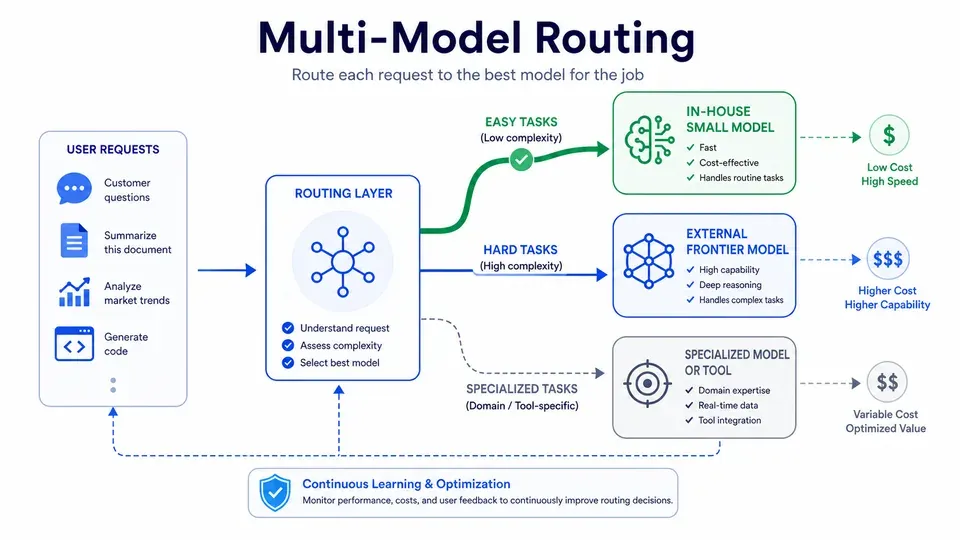
Crucially, Microsoft isn't ending its partnerships with OpenAI or Anthropic. It's changing how it uses them. Copilot and Azure AI are being turned into multi-model platforms that route each request to whichever model fits — and increasingly, for routine tasks, the cheapest model that clears the bar is Microsoft's own.
The real headline is a sentence, not a feature
Product swaps happen all the time. What makes this one matter is how bluntly Microsoft stated the motive. In June, Suleyman said:
"We pay a lot of money to Anthropic — so our goal is to reduce and ultimately eliminate that cost."
Read that as a business, not a soundbite. Microsoft is telling its own suppliers, on the record, that it intends to stop paying them. That's a strategic posture you almost never hear articulated so plainly, and it reframes the entire relationship between platform giants and the AI labs that supply them.
The logic is the oldest one in tech: build vs. buy. When a bought input is small, you rent. When it becomes one of your largest and fastest-growing cost lines, you bring it in-house. Frontier-model API access became exactly that kind of cost. And unlike most inputs, Microsoft has the capital, the talent (Suleyman co-founded DeepMind and Inflection), the distribution, and the data to build a "good enough" substitute for the 80% of tasks that don't need the absolute best model.
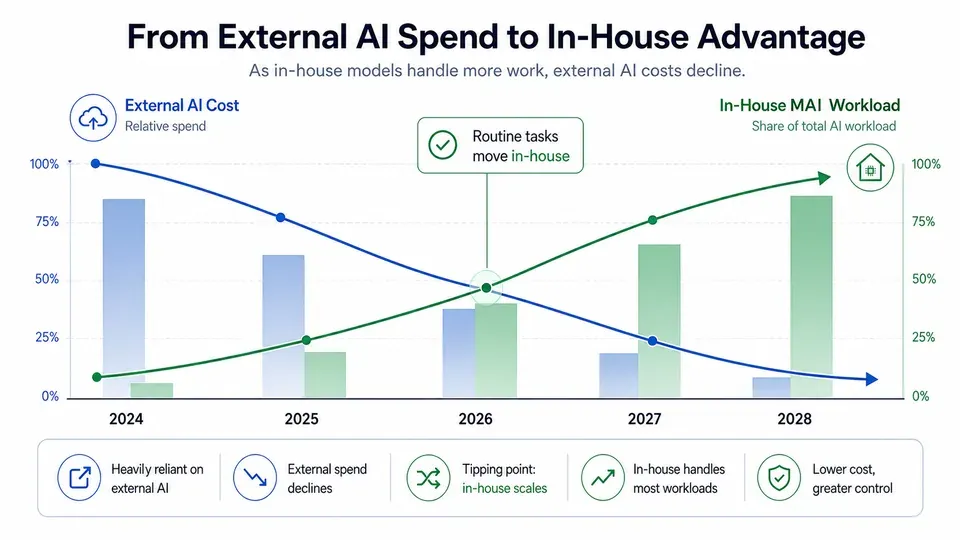
## Build vs. buy: the economics driving the swap
Why go through the pain of building your own models when OpenAI and Anthropic already have great ones? Because for a platform at Microsoft's scale, the math flips. Here's the trade-off in plain terms.
| Factor | Renting frontier models (OpenAI/Anthropic) | Building in-house (MAI) |
|---|---|---|
| Per-call cost | High, and set by the lab | Low, and controlled by Microsoft |
| Pricing power | Held by the supplier | Held by Microsoft |
| Capability ceiling | Best-in-class today | "Good enough" for routine tasks, catching up |
| Upfront investment | Minimal | Enormous (talent, compute, training) |
| Strategic dependence | High — you rely on a competitor's roadmap | Low — you own the stack |
The key insight is task segmentation. Not every prompt needs a frontier model. Summarizing an email, cleaning a spreadsheet, drafting a routine reply — these are high-volume, low-difficulty tasks where a cheaper model that's nearly as good wins on cost every time. Microsoft can reserve the expensive external models for the hard 20% and route the easy, high-frequency 80% to MAI. Across billions of Copilot interactions, that mix is worth enormous money.
This is the same cost pressure we've tracked from the buyer's side before: frontier-model pricing has been climbing, not falling, for the hardest tiers — see AI API Pricing Explained: Why 'GPT-5' Got 4x More Expensive in Under a Year. When your key input keeps getting pricier, "build our own" stops being a moonshot and starts being a budget line.
What it means for OpenAI, Anthropic — and everyone building on them
If a company as deep-pocketed as Microsoft is engineering its way off your models for routine work, that's a signal worth reading carefully.
- Concentration risk is real. A large share of frontier-lab revenue flows through a handful of hyperscaler partners and platforms. When those partners in-house the easy tasks, the labs keep the hard, prestigious workloads — but lose the high-volume, high-margin base underneath them.
- The moat has to be capability, not lock-in. Microsoft's whole argument is "MAI is good enough for this." The labs' defense is to keep the frontier far enough ahead that "good enough" never quite is. That's a treadmill they have to keep running.
- It validates the model layer as a commodity-in-waiting. The more players prove they can build a serviceable model, the more the durable value migrates to distribution, data, and the application layer — exactly where Microsoft is strongest.
- For smaller builders, there's a lesson too. If Microsoft is diversifying across many models to control cost, a startup betting its entire product on one provider's pricing is exposed. Multi-model architecture isn't just a Microsoft luxury; it's a hedge anyone can adopt.
None of this means OpenAI or Anthropic are in trouble. Frontier capability still commands a premium, and Microsoft still pays for it where it counts. But the relationship has shifted from "essential supplier" toward "one supplier among several, used only where nothing cheaper will do." That's a materially weaker position than being the indispensable brain behind Copilot — and Microsoft just said, out loud, that it wants to keep weakening it.
## Frequently Asked Questions (FAQ)
Is Microsoft dropping OpenAI and Anthropic? No. It's reducing how much it uses them for routine tasks by routing those to its own MAI models, while keeping the partnerships for harder workloads. Suleyman's stated goal is to "reduce and ultimately eliminate" the cost, not the relationship overnight.
What are MAI models? Microsoft's in-house AI family. At Build in June 2026, Microsoft announced seven new MAI models, including MAI-Thinking 1, its first reasoning model, which it claims matches Anthropic's Sonnet 4.6 and Opus 4.6 on coding in human evaluations.
Where are MAI models being used? Reported so far: Excel and Outlook (tens of thousands of prompts a week), GitHub Copilot, with a proprietary transcription model expected in Teams. Expect the footprint to expand.
Why build its own models instead of just buying the best? Cost and control. For high-volume, routine tasks, a cheaper in-house model that's "good enough" beats paying a supplier's premium — and it removes dependence on a competitor's pricing and roadmap.
Does this hurt OpenAI and Anthropic? It pressures the high-volume base of their business, not the frontier premium. The risk is losing routine workloads to "good enough" in-house models while keeping only the hardest tasks.
Key Takeaways
- Microsoft has started replacing OpenAI/Anthropic models with its own MAI models inside Excel and Outlook — tens of thousands of prompts a week and growing.
- The strategic tell is Suleyman's line: reduce and "ultimately eliminate" what Microsoft pays Anthropic.
- The driver is classic build vs. buy economics: route the easy, high-volume 80% of tasks to cheap in-house models, reserve pricey frontier models for the hard 20%.
- Microsoft claims its MAI models match Sonnet 4.6 / Opus 4.6 on coding (human eval) at lower cost — the "good enough" bar that makes the swap work.
- For AI labs, it's a warning: when your biggest customer becomes your competitor, capability has to stay ahead of "good enough," or the model layer commoditizes.
How this was written AI assisted with gathering sources and structuring a first draft — fact-checking and final edits were done by a person.
References
- Bloomberg: "Microsoft Replaces OpenAI, Anthropic With Own AI in Some Apps" — https://www.bloomberg.com/news/articles/2026-07-07/microsoft-replaces-openai-anthropic-with-own-ai-in-some-apps
- CNBC: "Microsoft unveils new AI models to lessen reliance on OpenAI and lower costs for developers" — https://www.cnbc.com/2026/06/02/microsoft-unveils-new-ai-models-lessen-reliance-on-openai-lower-costs.html
- The Decoder: "Copilot goes cheap as Microsoft phases out OpenAI and Anthropic models to cut costs" — https://the-decoder.com/copilot-goes-cheap-as-microsoft-phases-out-openai-and-anthropic-models-to-cut-costs/
- The Tech Portal: "Microsoft begins replacing OpenAI, Anthropic models with in-house MAI AI across key products" — https://thetechportal.com/2026/07/07/microsoft-begins-replacing-openai-anthropic-models-with-in-house-mai-ai-across-key-products-report/
- Euronews: "Microsoft launches its own AI models to take on OpenAI and Anthropic" — https://www.euronews.com/next/2026/06/03/microsoft-launches-its-own-ai-models-to-take-on-openai-and-anthropic


Comments ()