AI API Pricing Explained: Why 'GPT-5' Got 4x More Expensive in Under a Year

TL;DR — Per-million-token API prices across Claude, GPT, and Gemini now range from about $1 to $30 depending on which specific model you pick — and confusingly, the same base name can span that whole range. The original GPT-5 still runs at $1.25 input / $10 output per million tokens, while GPT-5.5 costs $5 input / $30 output — a 4x jump in input price under the same "GPT-5" family name. Here's what's actually driving the spread, and how to read a pricing page without getting fooled by version numbers.
What "Price Per Million Tokens" Actually Means
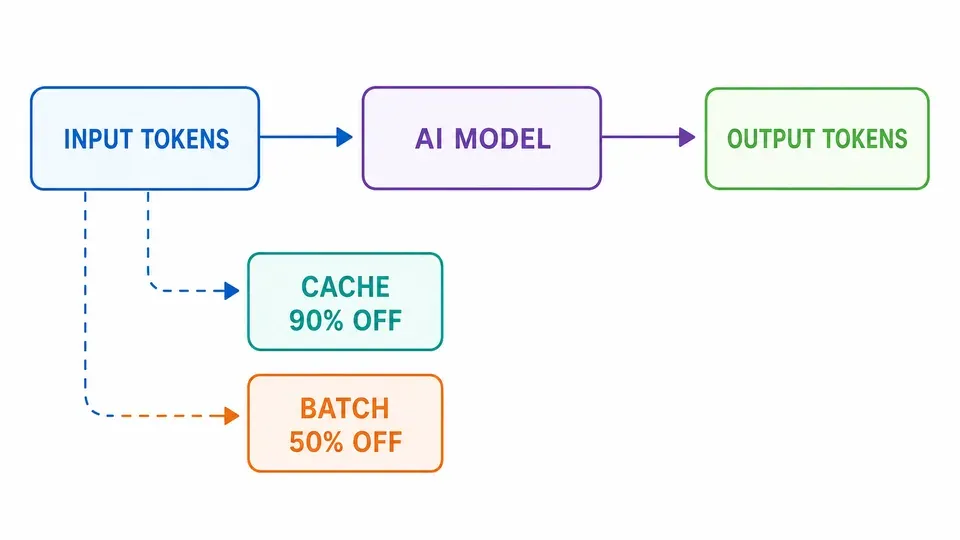
Every major AI API charges per token — roughly ¾ of a word — split into two separate rates: input tokens (what you send the model) and output tokens (what it generates back). Output almost always costs more than input, usually by a factor of 5, because generating text token-by-token is more compute-intensive than reading a prompt in one pass.¹²
Two mechanisms shift the effective price further: - Prompt caching can cut cached input cost by as much as 90% on repeat context, which matters a lot for agents that reuse the same system prompt thousands of times.¹ - Batch APIs typically offer a 50% discount on both input and output for requests that don't need an instant response.¹
## The 2026 Price Landscape: Claude vs GPT vs Gemini
Here's where things actually stand, model by model, in dollars per million tokens (input / output):
| Model | Input | Output | Notes |
|---|---|---|---|
| Claude Haiku 4.5 | $1.00 | $5.00 | Anthropic's cheapest tier³ |
| GPT-5 (original) | $1.25 | $10.00 | Still available as a legacy option⁴ |
| Gemini 2.5 Pro | $1.25 | $10.00 | Prior-gen flagship, still offered⁴ |
| Gemini 3.1 Pro | $2.00 | $12.00 | Current Google flagship⁴ |
| Claude Sonnet 5 (promo, through Aug 31) | $2.00 | $10.00 | Anthropic's new mid-tier agent model⁵ |
| Claude Sonnet 5 (from Sep 1) / Sonnet 4.6 | $3.00 | $15.00 | Standard rate after promo ends⁵³ |
| GPT-5.4 | $2.50 | ~$15.00 | Mid-2026 successor⁴ |
| Claude Opus 4.8 | $5.00 | $25.00 | Anthropic's flagship³ |
| GPT-5.5 | $5.00 | $30.00 | OpenAI's current flagship⁴ |
| Claude Opus 4.8 (Fast Mode) | $10.00 | $50.00 | 2.5x speed, 3x cheaper than Opus 4.7's Fast Mode³ |
| Claude Fable 5 | $10.00 | $50.00 | Anthropic's most capable "Mythos-class" model³ |
| GPT-5 Pro | $15.00 | $120.00 | Extended-reasoning variant⁴ |
| GPT-5.5 Pro | $30.00 | $180.00 | OpenAI's top-of-line tier⁴ |
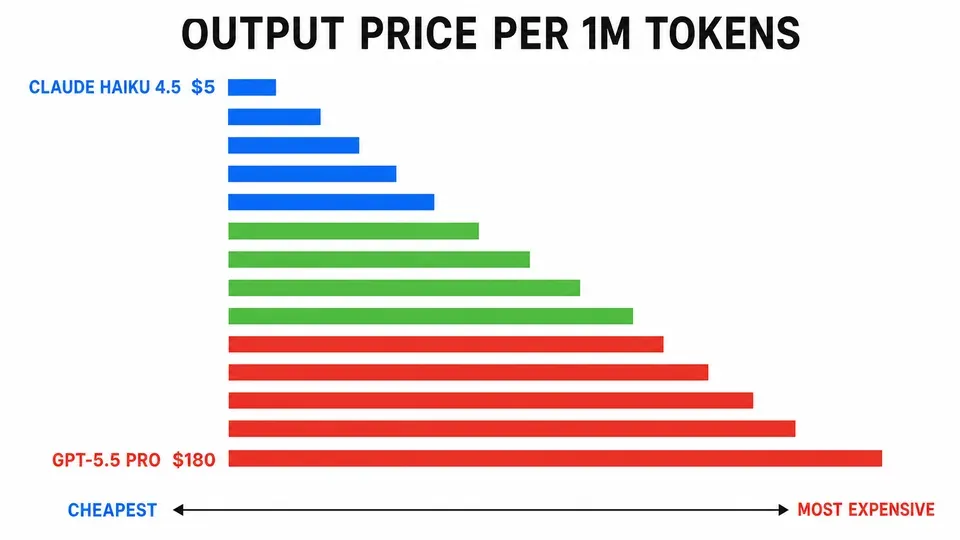
Notice Anthropic and OpenAI's cheapest and priciest tiers roughly bracket each other — this isn't a coincidence. Both companies price a bottom tier for high-volume, simple tasks and a top tier for the hardest reasoning work, then fill in the middle as compute costs shift.
Why "GPT-5" Can Mean 4 Different Prices
This is the part that actually catches people out. OpenAI kept "GPT-5" as a lineage name across multiple pricing generations instead of renaming with each update:⁴
- GPT-5 (original, 2025): $1.25 / $10 — still live as a legacy, cheaper option.
- GPT-5.4: $2.50 input, roughly $15 output — a mid-2026 refresh.
- GPT-5.5: $5 / $30 — the current flagship, priced identically to Claude Opus 4.8 on input.
- GPT-5 Pro / GPT-5.5 Pro: $15–$30 input, $120–$180 output — extended-reasoning variants aimed at the hardest tasks.
That's a 4x jump on input pricing (from $1.25 to $5) and a 3x jump on output pricing (from $10 to $30) between the original GPT-5 and GPT-5.5 — all sold under a name that, to a casual reader, just says "GPT-5." Google and Anthropic have the same pattern in miniature: Gemini 2.5 Pro ($1.25/$10) is still sold alongside the newer, pricier Gemini 3.1 Pro ($2/$12), and Claude Sonnet 4.6 quietly became the permanent standard rate ($3/$15) that Sonnet 5 reverts to once its promotional window ends.⁵
The practical takeaway: the marketing name tells you the family, not the price. Before committing an app to a model, always check the exact dated or versioned model string on the provider's live pricing page — not the name a headline used.
Real-World Cost Example
A support-triage agent processing 10,000 tickets a month, averaging 2,000 input tokens and 500 output tokens per ticket, uses about 20M input tokens and 5M output tokens monthly. Run through a few tiers:
| Model | Input cost | Output cost | Total/month |
|---|---|---|---|
| Claude Haiku 4.5 | $20 | $25 | $45 |
| Claude Sonnet 5 (promo) | $40 | $50 | $90 |
| Claude Opus 4.8 | $100 | $125 | $225 |
| GPT-5.5 | $100 | $150 | $250 |
At this volume, the gap between the cheapest and most expensive "reasonable" tier is roughly 5x — enough to change whether a side project is profitable, which is exactly why Amazon has reportedly been shopping for cheaper Claude alternatives for its own AI-powered products rather than defaulting to the flagship tier.
Frequently Asked Questions
Why does output cost more than input for AI APIs? Generating text requires the model to compute one token at a time in sequence, which is far more compute-intensive than processing an entire input prompt in a single forward pass. That's why output tokens are typically priced 4–6x higher than input tokens across Claude, GPT, and Gemini.
Is the cheapest AI model always the worst choice? Not necessarily. Cheaper tiers (Claude Haiku 4.5, legacy GPT-5, Gemini 2.5 Pro) are often good enough for simple, high-volume tasks like classification or short Q&A. The expensive flagship and Pro tiers earn their price on complex reasoning, long-context work, or agentic tasks that need to plan multiple steps.
Why is GPT-5.5 priced the same as Claude Opus 4.8 on input tokens? Both sit at $5 per million input tokens, which likely reflects similar underlying compute costs for flagship-class models in 2026, plus competitive pricing pressure — neither company wants to be meaningfully more expensive than the other at the same capability tier.
Do prompt caching and batch discounts actually matter? Yes, significantly for high-volume use. Cached input tokens can cost 90% less, and batch processing (for non-real-time requests) typically cuts both input and output costs by half — for an agent that reuses the same system prompt thousands of times a day, caching alone can cut the effective bill dramatically.
How do I avoid overpaying due to model name confusion? Always check the specific dated or numbered model string (e.g., "gpt-5.5" vs "gpt-5", "claude-opus-4-8" vs "claude-sonnet-5") on the provider's official pricing page before building against it — don't assume a headline's "GPT-5" or "Claude" reference means the same price you saw in an older article.
Key Takeaways
- AI API pricing spans roughly $1–$30 per million tokens depending on model and tier, with output tokens typically priced 4–6x higher than input.
- The same brand name (e.g., "GPT-5") can span a 4x price range across its generations — the original GPT-5 ($1.25/$10) and GPT-5.5 ($5/$30) are both live simultaneously.
- Claude Sonnet 5 launched at a promotional $2/$10 rate through August 31, 2026, before reverting to the same $3/$15 standard rate as Sonnet 4.6.
- Prompt caching (up to 90% off cached input) and batch processing (50% off both directions) are the two biggest levers for cutting real-world costs.
- Always verify the exact versioned model string on the provider's live pricing page — marketing names lag behind the actual pricing generation.
Sources 1. Finout: Anthropic API Pricing in 2026: Complete Guide 2. CloudZero: Claude Opus 4.8: Pricing, benchmarks, and which model to actually run in 2026 3. Finout: Claude Opus 4.8 Pricing 2026: Everything You Need to Know 4. IntuitionLabs: AI API Pricing Comparison (2026): Grok vs Gemini vs GPT-4o vs Claude 5. Carus Signal: Claude Sonnet 5 Makes AI Agents Cheap Enough to Actually Ship
Tags: #AI #APIPricing #Claude #GPT5 #Gemini #Explainer


Comments ()