
DeepSeek Is Building Its Own AI Chip — Why a $52B Startup Chose Inference, Not Nvidia's Fight
On July 7, 2026, Reuters reported that Chinese AI startup DeepSeek is quietly designing its own AI chip. The detail that matters is what kind: an inference chip, not a training chip. That single choice tells you almost everything about the strategy — a $52–59 billion company picking the one fight it can actually win under US export controls, instead of the one everyone assumed it would pick. Here's what DeepSeek is really building, the three walls it's routing around, and whether any of it dents Nvidia.
Every time a Chinese lab touches silicon, the headline writes itself: "China moves to break Nvidia." The reality is narrower and more interesting. DeepSeek isn't trying to build a chip that trains frontier models — it can't, and it knows it. It's building a chip to run models it has already trained. That distinction is the whole story, and most coverage skips it. This piece pulls the Reuters reporting together with the actual hardware constraints so you can see why "inference-only" is the smart move, not a consolation prize.
What DeepSeek is actually building — inference, not training
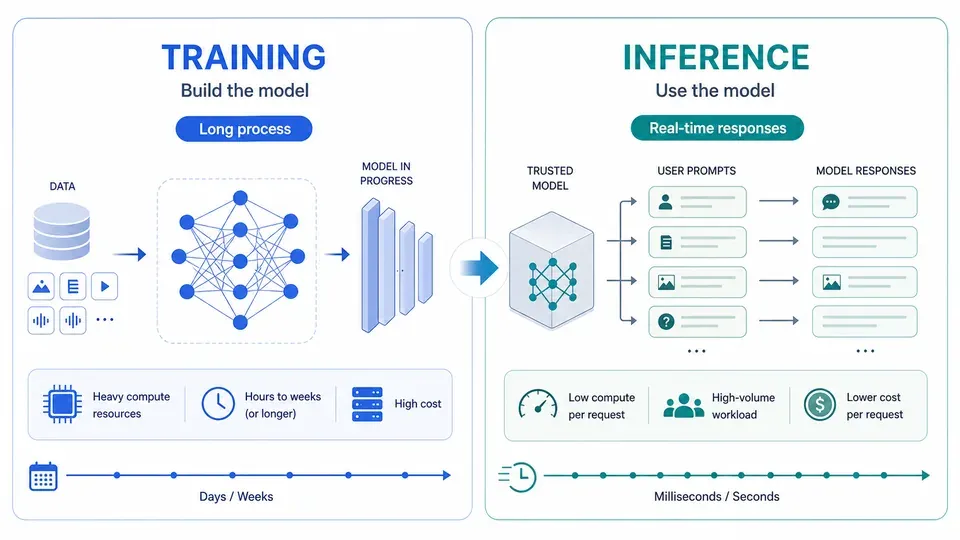
AI silicon splits into two jobs. Training is teaching the model — running enormous datasets through the network for weeks or months, the workload that made Nvidia's most advanced GPUs the most fought-over hardware on earth. Inference is using the finished model — the far cheaper, far more frequent step where a trained model answers a prompt. Every chat message, every code completion, every API call is inference.
According to Reuters (citing three people familiar with the matter), DeepSeek's chip targets inference. The company began exploring the effort about a year ago, has been recruiting chip engineers through private channels rather than public postings, and is now in discussions with chip-design firms, foundries, and memory suppliers. It's early-stage — no tape-out, no shipping product — but the intent is specific.
Why inference and not training? Because inference is where the volume — and the recurring cost — lives. As models get adopted, a lab spends far more compute serving users than it ever did training. It's also the more forgiving engineering target: inference chips don't need the absolute bleeding-edge manufacturing that training accelerators demand. If you're a company boxed in by sanctions, inference is the door that's actually open.
## The three walls: why building a training chip was never the option
To understand DeepSeek's choice, look at what US export controls actually block. There are three separate walls, and a cutting-edge training chip runs into all of them at once.
| Constraint | What it blocks | Why it hurts a training chip | Impact on inference chip |
|---|---|---|---|
| Advanced foundry access | No TSMC/Samsung leading-edge nodes for sanctioned Chinese firms | Frontier training silicon needs the newest process nodes | Serious, but inference tolerates older nodes far better |
| HBM supply | High-Bandwidth Memory export-restricted | Training accelerators are HBM-hungry; scarce HBM is a hard cap | Real constraint, but inference can lean on cheaper memory tiers |
| EUV lithography | No extreme-ultraviolet machines for sub-3nm | Can't domestically manufacture the densest logic | Less binding — inference doesn't require the densest node |
Stack those together and a homegrown training chip competitive with Nvidia's best is, for now, close to impossible: you'd need a leading node you can't access, HBM you can't buy, and lithography you can't import. An inference chip threads the gap. It can be built on more mature, more available process technology, and it can be designed around the memory you can actually get. DeepSeek didn't pick inference because it's glamorous. It picked it because it's the only lane where the walls are low enough to climb.
This is also why the "China breaks Nvidia" framing is premature. Even a successful DeepSeek inference chip leaves Nvidia's training franchise — the crown jewel — untouched. For the full picture of how hard Nvidia's position actually is to dislodge, see our earlier breakdown: Can Custom AI Chips Dethrone Nvidia? The 80% Empire vs the 44% ASIC Surge.
The constraint play: leaning on Huawei while building an exit from it
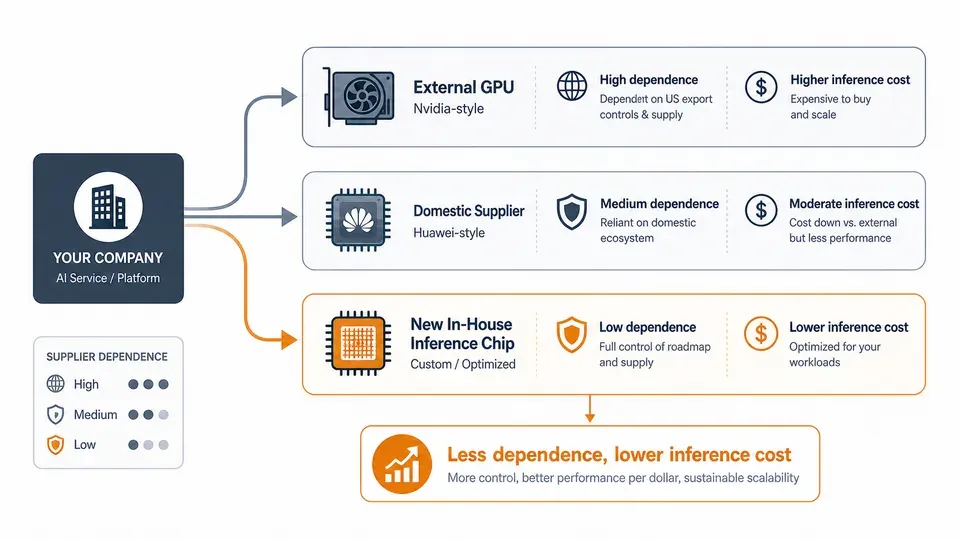
Here's the part that gets lost. DeepSeek isn't only trying to reduce reliance on Nvidia — Reuters frames the chip as a push to cut dependence on Huawei, too. That reframes the whole move.
DeepSeek has been deepening its Huawei ties, not loosening them. In April 2026 it released its V4 model adapted for Huawei's Ascend chips, and Huawei said its processors were used in part of the training of V4-Flash, a lighter version. Orders for Huawei's Ascend 950 from Chinese tech conglomerates surged afterward. So Huawei is currently both a supplier and a validation stamp for DeepSeek.
Designing its own inference silicon lets DeepSeek stop being a passenger. Relying on Huawei means competing for the same constrained Ascend supply as every other Chinese firm, on Huawei's roadmap and Huawei's terms. An in-house inference chip — tuned specifically for DeepSeek's own model architectures — is a hedge against that dependency, not just against Nvidia.
The timing lines up with money. Reuters reported in June 2026 that DeepSeek was set to raise $7 billion in its first-ever funding round, at a valuation of $52–59 billion — reversing years of refusing outside capital. Chip design is expensive and slow; embracing external investment right as it staffs up a silicon team is not a coincidence. The capital and the chip ambition arrived together.
Zoom out and there's a national backdrop. Huawei has been pushing its own workaround to sanctions, unveiling a "Tau (τ) Scaling Law" it claims could reach transistor density equivalent to a 1.4-nanometer process by 2031 — an attempt to bypass the EUV bottleneck through architecture rather than raw lithography. DeepSeek's chip is one more data point in the same story: Chinese firms adapting around constraints instead of waiting for them to lift.
## So does it actually threaten Nvidia?
Short answer: not the part of Nvidia that matters most, and not soon. Three honest calibrations:
- On training: essentially no near-term threat. The three walls above keep frontier training silicon out of reach, and Nvidia's training franchise is where its pricing power lives.
- On inference: a real long-term nibble. Inference is the fastest-growing slice of AI compute, and it's the slice most exposed to cheaper, custom, "good-enough" alternatives. If DeepSeek ships a chip tuned to its own models, that's demand that doesn't go to Nvidia — inside China, at least.
- On timing: early-stage means years, not quarters. No tape-out has been reported. Custom silicon routinely slips, and doing it under sanctions — without top foundry access or abundant HBM — makes slippage more likely, not less.
The useful way to read this: DeepSeek is doing exactly what a constrained, rational company should. It's not swinging at Nvidia's strongest point. It's carving out the one workload where domestic silicon is viable, reducing its exposure to both foreign GPUs and its own domestic supplier, and funding it with fresh capital. That's not a "DeepSeek moment" for hardware. It's a patient, defensive bet — and those are often the ones that compound.
Frequently Asked Questions (FAQ)
Is DeepSeek building a chip to replace Nvidia? Not the training GPUs Nvidia is famous for. Reuters reports the chip targets inference — running trained models — and is meant to cut reliance on both Nvidia and Huawei. Nvidia's training franchise isn't the target.
What's the difference between a training chip and an inference chip? Training builds the model (compute-heavy, needs the most advanced hardware). Inference runs the finished model to answer prompts (higher volume, more cost-sensitive, more tolerant of older manufacturing). DeepSeek chose the second.
Why doesn't DeepSeek just build a training chip too? US export controls block three things at once: leading-edge foundry access (TSMC/Samsung), High-Bandwidth Memory, and EUV lithography. A frontier training chip needs all three. Inference chips route around those limits.
How far along is the project? Early stage. DeepSeek began about a year ago and is talking to chip-design firms, foundries, and memory suppliers. No tape-out or shipping product has been reported, so realistic timelines are years out.
Is DeepSeek still using Huawei chips? Yes — for now. Its V4 model was adapted for Huawei's Ascend line, and Huawei helped train the lighter V4-Flash. The in-house chip is partly a hedge to reduce that dependence over time.
Key Takeaways
- DeepSeek is designing an inference chip, not a training chip — the single most important detail, and the one most headlines miss.
- The choice is dictated by three US export walls: foundry access, HBM, and EUV lithography — all of which block a competitive training chip but not an inference one.
- The move cuts reliance on both Nvidia and Huawei, not just Nvidia — DeepSeek currently leans on Huawei's Ascend chips and wants a hedge.
- It coincides with DeepSeek's first outside capital: a reported $7B raise at a $52–59B valuation.
- Near-term threat to Nvidia's core training business: minimal. Long-term pressure on inference demand inside China: real, but years away.
How this was written This piece was drafted with AI's research help; a human verified every fact and polished the final wording.
References
- Reuters (via Investing.com): "Exclusive-China's DeepSeek developing its own AI chip, sources say" — https://www.investing.com/news/economy-news/exclusivechinas-deepseek-developing-its-own-ai-chip-sources-say-4778697
- Taipei Times: "China's DeepSeek developing its own AI chip, sources say" — https://www.taipeitimes.com/News/biz/archives/2026/07/08/2003860388
- Bloomberg: "Chinese AI Startup DeepSeek Developing Own AI Chip, Reuters Says" — https://www.bloomberg.com/news/articles/2026-07-07/chinese-ai-startup-deepseek-developing-own-ai-chip-reuters-says
- Tech Startups: "DeepSeek is building its own AI chip to cut reliance on Nvidia and Huawei" — https://techstartups.com/2026/07/07/deepseek-is-building-its-own-ai-chip-to-cut-reliance-on-nvidia-and-huawei/
- CSIS: "DeepSeek, Huawei, Export Controls, and the Future of the U.S.-China AI Race" — https://www.csis.org/analysis/deepseek-huawei-export-controls-and-future-us-china-ai-race
- South China Morning Post: "Another 'DeepSeek moment'? Huawei milestone alters China trajectory in chip race" — https://www.scmp.com/tech/big-tech/article/3354938/another-deepseek-moment-huawei-milestone-alters-china-trajectory-chip-race-analysts


Comments ()