
AMD Helios vs Nvidia Vera Rubin: What Microsoft's Azure Deal Actually Changes (40 vs 50 PFLOPs)
AMD Helios vs Nvidia Vera Rubin: What Microsoft's Azure Deal Actually Changes (40 vs 50 PFLOPs)
On July 21, 2026, AMD said Microsoft will deploy its new Helios rack — 72 Instinct MI455X GPUs plus EPYC "Venice" CPUs — "at scale" on Azure, and AMD shares rose about 5%. The headline is "AMD challenges Nvidia," but the specs tell a more precise story: on raw compute the MI455X and Nvidia's Rubin GPU basically trade blows (40 vs 50 PFLOPs FP4), and on some rack-level metrics AMD actually leads. This post puts the real numbers side by side and explains why the deal matters more for AMD's position than for Nvidia's near-term lead.
"AMD is finally a real Nvidia competitor" gets written every product cycle, and it's usually half true and half hype. What's genuinely new here isn't a single faster chip — it's that a hyperscaler committed to deploying AMD's entire rack as a standard Azure offering, not just buying loose GPUs. That shifts AMD from "the cheaper alternative accelerator" toward "an integrated rack-scale provider," which is the category Nvidia has owned. Below are the specs that back that up, where AMD leads and trails, and the one moat the FLOPs charts don't show.
Table of Contents
- What Microsoft Actually Committed To
- Helios vs Vera Rubin, by the Numbers
- Why the Deal Matters More Than the Spec Sheet
What Microsoft Actually Committed To
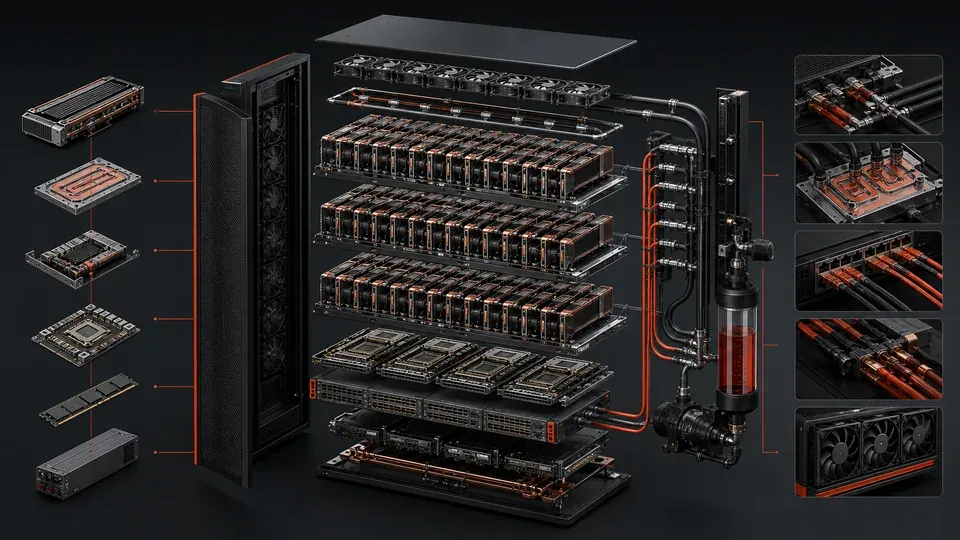
The core of the announcement is that Microsoft will run a new family of Azure virtual machines — the ND MI455X v7 series, aimed at large-scale AI inference — built on AMD's Helios rack-scale platform, with deployment planned for the second half of 2026. Helios is AMD's first true rack-scale system: 72 Instinct MI455X GPUs, 6th-generation EPYC "Venice" CPUs, Pensando networking, and the ROCm software stack, all in an Open Compute Project–compliant chassis with liquid cooling. Azure is also adding Venice-based general VM lines (the HDv2 and HXv2 series) for agentic AI, data processing, and chip-design workloads.
The word doing the heavy lifting is "rack." Anyone can sell a fast GPU; the hard part is delivering 72 of them wired together with CPUs, networking, cooling, and software as one deployable unit — which is exactly what Nvidia's rack-scale systems (Grace Blackwell, and the upcoming Vera Rubin NVL72) package. Microsoft picking Helios as a standard Azure SKU is a validation that AMD can compete at the system level, not just the silicon level. AMD stock's ~5% pop (to around $512) reflects that repositioning more than any single benchmark.
## Helios vs Vera Rubin, by the Numbers
Here is where the "AMD challenges Nvidia" story earns — and loses — some of its weight. On raw per-GPU compute, the MI455X and Nvidia's next-gen Rubin GPU are close enough that neither wins cleanly, and on a couple of rack-level bandwidth figures AMD claims an edge:
| Metric | AMD MI455X / Helios | Nvidia Rubin / Vera Rubin NVL72 |
|---|---|---|
| FP4 compute (per GPU) | 40 PFLOPs | 50 PFLOPs |
| FP8 compute (per GPU) | 20 PFLOPs | 17.5 PFLOPs |
| GPUs per rack | 72 | 72 |
| Scale-up bandwidth (in-rack) | ~260 TB/s | ~260 TB/s (on par) |
| Scale-out bandwidth | ~43 TB/s (UALink over Ethernet) | ~half of Helios (per AMD) |
| Software stack | ROCm (open) | CUDA (proprietary, incumbent) |
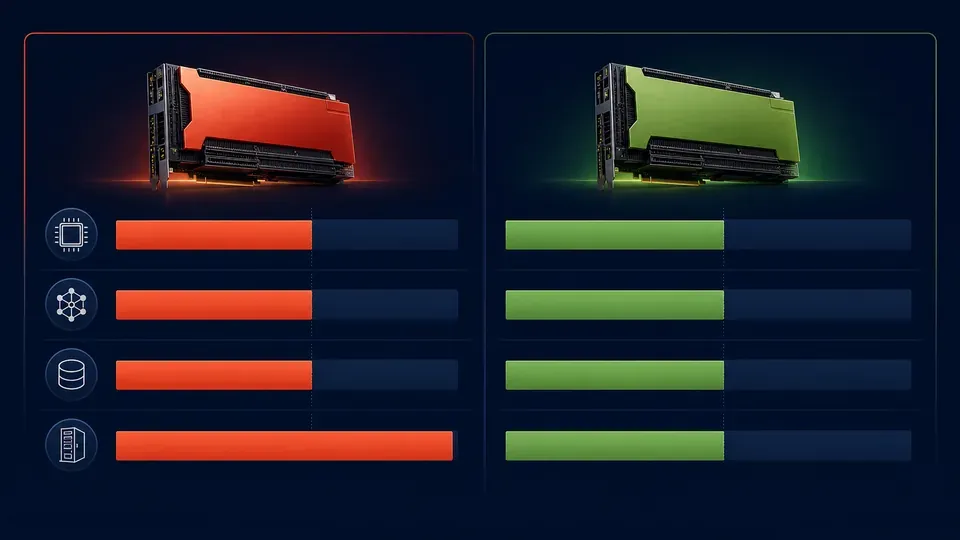
Read carefully, this is not a blowout in either direction. Nvidia's Rubin leads on FP4 (50 vs 40 PFLOPs), the format that matters most for cutting-edge low-precision inference. But the MI455X leads on FP8 (20 vs 17.5 PFLOPs) and is a genuine generational jump for AMD — roughly double the compute of its own prior MI350 series. On rack interconnect, AMD says Helios matches Vera Rubin's ~260 TB/s of scale-up bandwidth and roughly doubles its scale-out bandwidth using UALink over Ethernet. In other words, AMD has closed the hardware gap to "comparable," which is a real achievement given how far behind it was two generations ago.
The honest caveat: these are largely vendor-supplied peak figures for systems shipping in the second half of 2026, and peak PFLOPs rarely translate one-to-one into delivered training or inference throughput. Treat the table as "AMD is now in the same weight class," not "AMD wins."
## Why the Deal Matters More Than the Spec Sheet
If the chips are roughly comparable, why hasn't AMD already taken large share? Because the contest was never only about FLOPs. Nvidia's real moat is CUDA — a mature, entrenched software ecosystem that most AI code is written against — plus supply availability and the credibility of shipping full racks at scale. A competitive spec sheet doesn't move a hyperscaler that has retooled its entire stack around CUDA. That is why the Microsoft commitment is the actual news: it signals that AMD's ROCm software and rack delivery are now "good enough" for a top-three cloud to standardize on for production inference.
There's a strategic logic on Microsoft's side too. Hyperscalers do not want to be single-sourced to Nvidia at any price — it hurts their margins and their leverage. Microsoft already builds its own Maia accelerators and buys Nvidia in volume; adding AMD Helios as a first-class Azure option is a classic multi-silicon hedge that improves Microsoft's negotiating position and diversifies supply. For AMD, a flagship hyperscaler reference customer is worth more than any benchmark, because it de-risks the platform for every enterprise that follows.
So what actually changes? Near term, not Nvidia's lead — Nvidia still has the software moat, the bigger installed base, and its own 72-GPU Vera Rubin racks landing in the same window. What changes is the shape of the market: inference (as opposed to frontier training) is more price- and supply-sensitive and less locked to CUDA, and that's precisely where the ND MI455X v7 VMs are aimed. AMD doesn't need to beat Nvidia to win here; it needs to be a credible, cheaper-per-token second source for inference at scale. Microsoft just declared that it is. The right way to read July 21 isn't "Nvidia is in trouble" — it's "the AI-chip market is starting to look like a duopoly-in-progress instead of a monopoly, and inference is where the crack opens first."
Frequently Asked Questions
Is the AMD MI455X faster than Nvidia's Rubin GPU? It depends on the format. Nvidia's Rubin leads on FP4 (50 vs 40 PFLOPs), while AMD's MI455X leads on FP8 (20 vs 17.5 PFLOPs). They're in the same class rather than one clearly beating the other — and these are vendor peak figures.
What is "Helios"? Helios is AMD's first rack-scale AI system: 72 Instinct MI455X GPUs, 6th-gen EPYC "Venice" CPUs, Pensando networking, and ROCm software in one liquid-cooled, OCP-compliant rack. It's AMD's answer to Nvidia's full-rack systems like Vera Rubin NVL72.
Why does the Microsoft deal matter if the chips are similar? Because the barrier was never just chip speed — it was software (CUDA), supply, and proving AMD could deliver full racks. A top-three cloud standardizing on Helios for Azure validates AMD at the system level, which de-risks it for other buyers.
Does this mean Nvidia is losing? No. Nvidia keeps its CUDA software moat, a larger installed base, and its own 72-GPU Vera Rubin racks arriving in the same period. The change is that AMD is now a credible second source, especially for inference — not that Nvidia's lead has vanished.
Where is AMD most likely to gain share? In inference workloads, which are more price- and supply-sensitive and less tied to CUDA than frontier training. That's exactly what Microsoft's ND MI455X v7 VMs target.
Key Takeaways
- Microsoft will deploy AMD's Helios rack (72 MI455X GPUs + EPYC Venice) "at scale" on Azure as the ND MI455X v7 VMs in H2 2026; AMD stock rose ~5% to about $512.
- On compute, AMD and Nvidia trade blows: Rubin leads FP4 (50 vs 40 PFLOPs), MI455X leads FP8 (20 vs 17.5 PFLOPs) and roughly doubles AMD's prior MI350.
- On rack interconnect, AMD claims parity on scale-up (~260 TB/s) and about 2x scale-out vs Vera Rubin — the hardware gap is now "comparable."
- The deal matters for positioning, not a knockout: it validates AMD's ROCm software and rack delivery for a hyperscaler, moving AMD from "alternative GPU" to "integrated provider."
- Nvidia's real moat (CUDA + installed base + supply) is intact; the opening for AMD is inference, where buyers are more price- and supply-sensitive.
How this was written: AI assisted with gathering sources and structuring a first draft — fact-checking and final edits were done by a person.
References
- Microsoft will deploy AMD's Helios rack-scale AI accelerator 'at scale' on Azure — Tom's Hardware
- AMD Unveils Helios, Its Next-Gen AI Powerhouse With MI455X & 6th Gen EPYC — Wccftech
- AMD stock surges 5% as Microsoft locks in massive AI infrastructure deal — Yahoo Finance
- Microsoft Bets on AMD for Inference: Azure ND MI455X v7 VMs Arrive in Late 2026 — Windows News
- AMD stock jumps 4%: is Microsoft's AI deal just the opening act? — Invezz

Comments ()