
TSMC's 67.7% Margin vs a $265 Billion Bet: Why Record Profits Still Sank the Stock
TSMC's 67.7% Margin vs a $265 Billion Bet: Why Record Profits Still Sank the Stock
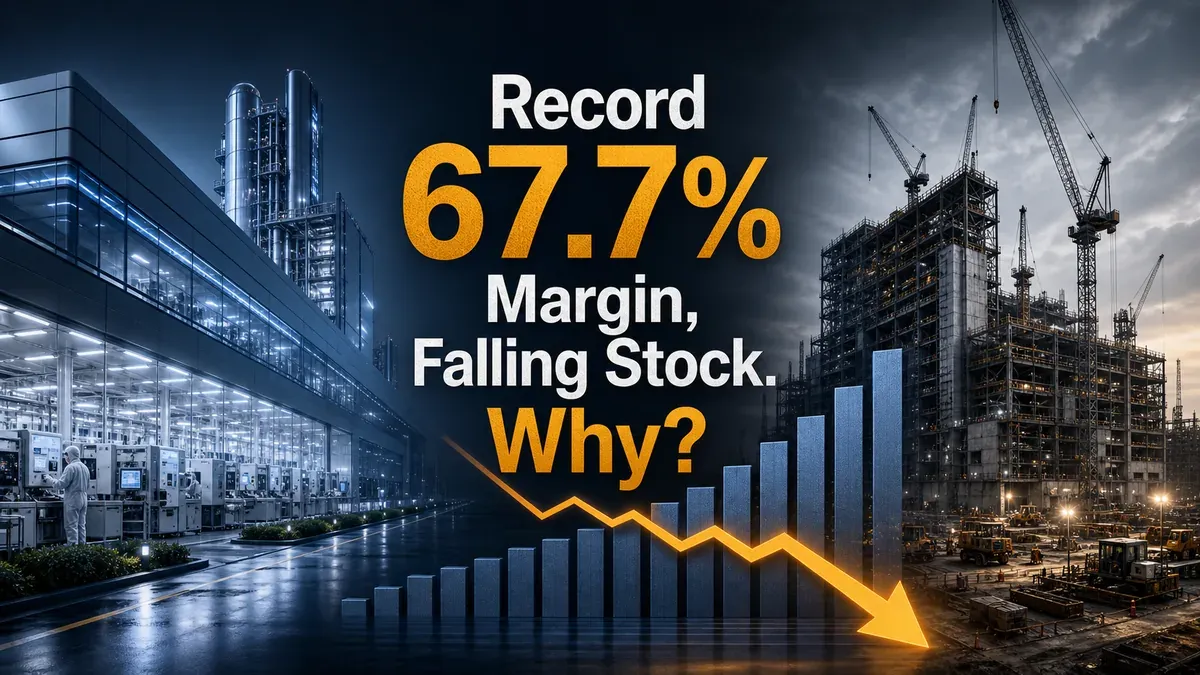
In July 2026, TSMC posted its best quarter ever — record revenue, a 77% jump in profit, and a 67.7% gross margin most manufacturers can only dream of. Then the stock fell about 6–7%. This post reconciles the paradox: the culprit is math, specifically the gross-margin dilution from building chips in Arizona (4–5x Taiwan's cost) and ramping 2-nanometer production, set against a capex bill that just jumped again.
"Record earnings, falling stock" looks like a market glitch until you read the guidance instead of the headline. TSMC's Q2 2026 numbers were genuinely spectacular, and its shares still slid on the news. The reason isn't sentiment — it's a set of specific, quantified margin and spending commitments that tell investors the next few years cost more per chip than the last few. Here is the actual arithmetic behind the reaction.
Table of Contents
- The Record Quarter, in Numbers
- Why the Stock Fell Anyway: Three Dilution Sources
- The $265 Billion Arizona Question
The Record Quarter, in Numbers
There is no way to read TSMC's Q2 2026 report as weak. The company earned NT$706.56 billion in net income, up 77.4% year over year — a record — on NT$1.27 trillion (about $40.2 billion) of revenue, up roughly 36%. Its gross margin hit 67.7%, an exceptional figure for a capital-intensive manufacturer, and it was the company's fifth straight record-profit quarter.
The mix underneath explains the strength. High-performance computing — the AI-chip category — was 66% of revenue, with smartphones a distant 22%. Leading-edge nodes did the heavy lifting: chips at 7nm and below made up 77% of wafer revenue, with 5nm at a 33% share and 3nm at 30%. TSMC is, in effect, the toll booth for advanced AI silicon, and demand is not the problem — the company's full-year 2026 growth outlook runs above 40%.
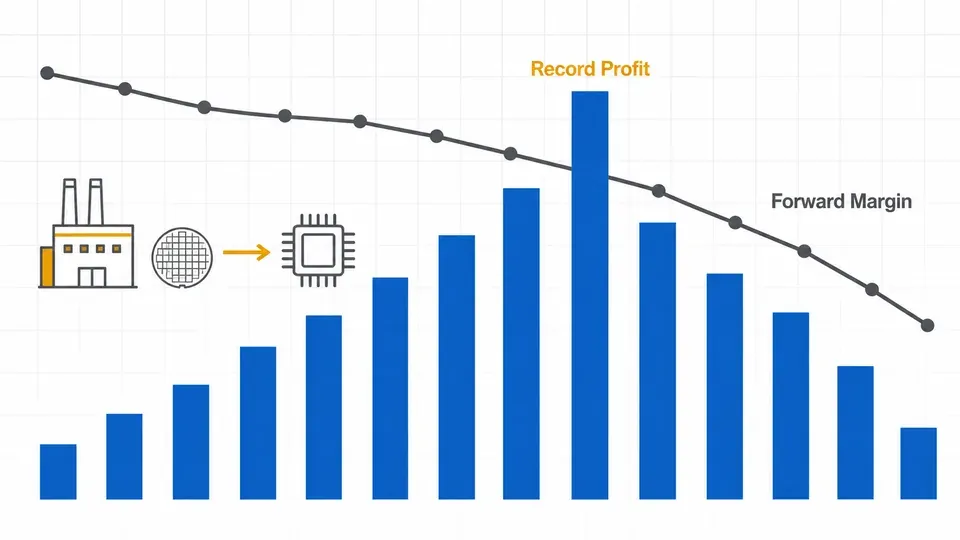
So if the business is firing on every cylinder, why did the stock react the way it did? Because a foundry's stock does not trade on last quarter's margin — it trades on where margins are heading, and TSMC used the same earnings call to tell investors that number is coming down.
## Why the Stock Fell Anyway: Three Dilution Sources
The negative reaction came from guidance, and it stacks up in three parts. Individually each is manageable; together they told the market that TSMC's world-leading margin has a ceiling in sight.
| Pressure | What TSMC guided | Effect on margin |
|---|---|---|
| Overseas fabs (esp. Arizona) | Ramp dilutes gross margin 2–3 pts early, widening to 3–4 pts later | Structural, multi-year |
| 2nm ramp | New-node start-up costs | ~3–4 pts hit to Q3 gross margin |
| Q3 guidance | Gross margin 65–67%, operating margin 56–58% | Down from the 67.7% record |
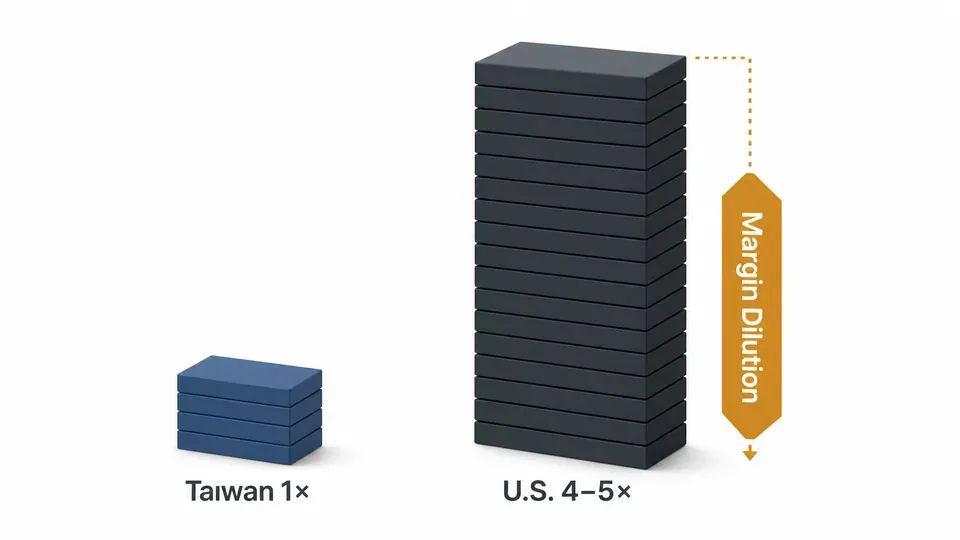
Start with geography. Building and running a fab in the United States costs an estimated four to five times what the equivalent costs in Taiwan — higher construction, labor, and operating expenses that don't magically disappear once the fab opens. TSMC told investors the dilution from ramping these overseas fabs would be 2 to 3 percentage points in the early years, widening to 3 to 4 points as they scale. That is a structural, multi-year drag baked into the growth plan, not a one-quarter blip.
Then add technology. The move to 2-nanometer production carries the usual new-node penalty: yields start low and start-up costs are high, which TSMC said would knock 3 to 4 percentage points off gross margin as the ramp accelerates. Put the two together and you get the headline number that spooked the tape: Q3 gross-margin guidance of 65–67%, visibly below the 67.7% just delivered.
The final ingredient was spending. TSMC raised its 2026 capital expenditure to $60–64 billion, up from prior guidance in the $52–56 billion range. More capex to meet AI demand is bullish for the long run, but in the near term it means more depreciation and more cash out the door — exactly the kind of "we're spending more to earn slightly lower margins" message that makes a stock at record highs vulnerable. TSMC's Taipei shares fell about 7.3% that week, its U.S.-listed ADRs dropped around 6% on the day, and the broader Philadelphia semiconductor index slid roughly 10% over the same stretch.
## The $265 Billion Arizona Question
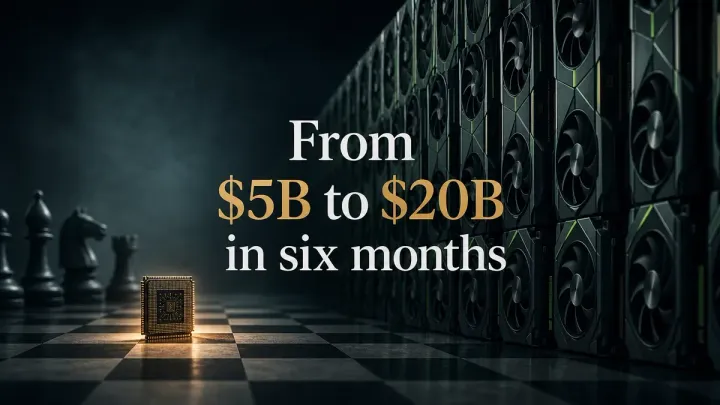
The single most attention-grabbing announcement was the one that most directly explains the margin story: TSMC committed an additional $100 billion to Arizona, lifting its total U.S. investment pipeline to $265 billion — enough, the company suggested, for roughly four more plants targeting 2nm production and advanced packaging over time.
This is where the "record profits, falling stock" paradox fully resolves. From a policy and supply-chain standpoint, $265 billion in U.S. capacity is a strategic win: it diversifies TSMC's manufacturing base away from a geographically concentrated Taiwan and aligns with Washington's push to onshore advanced chips. But from a near-term margin standpoint, it is precisely the source of the 2–4 point dilution the guidance just quantified. Investors were, in effect, asked to pay for sovereignty and resilience with lower gross margins for years — and at a record-high share price, some of them declined.
The honest framing is that none of this signals a broken business. Analysts largely called the sell-off a correction rather than a fundamental breakdown, and a company still guiding to 65%+ gross margins while diluting for U.S. fabs and a new node is demonstrating enviable pricing power. The takeaway is subtler: TSMC's margin peak and its geopolitical strategy are now in tension, and the market just repriced for the fact that "essential monopoly on advanced AI chips" and "ever-expanding margins" are not the same promise. The demand is real; the cost of meeting it politically and technologically is simply higher than the 67.7% headline implied.
Frequently Asked Questions
Did TSMC actually have a bad quarter? No — the opposite. It set records: net income up 77.4% to NT$706.56 billion, revenue around $40.2 billion (up ~36%), and a 67.7% gross margin. The stock fell on forward guidance, not on the quarter itself.
Why did the stock drop if earnings were a record? Because guidance pointed to lower future margins: overseas (Arizona) fabs dilute gross margin 2–4 points over time, the 2nm ramp costs another 3–4 points near term, and 2026 capex was raised to $60–64 billion. Markets price the trajectory, not just the last print.
How much more does a US fab cost than a Taiwan fab? TSMC and analysts estimate roughly four to five times as much, driven by higher construction, labor, and operating costs — which is why U.S. expansion structurally dilutes gross margin.
What is the $265 billion figure? It is TSMC's total planned U.S. (Arizona) investment after adding a fresh $100 billion, covering additional fabs for 2nm production and advanced packaging.
Is this a reason to worry about TSMC long term? Most analysts framed the sell-off as a correction, not a breakdown. AI demand remains strong (HPC is 66% of revenue; full-year growth guided above 40%). The tension is between peak margins and a costly, strategically necessary U.S. build-out — not between the company and its customers.
Key Takeaways
- TSMC's Q2 2026 was a record: net income up 77.4% to NT$706.56B, revenue ~$40.2B, gross margin 67.7%, HPC/AI at 66% of sales.
- The stock still fell ~6–7% because guidance flagged margin dilution: overseas fabs (2–4 pts) and the 2nm ramp (3–4 pts), cutting Q3 gross-margin guidance to 65–67%.
- A US fab costs ~4–5x a Taiwan fab, making the Arizona build-out a structural, multi-year margin drag.
- TSMC added $100B to Arizona, total $265B — a strategic diversification win that is also the direct source of the margin pressure.
- The real signal: TSMC's margin peak and its geopolitical strategy are now in tension; demand is not the issue, the cost of meeting it is.
How this was written: AI assisted with gathering sources and structuring a first draft — fact-checking and final edits were done by a person.
References
- TSMC Q2 2026 earnings: Record profit, $100 billion Arizona investment — Yahoo Finance
- TSMC Adds $100B Arizona Investment as Q2 Profit Surges 77% to Record $22B — MLQ News
- TSMC Q2 revenue up 34% YoY; plans another $100bn investment in Arizona — Electronics Weekly
- Why is TSMC stock falling despite record Q2 earnings? — Invezz
- Taiwan Semiconductor (TSM) Stock Is Down Nearly 15% This Month Despite Record AI Demand — Yahoo Finance
- TSMC Lifts Arizona to $265 Billion After Record Quarter: Four Fabs Target AI Packaging Bottleneck — TechTimes
- TSMC Shares Plunge Despite Blowout Earnings; Analysts Say It's a Correction, Not a Fundamental Breakdown — BigGo Finance


Comments ()