
Etched's Jump From $5B to $20B: What a Transformer-Only AI Chip Means for Nvidia's Grip
Etched's Jump From $5B to $20B: What a Transformer-Only AI Chip Means for Nvidia's Grip
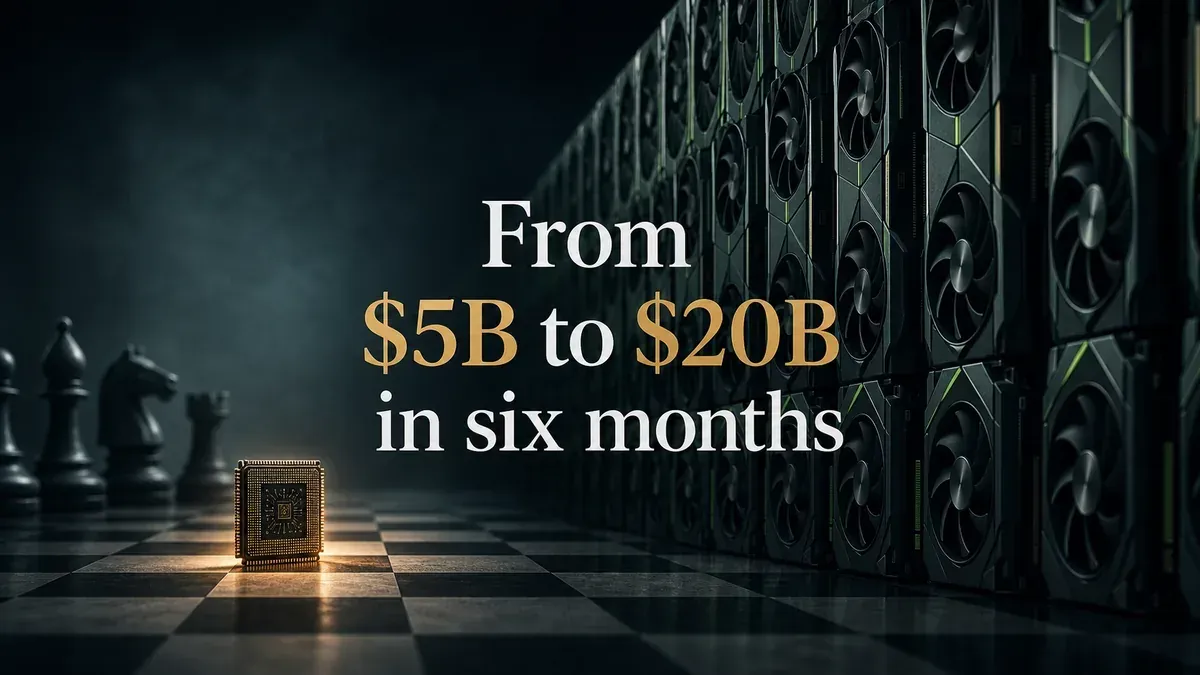
AI chip startup Etched is reportedly in talks for a funding round valuing it near $20 billion — roughly 4x the ~$5 billion valuation from its round just months earlier. The company sells one thing: Sohu, a chip that only runs transformer models but claims to run them far faster than a general-purpose GPU. This post separates what's verified (funding, contracts, silicon) from what's still a vendor claim (the speed numbers), and lays out why a one-trick chip could matter to Nvidia — and why it might not.
Nvidia's moat has never really been the raw silicon. It's that its GPUs run everything — training, inference, transformers, diffusion models, whatever ships next — plus a software stack (CUDA) that a decade of developers already know. Etched is betting the opposite: that the AI world has quietly standardized on one architecture, the transformer, and that a chip hardwired to run only transformers can beat a flexible GPU badly enough to be worth giving up the flexibility. Investors are pricing that bet aggressively. Below is what's actually confirmed, the comparison that matters, and the honest case on both sides.
Table of Contents
What Etched Actually Is
Etched came out of stealth on June 30, 2026. The verified facts from that launch are concrete: the company has raised roughly $800 million across four rounds, holds over $1 billion in signed customer contracts, and has demonstrated working silicon plus a rack-scale, 8-chip inference system. Its earlier round was reported at about a $5 billion valuation; the newer round now in talks would value it near $20 billion — a roughly 4x jump in a matter of months.
The product is a single chip called Sohu, built on TSMC's N4P process. Unlike a GPU, it can't train models, can't run diffusion image generators, and can't pivot to a new architecture. It does exactly one job: inference on transformer models — the family that includes GPT, Claude, Llama, and essentially every large language model in production today. Etched's thesis is that by burning the transformer's structure directly into fixed-function circuits (rather than emulating it on flexible GPU cores), it can devote nearly all of its silicon to the one computation that matters.
Here's the honest line between fact and claim. The funding, the contracts, and the existence of working chips are reported and confirmed. The performance numbers are Etched's own benchmarks, not independently verified: the company claims Sohu delivers up to ~20x the throughput of an Nvidia H100 on transformer inference, citing figures like ~500,000 tokens per second on Llama 70B versus roughly 25,000 for a comparable H100 setup. Treat those as the vendor's marketing claims until third parties test them — chip startups routinely quote best-case, hand-tuned numbers.
## ASIC vs GPU: The Trade That Defines the Bet
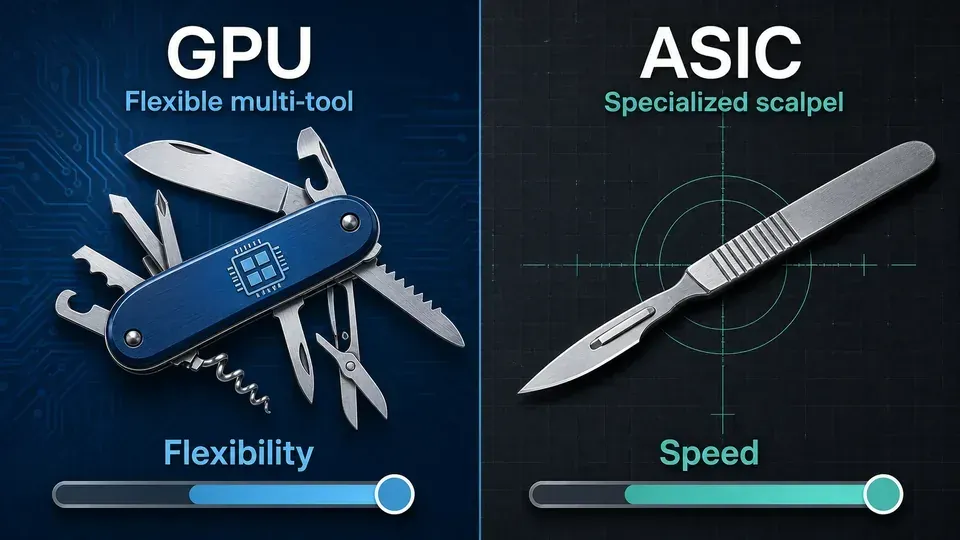
Sohu is an ASIC — an application-specific integrated circuit. The entire history of computing hardware is a pendulum between flexible-but-slower general chips and fast-but-rigid specialized ones. Bitcoin mining is the cleanest precedent: it started on GPUs and within a few years moved almost entirely to ASICs, because once the workload froze, specialized silicon crushed general chips on speed and power. Etched is wagering that transformer inference is now frozen the same way.
Here's the trade, laid out directly:
| Dimension | General-purpose GPU (Nvidia) | Transformer-only ASIC (Etched Sohu) |
|---|---|---|
| Workload range | Training + all inference types | Transformer inference only |
| Speed on transformers | Baseline | Claimed up to ~20x (vendor benchmark) |
| Adapts to new architectures | Yes, via software | No — fixed in silicon |
| Software ecosystem | CUDA, mature, huge | New, must be built |
| Risk if the field shifts | Low (re-programmable) | High (chip becomes obsolete) |
The whole investment case lives in the bottom two rows. If transformers remain the dominant architecture for the next several years, an ASIC that's dramatically faster and cheaper per token is enormously valuable — inference, not training, is where the ongoing operational cost of AI actually sits, and it scales with every user query. If a genuinely new architecture displaces the transformer (state-space models, or something not yet invented), a chip that can only do transformers becomes expensive scrap. Nvidia's flexibility is exactly the insurance Etched is choosing to sell off in exchange for speed.
## Does This Dent Nvidia?
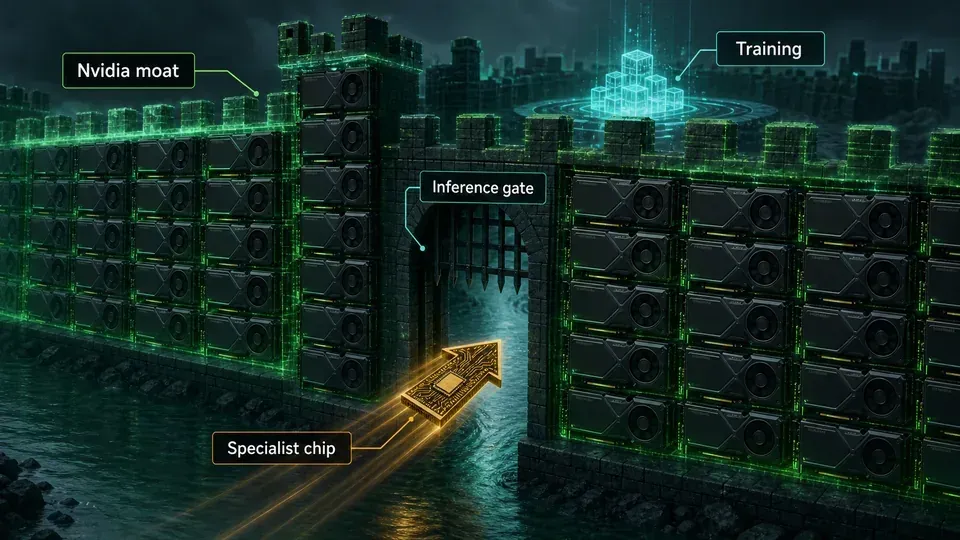
Probably not the way headlines imply — but the direction matters. Nvidia's dominance is anchored in training, where flexibility and CUDA are close to non-negotiable, and Sohu doesn't compete there at all. What Etched is contesting is the inference slice: the repetitive, high-volume work of serving already-trained models to users. That slice is growing faster than training as AI products scale, and it's the part most exposed to a cheaper, faster specialist.
The realistic near-term outcome isn't Nvidia losing its crown; it's margin pressure and customer optionality at the edges. Every large AI operator would love a credible second source that lowers the cost per token — even the threat of Etched gives cloud buyers leverage in Nvidia negotiations. And Etched isn't alone: hyperscalers are building their own inference silicon (Google's TPUs, Amazon's Trainium/Inferentia, Meta's in-house chips), all chipping at the same inference tier from different angles. The $20 billion valuation isn't really a bet that Etched beats Nvidia; it's a bet that the inference market gets big enough, and specialized enough, that a pure-play transformer chip captures a valuable corner of it.
The catch worth watching: a valuation quadrupling in months, on a single unshipped product line whose headline speed numbers are self-reported, is priced for near-flawless execution. First racks are due to ship in summer 2026. Independent benchmarks and real customer deployments — not funding rounds — are what will tell you whether the bet is working.
Frequently Asked Questions
What is a transformer ASIC? An ASIC (application-specific integrated circuit) is a chip designed to do one task extremely efficiently. A transformer ASIC like Sohu is hardwired to run transformer neural networks — the architecture behind most modern AI models — and nothing else, trading flexibility for speed and power efficiency.
Can Etched's chip train AI models? No. Sohu is built only for inference (running already-trained models). Training still requires flexible hardware like Nvidia's GPUs, which is a major reason Nvidia's core business isn't directly threatened.
Are the "20x faster than H100" claims verified? Not independently. Those figures come from Etched's own benchmarks. Startup performance claims are typically best-case; wait for third-party testing and real deployments before treating them as fact.
Why would a $5 billion company be worth $20 billion months later? The reported jump reflects investor enthusiasm for AI inference hardware, over $1 billion in signed contracts, and the strategic value of any credible alternative to Nvidia — not a proven change in the underlying product.
Is this the same as Google's TPU or Amazon's Inferentia? Similar idea, different owner. Those are in-house inference chips built by hyperscalers for their own clouds. Etched is an independent vendor selling to anyone, which is why it's framed as a direct market challenger.
Key Takeaways
- Etched is reportedly in talks for a ~$20 billion valuation, roughly 4x its earlier ~$5 billion round.
- Verified: ~$800M raised, $1B+ in contracts, working silicon, an 8-chip rack system, out of stealth June 30, 2026.
- Not verified: the ~20x-vs-H100 speed claims are Etched's own benchmarks, not independent tests.
- Sohu only runs transformer inference — its whole value depends on transformers staying dominant.
- The real target is Nvidia's inference margins and customer leverage, not its training crown.
How this was written: AI helped research this piece, but every source, fact, and sentence was checked and finalized by hand.
References
- Transformer Chip Startup Etched Exits Stealth: $800M Raised, $1B in Contracts — Tech Times
- Etched raises $800M and locks in $1B in sales contracts for its transformer chip — Crypto Briefing
- Etched AI Sohu vs NVIDIA: Transformer ASIC vs General-Purpose GPU for LLM Inference (2026) — Spheron
- Welcome to the club, Etched — Jon Peddie Research
- Etched unveils Sohu chip and first inference system, plans summer shipments — Crypto Briefing
Comments ()