Nvidia's 9.3% Nebius Stake and $6.3B CoreWeave Backstop: Is This 'Circular Financing' or Real Demand?
Nvidia's 9.3% Nebius Stake and $6.3B CoreWeave Backstop: Is This 'Circular Financing' or Real Demand?
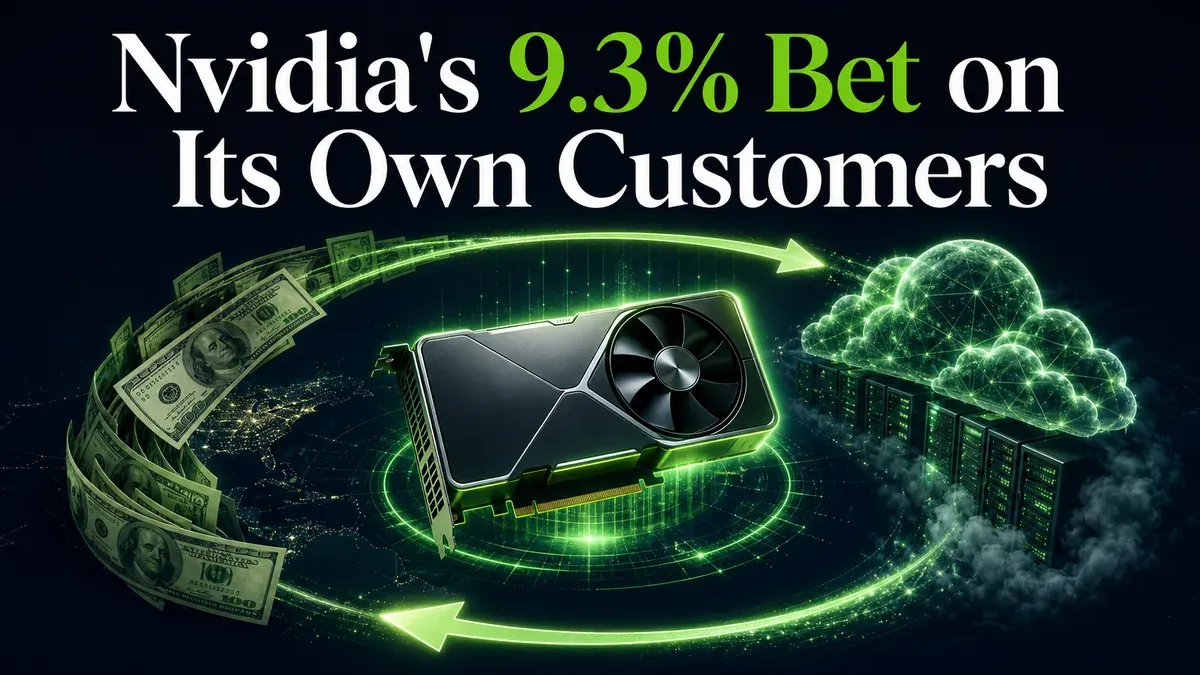
On July 20, 2026, a regulatory filing revealed that Nvidia holds a 9.3% stake in the AI cloud company Nebius — and the stock jumped nearly 19%. It is the latest node in a pattern that critics call "circular financing": Nvidia puts equity into the specialized cloud providers ("neoclouds") that then spend heavily on Nvidia's own chips. This post lays out exactly what Nvidia owns, what it has guaranteed, and how to tell a genuine demand signal apart from a loop that mostly moves money in a circle.
Every few weeks, Nvidia's name shows up as an investor in a company that is also one of its customers. The reflex reaction is either "great, demand is booming" or "this is 1999 vendor financing all over again." Neither slogan is analysis. The useful move is to look at the actual mechanics — how much Nvidia invested, what it is contractually on the hook for, and whether the customer could survive without Nvidia's money. Below is that breakdown for the two clearest public examples, Nebius and CoreWeave, and a framework for reading the next headline that follows the same template.
Table of Contents
- What Nvidia Actually Owns in Nebius
- The Loop, Drawn Out: Nebius vs CoreWeave
- Circular Financing or Strategic Bet? How to Tell
What Nvidia Actually Owns in Nebius
Nebius is an Amsterdam-based "neocloud" — a specialized cloud provider that rents out GPU compute to AI labs and enterprises, filling the gap between what the big hyperscalers can supply and what the market wants. On July 20, 2026, a securities filing disclosed that Nvidia holds a 9.3% stake, amounting to roughly 22.26 million shares. The structure matters: only about 1.19 million of those are Class A shares held outright, while the remaining ~21.07 million sit inside a pre-funded warrant that Nvidia is barred from exercising before September 11.
That stake traces back to a $2 billion investment Nvidia made in Nebius on March 11, 2026, which bundled equity with the warrant. By July, that position was reported to be worth close to $4 billion at market prices — one reason the disclosure sent Nebius shares up nearly 19%. The timing is also telling: just days earlier, on July 17, Nebius had raised $775 million in senior secured debt. So within a single week, the market saw the same company take on fresh debt and have its largest chip supplier revealed as a near-10% owner.
None of that is illegal or even unusual for a fast-scaling infrastructure company. But it is the exact shape that makes the "circular financing" critique land: the supplier's capital and the customer's spending are pointed at each other.

## The Loop, Drawn Out: Nebius vs CoreWeave
Nebius is not the only example, and it is not even the most extreme one. CoreWeave — the publicly listed neocloud that IPO'd in 2025 — shows the same dual role in sharper relief. Nvidia added roughly $2 billion more equity in January 2026, and CoreWeave's own filings list Nvidia as both a top customer and a significant shareholder. The most striking piece is a backstop: under an agreement with an initial value of about $6.3 billion running through April 2032, Nvidia is contractually obligated to buy CoreWeave's unsold computing capacity if the cloud provider can't find other buyers.
Here is the pattern side by side:
| Nebius | CoreWeave | |
|---|---|---|
| Nvidia as investor | 9.3% stake (~22.26M shares), from a $2B March 2026 investment incl. a warrant | ~$2B added equity (Jan 2026), on top of prior stakes |
| Nvidia as supplier/backstop | Sells GPUs to it | Sells GPUs to it and backstops up to ~$6.3B of unsold capacity to Apr 2032 |
| Recent financing stress | Raised $775M senior secured debt (Jul 17, 2026) | ~$24.9B total debt; Q1 2026 free cash flow −$4.71B |
Two things stand out. First, the neoclouds are running deeply cash-negative while they build: CoreWeave posted about $2.98 billion in operating cash flow against $7.7 billion of capital expenditure in Q1 2026 alone — a negative $4.71 billion free-cash-flow quarter — funded largely by debt. Second, Nvidia's money and guarantees reduce the risk that a neocloud gets stuck holding chips it can't monetize, which in turn makes it easier for that neocloud to keep ordering more chips. Demand that is partly underwritten by the seller is real demand, but it is not the same as unassisted demand.

## Circular Financing or Strategic Bet? How to Tell
The phrase "circular financing" carries a specific historical charge: during the telecom build-out of 1999–2001, equipment makers lent customers the money to buy their gear, which flattered revenue right up until the customers defaulted and the loans blew back onto the lenders' books. Skeptics see the same silhouette here — a dominant supplier keeping demand aloft with its own balance sheet.
But the parallel isn't automatic, and lumping every Nvidia investment into "bubble proof" is as lazy as calling it all healthy growth. Three questions separate a strategic ecosystem bet from a genuine circular-financing risk:
- Could the customer survive without the supplier's capital? A neocloud that is already cash-flow negative and leaning on both fresh debt and supplier equity is more fragile than one taking a strategic minority investment on top of a self-funding business. CoreWeave's −$4.71B free-cash-flow quarter is the number to watch, not the headline valuation.
- Is the supplier guaranteeing demand, or just owning upside? A pure equity stake (Nvidia in Nebius) mostly gives Nvidia upside if the cloud does well. A backstop to purchase unsold capacity (Nvidia–CoreWeave, ~$6.3B) is different — it directly props up the customer's willingness to order, and it puts risk back on Nvidia if the capacity really can't be sold.
- How big is it relative to the supplier? For Nvidia, a couple of billion dollars is a rounding error against its cash generation, which is the bull's strongest point: these are cheap options on the ecosystem it already dominates, not a company betting the farm to manufacture its own revenue.
Put those together and the honest read is tiered. The Nebius stake, on its own, looks more like a strategic bet — an equity option on a customer Nvidia wants to keep well-capitalized. The CoreWeave relationship is where the circular-financing critique has the most teeth, because the ~$6.3B backstop and the customer's heavy cash burn are exactly the ingredients that made telecom-era vendor financing dangerous. The distinction that matters isn't "Nvidia invested — good or bad," but whether Nvidia is guaranteeing the demand it then books as sales. When the AI capex cycle eventually cools, the neoclouds most dependent on supplier-backed demand are the ones that re-rate first — and the backstops are where Nvidia's own risk quietly lives.
Frequently Asked Questions
What is a "neocloud"? A specialized cloud provider (like Nebius or CoreWeave) that rents out GPU compute for AI training and inference, filling the gap between traditional hyperscalers and what AI labs need. They are capital-intensive and typically debt-heavy while building out data centers.
Does Nvidia's 9.3% stake mean it controls Nebius? No. 9.3% is a significant minority stake, not control, and much of it sits in a warrant Nvidia can't exercise before September 11, 2026. It gives Nvidia economic upside and a strategic tie, not board control.
Why do people call this "circular financing"? Because Nvidia invests capital in companies that then use money (including debt) to buy Nvidia's chips. Critics compare it to telecom-era vendor financing, where suppliers funded their own customers' purchases — which ended badly when those customers couldn't pay.
Is the CoreWeave backstop the same as the Nebius stake? No, and the difference is the whole point. The Nebius position is mostly an equity stake (upside if it does well). The CoreWeave arrangement includes a contractual backstop — Nvidia agreeing to buy up to ~$6.3B of unsold capacity through April 2032 — which more directly supports the customer's demand.
Does this prove there's an AI bubble? Not by itself. It shows demand is partly supplier-supported, which is a risk factor, not a verdict. The signal to track is whether the neoclouds can eventually fund purchases from their own cash flow rather than from debt plus Nvidia's balance sheet.
Key Takeaways
- Nvidia disclosed a 9.3% stake in Nebius (~22.26M shares, from a $2B March 2026 investment); the stock jumped nearly 19% on the news.
- The stake is mostly a pre-funded warrant Nvidia can't exercise before Sept 11, 2026 — economic upside, not control.
- CoreWeave is the sharper case: Nvidia is investor and supplier, plus it backstops up to ~$6.3B of unsold capacity through April 2032, while CoreWeave burns cash (Q1 2026 free cash flow −$4.71B, ~$24.9B total debt).
- The useful test isn't "good or bad" but whether Nvidia is guaranteeing the demand it books — a pure equity stake and a purchase backstop are different risks.
- Supplier-backed demand is real, but the neoclouds most dependent on it are the ones that would re-rate first if the AI capex cycle cools.
How this was written: This piece was drafted with AI's research help; a human verified every fact and polished the final wording.
References
- Nebius stock surges nearly 19% as Nvidia discloses 9.3% stake in neocloud — CNBC
- Nvidia discloses 9.3% stake in neocloud computing firm Nebius — Investing.com
- Nebius Group N.V. — Form 6-K (FY2026) — SEC
- Nvidia Just Plowed Nearly $4 Billion Into a Company That's Reshaping the Cloud Industry — The Motley Fool
- Nvidia Invests Another $2 Billion in CoreWeave, Offers New Chip — Bloomberg
- Nvidia Circular Financing: $24.9B CoreWeave Debt Puts Pension Funds at Risk — TechTimes
- Nvidia, CoreWeave, and Nebius: Inside the Circular Financing of the GPU Boom — Seeking Alpha

Comments ()