
China's Optical Chip, Explained: How a Peking University System Ran AI Inference 100x Faster on One-Ninth the Compute

China's Optical Chip, Explained: How a Peking University System Ran AI Inference 100x Faster on One-Ninth the Compute
In July 2026, a Peking University team reported an optical interconnect system that ran a distributed AI inference task more than 100 times faster while using about one-ninth of the computing resources a commercial GPU needed for the same job. The result, published in National Science Review, is real and striking — but it is not a drop-in Nvidia killer. Here's what the system actually does, why light helps, and where the honest limits are.
Every few months a headline promises that some new chip will make Nvidia obsolete. Almost none survive contact with the details. This one is more interesting than most, because it doesn't try to build a faster GPU at all — it attacks a different bottleneck entirely, using light instead of copper to move data between chips. Understanding what that means, and what it doesn't, tells you a lot about where AI hardware is actually headed.
Table of Contents
- What the Peking University Team Actually Built
- Why Light Beats Copper for Moving Data
- The 100x Number, in Context
- What This Does and Doesn't Threaten
What the Peking University Team Actually Built
The system is not a single magic chip. It's an optical interconnect network that links standard electronic processors using custom photonic hardware and co-designed algorithms. The headline components are concrete and measurable:
| Component | Specification |
|---|---|
| Silicon photonic transceiver | 400 Gbps (converts electrical ↔ optical) |
| Optical switch chip | 16×16 configuration |
| Aggregate switching bandwidth | 6.4 Tbps |
| Switch insertion loss | under 5 dB (including coupling) |
| Spectral response | exceeds 100 nm |
The clever part is the architecture. Instead of each processor finishing its work, writing the result to memory, and having the next processor read it back, the system transmits feature maps directly through the optical network between computing nodes. Intermediate data never has to sit in memory waiting to be shuffled around. That's the whole game: keep the processors continuously fed and continuously working, and you eliminate the stalls that dominate distributed AI workloads.
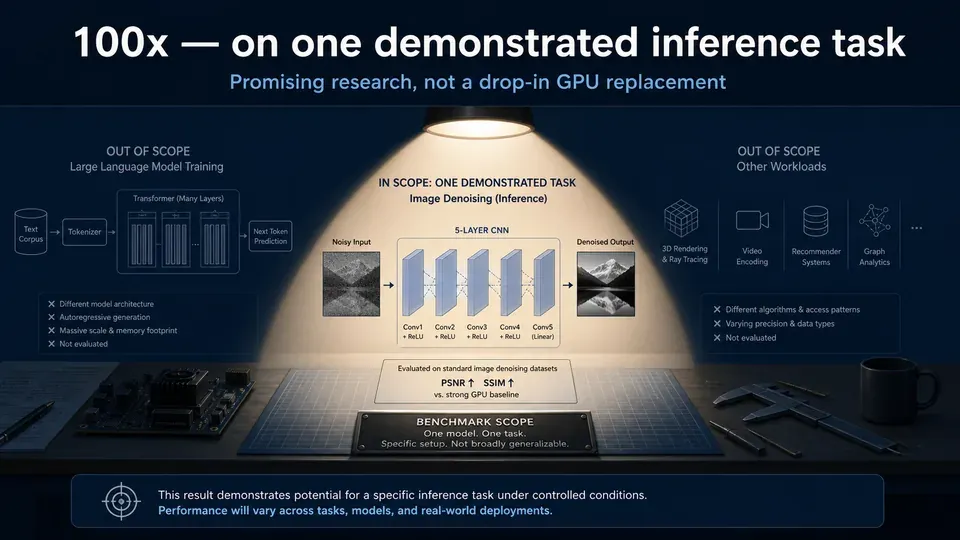
The team demonstrated this on a five-layer convolutional neural network doing image denoising — a real but specific benchmark, not a giant language model. The result was published as an advance article in National Science Review in 2026.
Why Light Beats Copper for Moving Data
To see why this matters, you have to appreciate the problem it solves. Modern AI accelerators are rarely limited by raw math throughput. They're limited by data movement — getting weights and activations to the compute units fast enough, and shuttling intermediate results between chips. This is the same "memory wall" problem that made high-bandwidth memory so valuable; our explainer on what HBM is and why AI chips can't ship without it covers the electronic side of the same bottleneck.
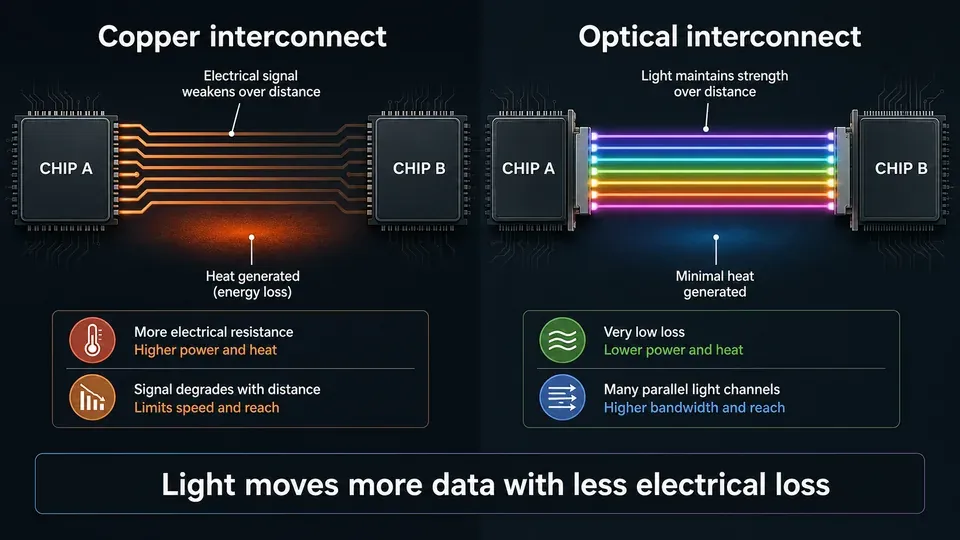
Optical interconnects attack that wall directly. Light has three structural advantages over copper for moving data across a chip or between chips:
- Bandwidth. A single optical channel can carry enormous data rates, and multiple wavelengths of light can travel the same path simultaneously (wavelength multiplexing) — which is why a spectral response exceeding 100 nm matters.
- Distance without degradation. Electrical signals lose integrity and burn energy as they travel copper traces; light carries information across much longer distances with far less loss.
- Energy. Moving bits electrically is a major and growing share of a data center's power budget. Doing it optically can slash the energy cost per bit — which is exactly why the "one-ninth the compute" figure is as notable as the speed.
## The 100x Number, in Context
The claim traveling fastest is "100x faster than a commercial GPU." It's important to read that precisely. The 100x speedup and one-ninth compute savings apply to the specific distributed-inference benchmark the team ran — not to every AI workload, and not to training the largest models. This is a demonstration of what an optically interconnected, co-designed system can do on a task suited to it, not a universal benchmark win.
The researchers themselves are explicit that algorithms, processor micro-architecture, and chip-level interconnections are co-designed together. That co-design is the source of the gains — and also the caveat. A system tuned end-to-end for one class of problem can post spectacular numbers on that problem while offering far less on workloads it wasn't shaped for. That's not a knock; it's how specialized accelerators work. But it's the difference between "100x on a co-designed inference pipeline" and the misleading shorthand "100x faster than Nvidia."
## What This Does and Doesn't Threaten
So where does this leave the AI hardware landscape? A balanced read:
What it genuinely signals. Optical interconnects are moving from lab curiosity toward practical systems, and they target the real bottleneck — data movement and energy — rather than chasing raw FLOPS. For a country facing GPU supply constraints and rising data-center power demand, a route to faster, more energy-efficient inference that leans on standard electronic chips plus custom photonics is strategically meaningful. It's a way to do more with fewer and less-advanced processors.
What it does not do. It doesn't replace GPUs for training frontier models. It doesn't make Nvidia's ecosystem — CUDA, the software stack, the manufacturing scale — irrelevant overnight. And a single published benchmark, however impressive, is a long way from volume production, yield, and deployment at data-center scale. The gap between "works in National Science Review" and "ships in a hyperscaler's rack" is measured in years and billions of dollars.
The honest framing is that this is a credible, well-quantified step in photonic computing, not a changing of the guard. Light-based data movement is very likely part of AI's future; whether this specific system is the one that scales is the open question.
Frequently Asked Questions (FAQ)
Is this really 100 times faster than Nvidia's GPUs? On the specific distributed-inference benchmark the team ran — a five-layer CNN for image denoising — the co-designed optical system was reported as more than 100x faster using about one-ninth the compute of a commercial GPU. It is not a general-purpose 100x win across all AI workloads.
What is an optical interconnect? Hardware that moves data between chips using light instead of electrical signals over copper. Light offers higher bandwidth, longer reach with less loss, and lower energy per bit — the main bottlenecks in modern AI systems.
Does this replace GPUs? No. It links standard electronic processors more efficiently and shines on inference-style workloads. It doesn't replace GPUs for training large models, nor the surrounding software and manufacturing ecosystem.
Why does it matter that China built it? Facing GPU supply constraints and growing data-center power needs, a path to faster, more energy-efficient AI using standard chips plus custom photonics gives China an alternative route that depends less on the most advanced imported processors.
How close is this to real deployment? It's an advance research result published in National Science Review. Moving from a lab demonstration to volume production and data-center-scale deployment typically takes years.
Key Takeaways
- A Peking University team reported an optical interconnect system running distributed AI inference 100x faster on about one-ninth the compute of a commercial GPU, published in National Science Review in 2026.
- The core hardware: a 400 Gbps silicon photonic transceiver and a 16×16 optical switch with 6.4 Tbps aggregate bandwidth and under 5 dB loss.
- The trick is transmitting feature maps directly through the optical network, sidestepping the memory-movement bottleneck that limits distributed AI.
- The gains are real but application-specific — the result comes from end-to-end co-design on one benchmark, not a universal win over Nvidia.
- It's a credible step for photonic computing and a strategic route around GPU constraints, not an overnight replacement for the GPU ecosystem.
How this was written: AI assisted with gathering sources and structuring a first draft — fact-checking and final edits were done by a person.
References
- Interesting Engineering — China's optical AI network 100x faster inference
- South China Morning Post — China's optical chip breakthrough boosts AI speed 100-fold
- eWeek — China's Optical Chip Breakthrough Speeds AI 100x
- Electropages — Chinese Optical Interconnect Breakthrough Could Transform AI Computing



Comments ()