
DiffusionGemma Hits 1,000 Tokens per Second—But Its Benchmarks Reveal the Real Tradeoff

DiffusionGemma Hits 1,000 Tokens per Second—But Its Benchmarks Reveal the Real Tradeoff
Google's experimental DiffusionGemma can exceed 1,000 tokens per second on one H100 by refining 256-token blocks in parallel. The same official model card shows that this speed comes with lower accuracy than autoregressive Gemma 4 on most major reasoning, coding, vision and long-context benchmarks.
Table of Contents
- How diffusion text generation changes the bottleneck
- The speed numbers and the hardware they require
- What the benchmark table actually says
- When DiffusionGemma is the better engineering choice
How diffusion text generation changes the bottleneck
Most language models generate text autoregressively. They predict one token, append it to the context, then predict the next. The process is stable and intuitive, but it forces GPUs to revisit model weights repeatedly while producing a sequence. For local and low-batch inference, memory bandwidth often becomes the limiting resource.
DiffusionGemma takes a different path. Google's model begins with a 256-token canvas filled with placeholder states. It refines many positions in parallel over multiple denoising steps. High-confidence positions help resolve neighboring positions, while uncertain tokens can be replaced and refined again.
For output longer than 256 tokens, the model commits a completed block to its key-value cache and opens a new canvas conditioned on the previous block. Google calls this a block-autoregressive diffusion design. It keeps some sequential structure between blocks while parallelizing generation inside each block.
The architectural goal is not simply "fewer steps." It is to give the GPU a wider, compute-heavy workload. Instead of waiting on repeated weight transfers for one token at a time, the model can use tensor cores across a whole canvas. Google says this shifts the bottleneck from memory bandwidth toward compute.
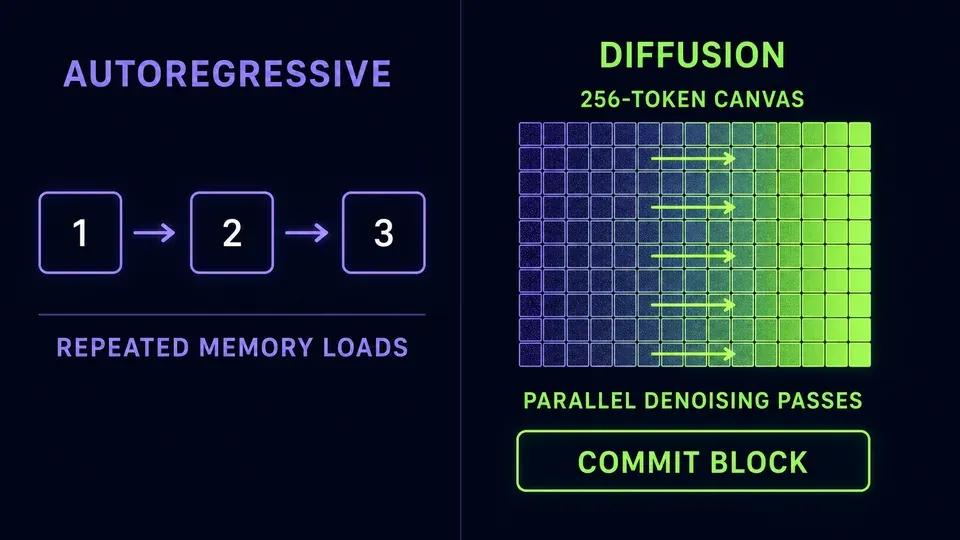
Diffusion also gives the model a limited form of within-block revision. An autoregressive model normally treats an emitted token as fixed. DiffusionGemma can reconsider uncertain positions while denoising the current canvas. That does not mean it can freely rewrite an entire answer after generation, but it can propagate constraints bidirectionally inside the block.
Google demonstrates this behavior with Sudoku. The base model scored near zero on the task, but a supervised fine-tuned adapter reached 80% success. The tuned model also stabilized after 12 steps instead of the base model's unsuccessful 48-step attempt in Google's example. The lesson is not that DiffusionGemma is a universal Sudoku solver. It is that parallel constraint propagation may be valuable for tasks where distant positions inside one block must agree.
The speed numbers and the hardware they require
Google reports up to four times faster token generation than the autoregressive Gemma 4 counterpart. Its developer guide cites more than 700 tokens per second on an Nvidia GeForce RTX 5090 and more than 1,000 tokens per second on a single H100.
Those are striking numbers, but they are not a universal latency promise. Throughput depends on sampler configuration, canvas length, batch size, prompt length, quantization, framework and hardware. The official serving example uses vLLM with a specific entropy-bound sampler, a 256-token canvas, chunked prefill and tuned GPU utilization.
The model has 25.2 billion total parameters, with 3.8 billion active parameters per inference step. It uses a mixture-of-experts architecture with 128 experts, eight active experts plus one shared expert. The official card lists context up to 256,000 tokens and a 256-token canvas.
Google says a quantized version can fit within roughly 18 GB of VRAM. That places it within reach of high-end consumer hardware, although practical memory needs also include the KV cache, runtime overhead and input modality.
The model is open-weight under the Apache 2.0 license. Google lists support across vLLM, Hugging Face Transformers, SGLang and MLX, with deployment options extending from consumer RTX hardware to Hopper and Blackwell servers. That breadth matters because a novel architecture has little value if every serving stack needs to be rebuilt.
What the benchmark table actually says
The official model card compares instruction-tuned DiffusionGemma 26B A4B with autoregressive Gemma 4 26B A4B. DiffusionGemma is faster, but it trails Gemma 4 on most published capability measures.
| Benchmark | DiffusionGemma | Gemma 4 | Difference |
|---|---|---|---|
| MMLU Pro | 77.6% | 82.6% | -5.0 points |
| AIME 2026, no tools | 69.1% | 88.3% | -19.2 points |
| LiveCodeBench v6 | 69.1% | 77.1% | -8.0 points |
| GPQA Diamond | 73.2% | 82.3% | -9.1 points |
| Tau2 average | 56.2% | 68.2% | -12.0 points |
| MMMU Pro | 54.3% | 73.8% | -19.5 points |
| MRCR v2, 128K | 32.0% | 44.1% | -12.1 points |
DiffusionGemma does beat Gemma 4 on Humanity's Last Exam without tools: 11.0% versus 8.7%. That isolated result does not reverse the broader pattern. On the listed reasoning, coding, agentic, vision and long-context metrics, the autoregressive model is usually stronger.
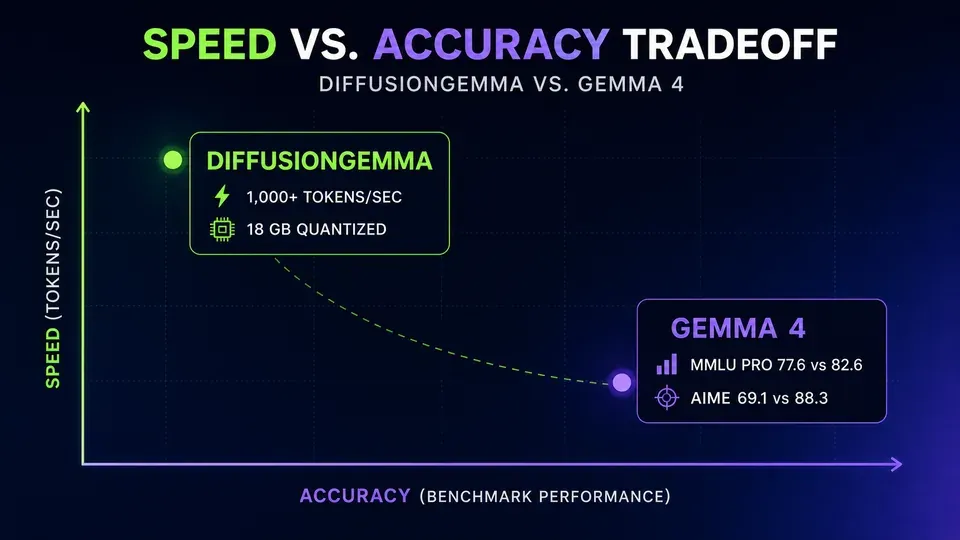
This is why the headline "four times faster" needs context. If a workload requires multiple retries, stronger verification or a larger model to recover lost accuracy, raw tokens per second may not reduce total cost. The relevant metric is successful outputs per dollar, not tokens per second alone.
A practical measure is:
Effective throughput = accepted outputs / total generation time
Acceptance should include factual accuracy, format compliance and task completion. For a low-stakes summarization service, a small quality gap may be acceptable. For code generation, scientific reasoning or agentic actions, an eight-to-twelve-point benchmark gap may have operational consequences.
When DiffusionGemma is the better engineering choice
DiffusionGemma is compelling for workloads with four characteristics.
First, users value low latency or high throughput more than the final few points of benchmark accuracy. Interactive drafting, autocomplete, extraction and classification may fit this profile.
Second, outputs have bounded formats that can be checked cheaply. If a schema validator or deterministic rule catches failures, the system can exploit fast generation without accepting every answer blindly.
Third, developers control the hardware. An open-weight model running locally can reduce data movement, provide predictable capacity and support private workflows. The 18 GB quantized target makes serious experimentation possible outside a data center.
Fourth, the task benefits from parallel constraints inside a block. Structured generation, grid-like problems and tightly coupled output fields may gain from bidirectional refinement, especially after task-specific fine-tuning.
Autoregressive Gemma 4 remains the safer default when benchmark accuracy dominates, when outputs are long and reasoning-heavy, or when the engineering team does not want to tune a diffusion sampler. The official table makes that choice defensible.
The strongest deployment strategy may be a cascade:
- Send easy, verifiable requests to DiffusionGemma.
- Validate the output automatically.
- Escalate failures or high-risk requests to a stronger autoregressive model.
- Measure accepted outputs per second and per dollar.
That architecture turns the speed-quality gap into a routing problem. It also avoids treating one model as the answer to every workload.
DiffusionGemma's broader significance is architectural. For years, faster text generation mostly meant better kernels, quantization, speculative decoding or more hardware around the same left-to-right process. Google is testing whether the generation process itself can be reorganized to match GPU parallelism. The first release does not eliminate the quality tradeoff. It makes the tradeoff measurable.
Frequently Asked Questions
Is DiffusionGemma a text-to-image diffusion model?
No. It uses discrete diffusion to generate text. The released model accepts text and image inputs and produces text output.
How large is DiffusionGemma?
The official model card lists 25.2 billion total parameters and 3.8 billion active parameters. Google describes it as a 26B A4B mixture-of-experts model.
Can it run on a consumer GPU?
Google says quantized deployment can fit within about 18 GB of VRAM. Actual requirements vary with runtime configuration, context length and cache size.
Is it better than Gemma 4?
It is substantially faster in Google's reported generation tests. Gemma 4 scores higher on most capability benchmarks in the official comparison, so "better" depends on the workload.
Key Takeaways
- DiffusionGemma refines 256-token blocks in parallel instead of generating every token strictly left to right.
- Google reports 700+ tokens per second on an RTX 5090 and 1,000+ on one H100.
- The official model card shows lower scores than Gemma 4 on most reasoning, coding, vision and long-context benchmarks.
- Quantized deployment targets roughly 18 GB VRAM, making local experimentation practical.
- The right metric is accepted outputs per dollar, not raw token speed.
How this was written
This article was produced with AI assistance and reviewed against Google's developer guide and the official DiffusionGemma model card. All architecture, hardware and benchmark numbers come from those primary sources.

Comments ()