
SambaNova's $11 Billion Bet: Why JPMorgan Chose On-Prem AI Chips Over the Cloud

SambaNova's $11 Billion Bet: Why JPMorgan Chose On-Prem AI Chips Over the Cloud
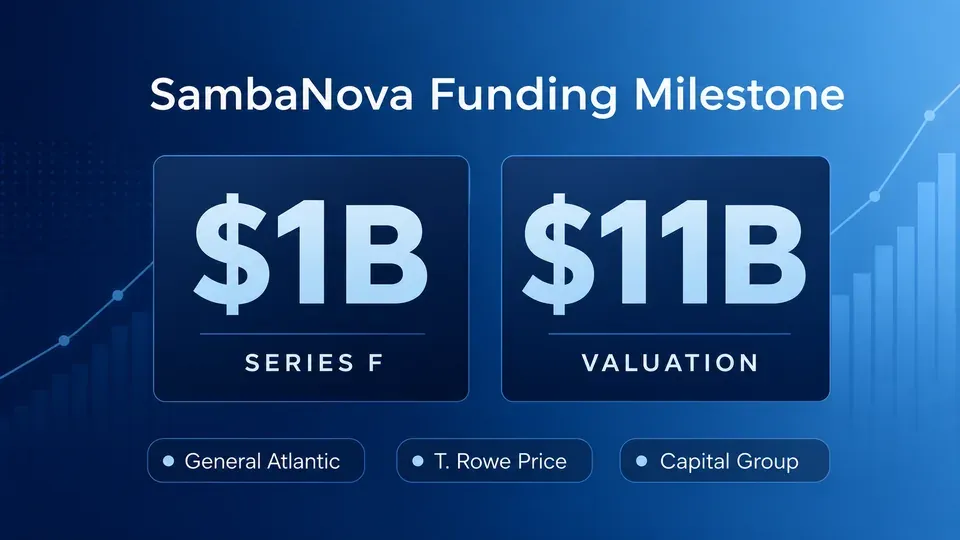
SambaNova just raised $1 billion at an $11 billion valuation and landed JPMorgan as an on-premises inference customer. The deal is a bet against the cloud-only AI thesis — here is what the numbers and the strategy actually say.
On July 8, 2026, at the RAISE summit in Paris, AI-chip startup SambaNova announced two things at once: the first close of a $1 billion Series F round that pushed its valuation to $11 billion, and a multi-year deal to power on-premises AI inference for JPMorgan Chase. Both signals point the same direction — money and a systemically important bank are betting that a meaningful slice of AI will run inside enterprises, not only in someone else's cloud. This post unpacks the funding, the chip claims, and why the JPMorgan choice matters more than the dollar figure.
The raise: who's backing the Nvidia challengers
The Series F was led by General Atlantic, with participation from T. Rowe Price, Capital Group, and Seligman Ventures. That is a notable investor mix: T. Rowe Price and Capital Group are large public-market managers, the kind that typically show up late in a company's life. Their presence signals that the "Nvidia challenger" thesis has moved from venture speculation toward mainstream institutional conviction.
SambaNova's focus is narrow on purpose. It does not try to out-train Nvidia on giant training clusters; it builds inference chips — the semiconductors that run trained models quickly and cost-efficiently — sold as full server units for data centers and, increasingly, on-premise deployments.
## The chip claim: SN50 vs. Nvidia's B200
SambaNova's pitch rests on its SN50 accelerator. The company's benchmarks — and it's important that these are vendor-reported, not independent — claim the SN50 delivers roughly 3x the throughput of Nvidia's B200 under real latency constraints. Here is the comparison as SambaNova presents it:
| Metric (SambaNova-reported) | SambaNova SN50 | Nvidia B200 |
|---|---|---|
| Llama 3.3 70B, FP8, 1K/1K tokens (per-user throughput) | ~895 tokens/sec | ~184 tokens/sec |
| Average throughput advantage (latency-constrained, across Llama 70B / GPT-OSS 120B / DeepSeek 671B) | ~3x higher | baseline |
| Raw FP8 compute (dense / sparse TFLOPS) | 3,200 | 4,500 / 9,000 |
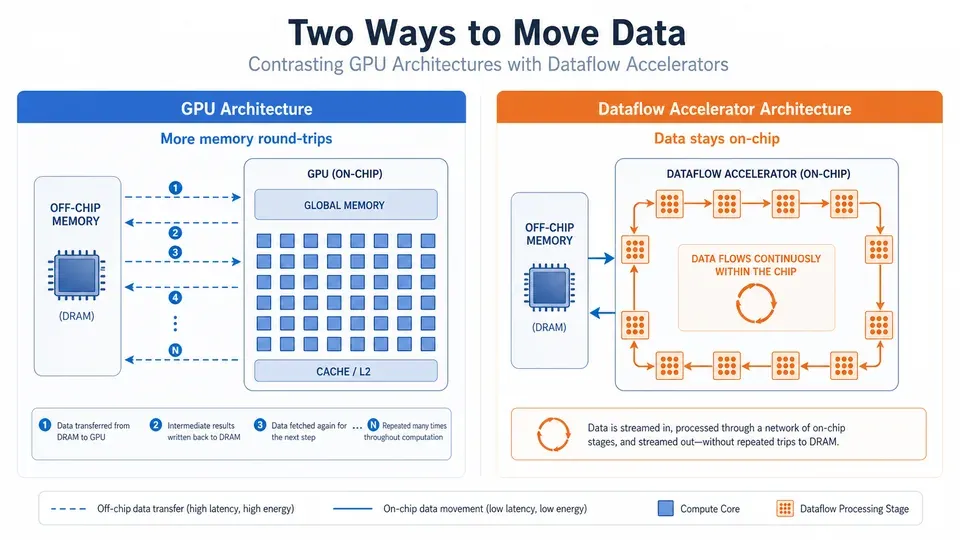
Notice the twist in the last row: the B200 actually wins on raw FLOPS. SambaNova's edge does not come from more compute — it comes from architecture. Its reconfigurable dataflow design and three-tier memory hierarchy keep data on-chip and cut the memory round-trips and scheduling overhead that eat GPU cycles. The claim, in plain terms: the SN50 wastes fewer cycles moving data around, so it converts less raw horsepower into more usable tokens per second.
The honest reading: these are impressive numbers, but they are SambaNova's own, on workloads it selected. Treat the 3x as a vendor claim worth watching, not a settled fact.
## Why JPMorgan's choice is the real headline
The dollar figures grab attention, but the strategically interesting part is who signed up and why. JPMorgan selected SambaNova's SN40L and SN50 systems to run inference on-premises — inside the bank's own infrastructure — rather than shipping its most sensitive data to a third-party cloud.
That is a direct challenge to the cloud-only AI narrative. The reasoning:
- Data sovereignty. Regulated institutions increasingly cannot send their most sensitive data to external servers. Tightening privacy and security rules push banks to keep data where they control it.
- Predictable cost at scale. For steady, high-volume inference, owning the hardware can beat metered cloud pricing over a multi-year horizon.
- Control and latency. On-prem means the bank controls the stack end to end and avoids network hops to a cloud region.
The takeaway is not "the cloud loses." It's that the market is splitting. Bursty, experimental, or variable workloads still favor the cloud's elasticity. But steady, sensitive, high-volume inference in regulated industries is exactly the segment the cloud-first story underweights — and it's the segment SambaNova is aiming at. A bank the size of JPMorgan validating that thesis is worth more than the $1 billion headline.
Frequently Asked Questions
How much did SambaNova raise and at what valuation? $1 billion in a Series F first close, at an $11 billion post-money valuation, led by General Atlantic.
Is the SN50 really faster than Nvidia's B200? On SambaNova's own benchmarks, yes — about 3x higher throughput under latency constraints, and ~895 vs. ~184 tokens/sec per user on one Llama 3.3 70B test. But the B200 leads on raw FLOPS, and these figures are vendor-reported, not independently verified.
What did JPMorgan actually agree to? A multi-year deal to run secure, on-premises AI inference using SambaNova's SN40L and SN50 systems, keeping sensitive data inside the bank's infrastructure.
Does this mean enterprises are abandoning the cloud for AI? No. It means the market is segmenting. Elastic and experimental workloads still favor the cloud; steady, sensitive, high-volume inference in regulated sectors is where on-prem makes sense.
Why inference and not training? Training the largest models is a capital-and-scale fight where Nvidia dominates. Inference is a different battle — cost-efficiency and deployment flexibility matter more, giving specialized challengers a real opening.
Key Takeaways
- SambaNova raised $1B at an $11B valuation (Series F, led by General Atlantic), with late-stage public-market investors joining.
- Its SN50 claims ~3x the throughput of Nvidia's B200 under latency limits despite lower raw FLOPS — an architecture story, and a vendor-reported one.
- JPMorgan picking SN40L/SN50 for on-premises inference is the bigger signal: a challenge to the cloud-only thesis, driven by data sovereignty and cost.
- The real story is market segmentation, not cloud vs. on-prem as winner-take-all.
How this was written AI assisted with gathering sources and structuring a first draft — fact-checking and final edits were done by a person.
References
- CNBC, "SambaNova hits $11 billion valuation as investors back Nvidia chip challengers": https://www.cnbc.com/2026/07/08/sambanova-ai-chip-funding-valuation.html
- TechCrunch, "AI chip maker SambaNova raises $1B at $11B valuation, 5 months after last mega round": https://techcrunch.com/2026/07/08/sambanova-draws-1b-at-11b-valuation-in-series-f-first-close/
- Tom's Hardware, "SambaNova claims SN50 chip is three times more efficient than Nvidia B200": https://www.tomshardware.com/tech-industry/artificial-intelligence/sambanova-introduces-new-ai-accelerator-partners-with-intel-to-deploy-xeon-cpus-for-inferencing-and-agentic-workloads-sambanova-claims-sn50-chip-is-three-times-more-efficient-than-nvidia-b200
- InvestorPlace, "JPMorgan Just Challenged the Cloud-Only AI Thesis": https://investorplace.com/hypergrowthinvesting/2026/07/jpmorgan-just-challenged-the-cloud-only-ai-thesis/
- Finextra, "JPMorgan Chase picks SambaNova for on-prem AI inference": https://www.finextra.com/newsarticle/48057/jpmorgan-chase-picks-sambanova-for-on-prem-ai-inference

Comments ()