Korea's AI Trade Just Broke: KOSPI -8.95%, SK Hynix -15%, and the 7th Circuit Breaker of 2026
Korea's AI Trade Just Broke: KOSPI -8.95%, SK Hynix -15%, and the 7th Circuit Breaker of 2026
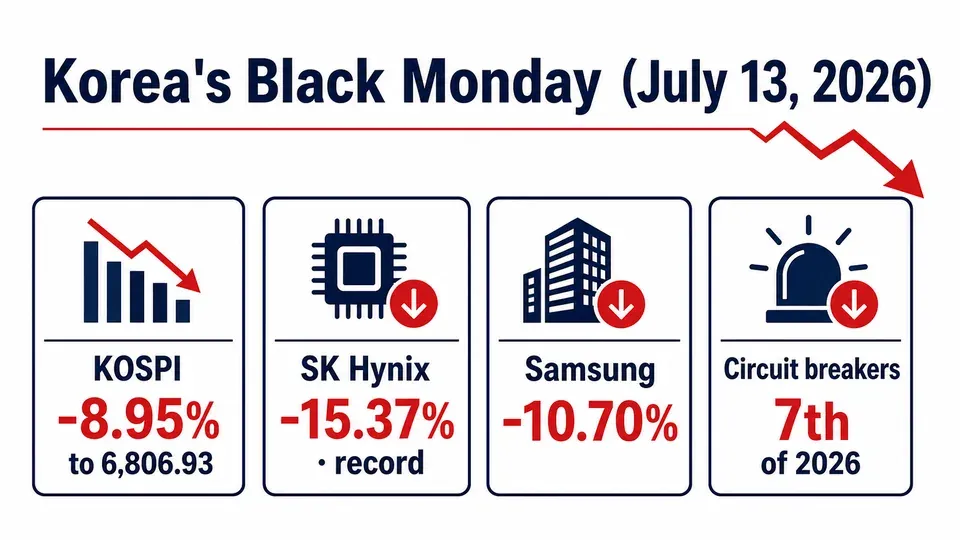
On July 13, 2026, South Korea's KOSPI fell 8.95% to close at 6,806.93 — a "Black Monday" that tripped the year's seventh circuit breaker. SK Hynix dropped 15.37% (its worst Seoul session on record) and Samsung 10.70%, as an over-concentrated, over-leveraged AI-memory trade unwound. Retail investors fled to crypto, sending Upbit volume up 1,426%. Here is what happened, why it broke in Seoul first, and what it signals for the global AI trade.
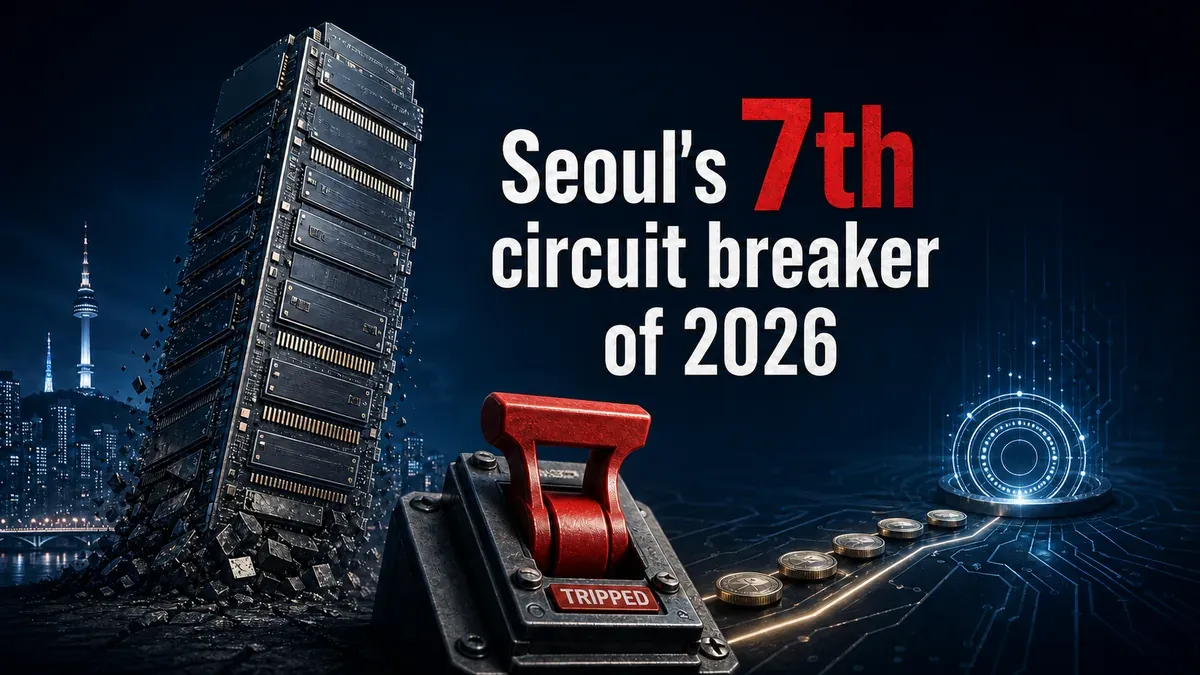
The AI trade didn't wobble in Silicon Valley first — it snapped in Seoul. On July 13, 2026, South Korea's benchmark KOSPI plunged 8.95% to close at 6,806.93, surrendering the 7,000 level barely two months after first reaching it and triggering the seventh circuit breaker of the year. The wreckage was overwhelmingly two stocks: SK Hynix fell 15.37% — its worst single session on record — and Samsung Electronics fell 10.70%. These aren't ordinary index members; together the two chipmakers make up roughly half of the entire KOSPI. When the memory-chip trade cracked, it took the whole market down with it, and it exposed exactly how concentrated and leveraged the global bet on AI has become. This post breaks down the crash, why Korea was the first domino, where the money ran, and what it means beyond Seoul.
Table of Contents
- What Happened on Korea's Black Monday
- Why It Broke in Seoul First
- Where the Money Fled: Crypto
- What It Signals for the Global AI Trade
What Happened on Korea's Black Monday
The session was violent enough to halt trading market-wide. Here are the verified numbers:
| Metric | Figure |
|---|---|
| KOSPI move (July 13) | -8.95%, closed at 6,806.93 |
| Level breached | Fell back below 7,000 (first reached ~2 months earlier) |
| Circuit breaker | 7th of 2026; triggered ~1:28 p.m., 20-minute halt (plus a sell-side sidecar) |
| SK Hynix | -15.37% — worst Seoul session on record |
| Samsung Electronics | -10.70% |
| KOSPI vs peak | More than 25% below its 2026 high |
A circuit breaker halts trading across the entire exchange to force a cooling-off period; hitting the seventh in a single year is itself a signal of how unstable 2026 has been. The trigger points were specific: profit-taking after SK Hynix's recent Nasdaq ADR listing, mounting "peak-out" fears for the semiconductor cycle, weaker-than-expected Q2 earnings guidance from chipmakers, and rising Middle East geopolitical tension. But the magnitude came from concentration.
## Why It Broke in Seoul First
Every major market rode the AI wave, so why did Korea crack first and hardest? Because the KOSPI is the most concentrated pure-play on the AI-memory boom in the world. Two companies — SK Hynix and Samsung — account for roughly half the index, and both sell the exact product at the white-hot center of the AI build-out: high-bandwidth memory (HBM), the stacked DRAM that every Nvidia-class accelerator needs.
That concentration is a double-edged sword. On the way up, it made the KOSPI a leveraged proxy for AI optimism — a way to buy "the picks and shovels of the memory supercycle" in a single index. On the way down, it means there is nowhere to hide: a bad day for HBM sentiment is a bad day for the entire national benchmark. We flagged exactly this fragility when SK Hynix listed in the U.S. and the market debated whether this was a memory supercycle or a bubble. July 13 was the bubble side of that debate getting a hearing.
Add leverage to concentration and you get a circuit breaker. Korean retail investors are famously willing to trade on margin, and much of the AI-memory rally had been financed with borrowed money. When SK Hynix's ADR listing gave early buyers a reason to take profits and the semiconductor "peak-out" narrative gained traction, the selling forced margin calls, and margin calls force more selling regardless of fundamentals. That reflexive loop is why an 8.95% day happens in one market while others fall 1–2%.
Where the Money Fled: Crypto
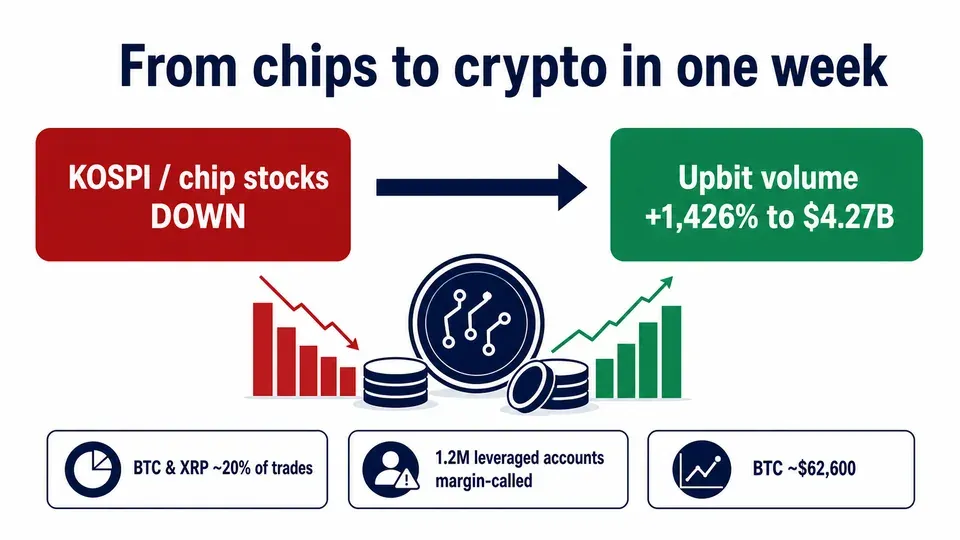
The most telling detail isn't the crash — it's where the capital ran. As Korean investors bailed out of stocks, they rotated straight into cryptocurrency. Upbit, Korea's largest exchange, saw trading volume explode 1,426% to about $4.27 billion, with Bitcoin and XRP alone accounting for nearly 20% of all trades. Roughly 1.2 million leveraged Korean retail accounts hit margin calls in the churn, and Bitcoin itself steadied around $62,600 as the rotation played out.
This is a specific, local flavor of risk behavior: capital didn't flee to safety (bonds, cash) so much as switch casinos, moving from leveraged chip stocks to leveraged crypto. It's the same appetite for volatility, redirected. That matters for context — the recent Bitcoin bear-market debate between $60,000 and a $100K rebound plays out very differently when a wall of displaced Korean retail money suddenly rotates in over a single week.
## What It Signals for the Global AI Trade
The tempting read is "this is a Korea problem" — an idiosyncratic mix of index concentration and retail leverage that doesn't travel. There's truth to that, and it's why Seoul's F4 response was so aggressive: the government activated its full stabilization apparatus — the Finance Ministry, the Bank of Korea, the FSC and the FSS — and summoned the CEOs of the ten largest securities houses for emergency talks. That's a localized firefight.
But the more useful read is that Korea is a stress test the rest of the market hasn't taken yet. The KOSPI is what every AI-heavy portfolio looks like in miniature: a small number of names, doing a small number of things (chips, memory, compute), priced for a supercycle, and increasingly bought with borrowed money. When one link — profit-taking after an ADR listing — pulled, the whole concentrated, leveraged structure amplified it into an 8.95% day. Nothing about that dynamic is uniquely Korean; Korea just has it in the most concentrated, most leveraged form, which is why it broke first.
My take: don't dismiss July 13 as a foreign curiosity, and don't extrapolate it into a global crash either. Treat it as a preview of the mechanism — concentration plus leverage plus a peak-out narrative — that any AI-heavy market carries. The specific trigger (an HBM peak-out scare) may or may not spread. The structural lesson — that the AI trade has become dangerously concentrated in a handful of chip names — is universal, and Seoul just illustrated it in red.
Frequently Asked Questions
How much did the KOSPI fall, and when? On July 13, 2026 the KOSPI fell 8.95% to close at 6,806.93, dropping back below 7,000 and triggering the seventh circuit breaker of the year.
Why did SK Hynix and Samsung fall so hard? Profit-taking after SK Hynix's Nasdaq ADR listing, "peak-out" fears for the semiconductor cycle, weak Q2 guidance, and geopolitical tension. SK Hynix fell 15.37% (a record) and Samsung 10.70%. Together they make up about half the index, so their drop dragged the whole market.
What is a circuit breaker? An automatic exchange-wide trading halt triggered by a large, rapid decline, meant to force a cooling-off period. Korea hit its seventh of 2026 on July 13.
Why did crypto volume spike during a stock crash? Korean retail investors rotated out of stocks and into crypto. Upbit volume jumped about 1,426% to ~$4.27B, with BTC and XRP nearly 20% of trades — a shift from one leveraged bet to another rather than a flight to safety.
Is this a global signal or a Korea-specific event? Both. The trigger and the leverage are Korea-specific, but the underlying setup — extreme concentration in a few AI-chip names — exists in many markets. Korea simply carries it in the most concentrated form.
Key Takeaways
- On July 13, 2026 the KOSPI fell 8.95% to 6,806.93, tripping the 7th circuit breaker of the year.
- SK Hynix -15.37% (record) and Samsung -10.70% drove it; the two chipmakers are ~half the index.
- The cause was an over-concentrated, over-leveraged AI-memory (HBM) trade unwinding, sparked by profit-taking after SK Hynix's ADR listing and peak-out fears.
- Capital fled to crypto: Upbit volume +1,426% to ~$4.27B, BTC/XRP ~20% of trades, ~1.2M leveraged accounts margin-called.
- The lesson is structural, not just Korean: the global AI trade is dangerously concentrated in a few chip names — Seoul just stress-tested it first.
How this was written Research and a first draft came together with AI's help; verification and the final pass were entirely human.
References
- Korea JoongAng Daily, "Kospi plunges 8.95% below 7,000 as sidecar and circuit breaker halt trading": https://www.koreajoongangdaily.com/business/black-monday-kospi-plunges-895-closes-below-7000/12771040
- TechTimes, "Korea's AI-Chip Rout Fires Seventh Circuit Breaker, Dragging Crypto Markets Lower": https://www.techtimes.com/articles/320383/20260713/koreas-ai-chip-rout-fires-seventh-circuit-breaker-dragging-crypto-markets-lower.htm
- TechTimes, "SK Hynix Posts Worst Seoul Session on Record as HBM Contracts Limit Earnings Upside": https://www.techtimes.com/articles/320352/20260713/sk-hynix-posts-worst-seoul-session-record-hbm-contracts-limit-earnings-upside.htm
- CoinDesk, "Bitcoin Steadies at $62,600 as South Koreans Flee Stocks Rout for Crypto": https://www.coindesk.com/markets/2026/07/14/bitcoin-steadies-at-usd62-600-as-south-koreans-flee-stocks-rout-for-crypto
- Coinpedia, "KOSPI Stock Index Falls as Upbit Trading Volume Surges 1,426%": https://coinpedia.org/crypto-live-news/kospi-stock-index-falls-4-as-upbit-trading-volume-surges-1426/


Comments ()