
Bitcoin Fell ~50% to $60,000: The 3 Bear-Market Drivers — and the Catch in the $100K Rebound Call

Bitcoin Fell ~50% to $60,000: The 3 Bear-Market Drivers — and the Catch in the $100K Rebound Call
Bitcoin trades near $60,000, roughly 50% below its 2025 record of $126,000. Analysts point to three drivers — the four-year cycle, reaccelerating inflation, and forced deleveraging — and one strategist projects a rebound to $100,000 by year-end. Here is the case, the counter-case, and the awkward assumption the bull call quietly depends on.
Bitcoin is doing the thing Bitcoin does every few years: falling hard enough to make believers quiet and skeptics loud. As of mid-July 2026 it trades around $60,000, down roughly 50% from its all-time high of $126,000 set in 2025. Predictably, the "Bitcoin is dead" takes are back — and so is the mirror-image call: a snap rebound to $100,000 by year-end. Both camps are citing the same three forces. This post walks through what's actually dragging Bitcoin down, lays out the bull-vs-bear math, and flags the one assumption the $100K prediction rests on that may not hold.
The three drivers, in plain terms
Analysts converge on three overlapping causes. None is mysterious; together they explain the drawdown.
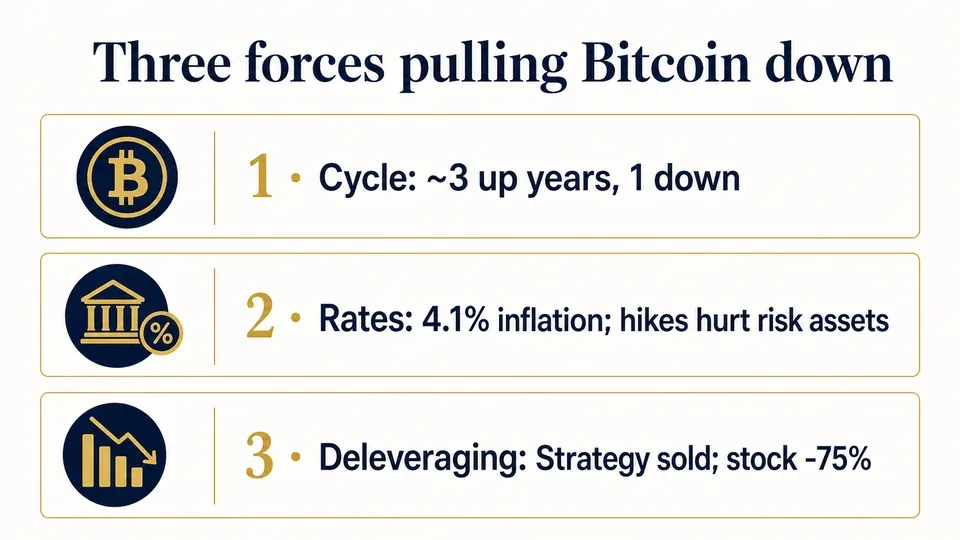
1. The four-year cycle. Bitcoin has historically run in a rhythm of roughly three up years followed by a down year. The prior down years are infamous — 2014 (after Mt. Gox collapsed) and 2018 (after the ICO bubble burst) — and each followed a euphoric peak. Bitwise CIO Matt Hougan attributes the current leg to plain investor psychology: "As we got towards the tail-end of 2025, we started to see some long-term Bitcoin holders…beginning to lighten up on their position." When enough early holders take profit at once, the cycle turns.
2. Reaccelerating inflation and rate fears. Inflation has climbed back toward 4.1% — roughly double the Fed's 2% target — pushed up in part by an oil-price spike tied to U.S.–Iran conflict. Higher inflation raises the odds of Fed rate hikes, and higher rates are poison for risk assets with no yield: when safe bonds pay more, speculative holdings like Bitcoin have to compete against a better risk-free return. This is the driver most likely to persist — and, as we'll see, the one that undercuts the bull case. (We broke down why markets now price a live hike risk in our piece on the 54% Fed-hike odds.)
3. Forced deleveraging. Bull markets tempt investors to borrow to buy more; bear markets force them to sell to cover. The clearest example is Strategy (formerly MicroStrategy), which accumulated roughly 4% of all Bitcoin through 2024–2025 using debt financing. Its stock has fallen about 75% since October, and the firm recently sold some Bitcoin — turning what was a relentless source of demand into a source of supply. When the market's largest leveraged buyer becomes a seller, price feels it.
## The bull case vs. the bear case
Put the two views side by side, because they're reading the same facts in opposite directions.
| Question | Bull case | Bear case |
|---|---|---|
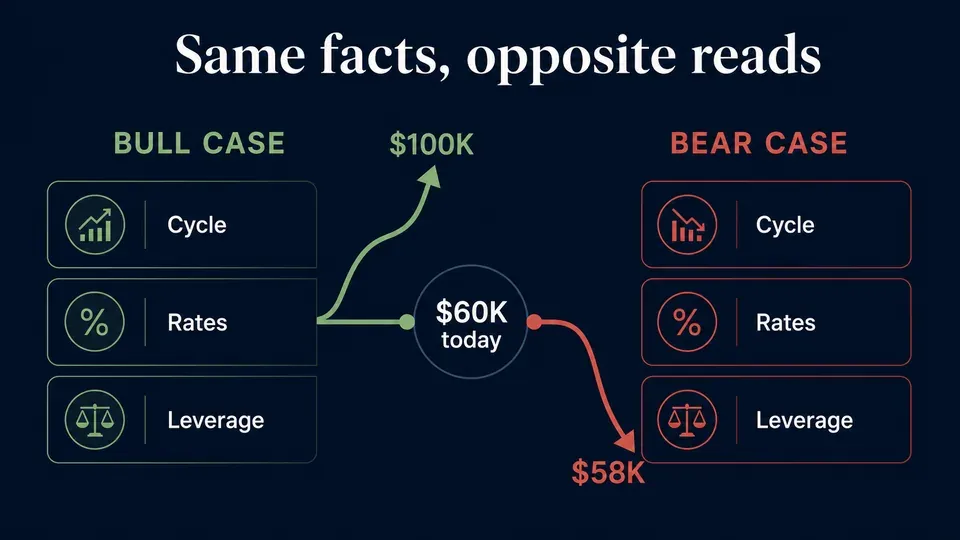
| The cycle | A down year sets up the next multi-year up-leg; buy the bottom | "This time" the halving-driven cycle may be weakening as the asset matures |
| Rates | Cuts eventually come; risk assets rip when they do | Cuts keep getting priced out; higher-for-longer caps the rebound |
| Strategy's selling | Forced selling exhausts itself, removing an overhang | A leveraged giant unwinding can cascade further |
| A bottom | Near — one analyst sees a floor this summer | Grayscale analyst floats a lower bottom around $58,000 |
The named bull call comes from Adrian Fritz, chief investment strategist at 21Shares, who expects Bitcoin to bottom sometime this summer and rebound toward $100,000 by year-end. His reasoning rests on two catalysts: eventual Fed rate cuts and an end to the Iran conflict easing the oil-driven inflation spike. On the other side, a Grayscale analyst has floated a potential bottom nearer $58,000 — meaning even some who expect a floor soon don't necessarily expect a fast round-trip to six figures.
## The catch in the $100K call
Here's the analytical knot worth seeing clearly. The $100,000 rebound thesis leans heavily on rate cuts arriving — that's the catalyst that would send risk assets higher. But the same inflation that's dragging Bitcoin down (driver #2) is exactly what's pushing rate-cut expectations further away. Prediction markets have been pricing the next Fed move as a hike, not a cut, and pricing cuts largely out of 2026.
So the bull case quietly assumes the very thing the bear case says won't happen soon. That's not a knockout against the prediction — inflation could cool, the Iran conflict could resolve, and the rate picture could flip. But it means the honest read is conditional: a $100K rebound is plausible if inflation eases and rate cuts return; it's a stretch if "higher for longer" holds. Anyone quoting the $100,000 target without stating that dependency is selling you the conclusion without the assumption.
For a reader, the takeaways are less about predicting a number and more about posture:
- Respect the cycle without worshipping it. Four-year patterns have held historically, but "past rhythm" is a probability, not a promise — especially as the asset matures and institutional flows change its behavior.
- Watch rates, not just crypto Twitter. The single biggest swing factor for Bitcoin's next move isn't a chart pattern; it's whether the Fed's path turns back toward cuts.
- Leverage is the accelerant in both directions. The Strategy story is a reminder that debt-funded buying inflates the top and deepens the bottom. Position sizes that survive a further drop are the ones that let you stay in for the eventual turn.
Frequently Asked Questions
How far has Bitcoin actually fallen? To around $60,000, roughly 50% below its 2025 all-time high of about $126,000.
What are the three reasons cited for the bear market? The four-year cycle (profit-taking after a peak), reaccelerating inflation near 4.1% that raises rate-hike odds, and forced deleveraging — notably Strategy (MicroStrategy) selling after its stock fell ~75%.
Who is predicting $100,000, and by when? Adrian Fritz, chief investment strategist at 21Shares, projects a summer bottom and a rebound toward $100,000 by year-end, citing eventual rate cuts and an end to the Iran conflict.
What's the weakness in that prediction? It depends on rate cuts returning, but the inflation that's currently weighing on Bitcoin is pushing rate-cut expectations further out. The rebound is conditional on inflation easing.
Is this financial advice? No. This is an explainer of competing analyst views. Crypto is highly volatile and price predictions are frequently wrong; treat any target — up or down — as a scenario, not a certainty.
Key Takeaways
- Bitcoin is near $60,000, about 50% below its 2025 record of $126,000.
- Three drivers: the four-year cycle, inflation near 4.1% raising rate-hike odds, and forced deleveraging (Strategy sold; stock −75%).
- One analyst (21Shares' Adrian Fritz) sees a summer bottom and a $100,000 year-end rebound; a Grayscale analyst floats a lower bottom near $58,000.
- The bull call's hidden assumption is that rate cuts return — but reaccelerating inflation is pushing cuts further out.
- Honest framing: a rebound is plausible if inflation eases, a stretch if "higher for longer" holds. Watch rates more than charts.
How this was written This piece was drafted with AI's research help; a human verified every fact and polished the final wording.
References
- Fortune, "3 reasons Bitcoin is stuck in a bear market—and why one analyst predicts a rebound to $100,000 by year-end" (July 12, 2026): https://fortune.com/2026/07/12/bitcoin-bear-market-three-drivers-rebound/
- Yahoo Finance (syndication of the Fortune report): https://finance.yahoo.com/markets/crypto/articles/3-reasons-bitcoin-stuck-bear-070000496.html
- NewsBTC, "Analyst Predicts When The Bitcoin Price Will Reach $100,000 In 2026": https://www.newsbtc.com/news/bitcoin/analyst-predicts-when-the-bitcoin-price-will-reach-100000-in-2026/

Comments ()