
AI Data Centers in Space: Why SpaceX Filed for 1 Million Satellites — and Whether the Physics Actually Works
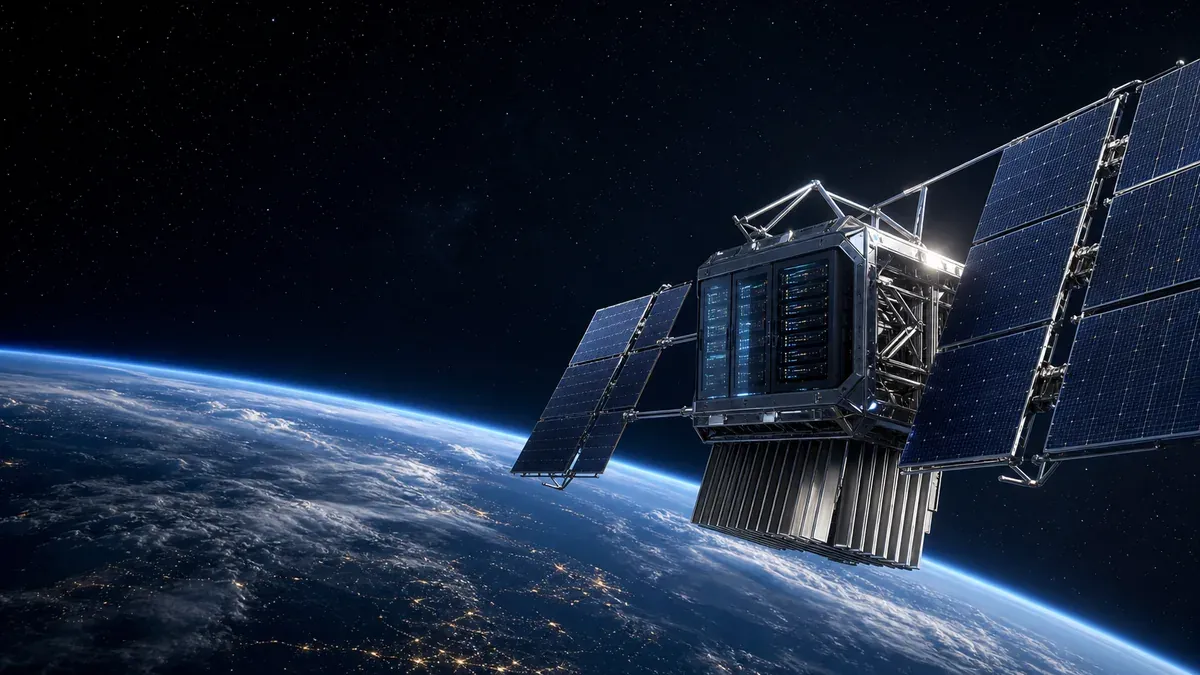
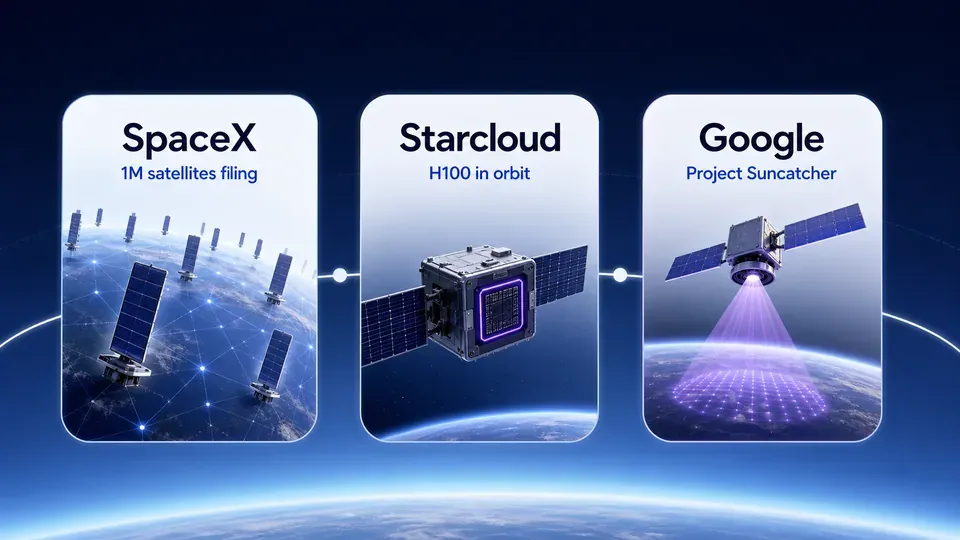
The AI build-out has run into a wall it can't code around: power, land, and water. Earth's grid can't spin up gigawatts fast enough, communities are fighting new data centers over water use, and permitting takes years. So the frontier players are looking up. In January 2026, SpaceX filed with the FCC for permission to launch up to one million satellites to form a solar-powered "orbital data center" megaconstellation. Nvidia-backed Starcloud already put an H100 GPU in orbit and trained a model there. Google's Project Suncatcher is studying TPU satellites. The pitch is seductive: infinite sun, deep-space cooling, no land fights. The catch is that SpaceX itself has admitted the economics "may not be commercially viable" yet. Here's what's real, what's aspirational, and how to tell the difference.
Data centers on Earth compete for scarce electricity, drink water for cooling, and trigger local opposition. Orbit, in theory, has none of those constraints — constant sunlight, the vacuum as a heat sink, and no neighbors. That's the whole case for moving AI compute off-planet. Whether it survives contact with physics and cost is the real question. Let's break down who's building what, and where the plan gets hard.
Why space, and why now
Three terrestrial bottlenecks are converging, and each one is worse for AI specifically:
- Power. Frontier AI training and inference need gigawatts. Grid interconnection queues stretch years, which is why AI is even reviving nuclear power — a sign of how desperate the search for firm electricity has become.
- Water. Ground data centers use evaporative cooling, consuming large volumes of fresh water — a growing flashpoint in drought-prone regions.
- Land and community. New campuses face zoning fights and local opposition over noise, water, and grid strain.
Orbit sidesteps all three in principle. In sun-synchronous orbit a satellite can sit in near-constant sunlight — effectively free, uninterrupted solar power with no batteries or backup. And instead of evaporating water, a spacecraft dumps heat as infrared radiation into the vacuum, which acts as an effectively infinite heat sink. No water, no land, no grid queue. That's the elevator pitch — and it's genuinely compelling on paper.
Who is actually building this
This isn't one company's moonshot. Three distinct efforts, at very different maturity levels:
| Player | What they're doing | Status (2026) |
|---|---|---|
| SpaceX | FCC filing for up to 1M solar-powered "orbital data center" satellites | Filed Jan 2026; requested milestone waiver |
| Starcloud | Nvidia-backed startup; H100/Blackwell compute satellites | Trained a model in orbit; $170M raised at $1.1B valuation |
| Project Suncatcher — constellations of TPU satellites | Feasibility study stage | |
| Blue Origin | Also planning space-based data centers | Early plans reported |
The most concrete progress is Starcloud's. The Seattle-area startup — an Nvidia Inception member and Google for Startups Cloud AI Accelerator graduate — launched a satellite carrying an Nvidia H100 GPU in early November 2025, reportedly 100x more powerful than any GPU compute previously in space. On it, they trained and ran NanoGPT (the compact model from OpenAI co-founder Andrej Karpathy) on the complete works of Shakespeare — the first model trained in orbit. Starcloud has since raised a $170 million Series A at a $1.1 billion valuation (the fastest Y Combinator startup to hit unicorn status), plans to run Google's open Gemma model in orbit, and intends to fly Nvidia's Blackwell platform on its next launch in October 2026. Its stated long-term goal: a 5-gigawatt orbital data center with solar and cooling panels roughly 4 kilometers on a side.
SpaceX's ambition is larger and vaguer. Its FCC filing describes "unprecedented computing capacity to power advanced AI models" — up to a million satellites. But SpaceX also requested a waiver of FCC milestone rules (which normally require half a constellation deployed within six years and the full system within nine) and has acknowledged the orbital-compute economics may not yet be commercially viable. That's the tell: the filing is a land grab for spectrum and orbital slots, not a committed build schedule.
## The physics and economics that decide it
Here's where the seductive pitch meets hard constraints. The advantages are real, but so are the problems — and they're not software problems.
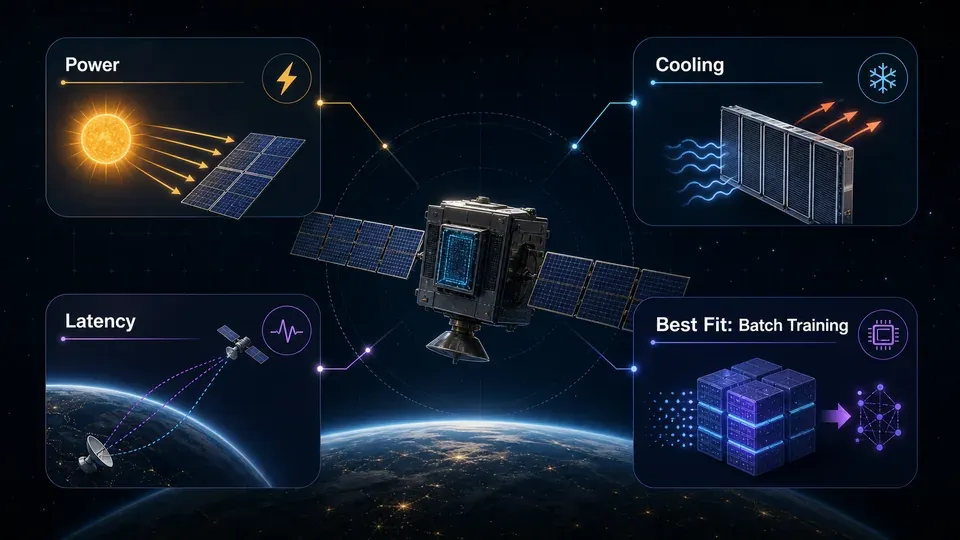
Cooling is harder than it sounds. "Infinite heat sink" is true but misleading. Radiative cooling into vacuum is slow compared with convection or evaporation on Earth — you can only shed heat as fast as radiator area allows. That's why Starcloud's design needs panels kilometers wide. Heat rejection, not power, is often the binding constraint in space.
You can't launch it in one piece. A gigawatt-scale platform, its solar arrays, and its kilometer-scale radiators can't fit in a single rocket. It has to be assembled in orbit — requiring in-space servicing, assembly, and manufacturing capabilities that barely exist today.
The environment is hostile. Radiation degrades chips faster than on the ground. Micrometeoroids and orbital debris threaten large, fragile structures. And maintenance means either robotic servicing or writing off failed hardware — there's no data-center technician swapping a drive.
Latency and data. Getting training data up and results down means enormous bandwidth. For latency-sensitive inference, a round trip to orbit is a real penalty; space compute fits batch training and non-urgent workloads far better than real-time serving.
Weigh it honestly and a nuanced picture emerges: for energy-hungry, latency-tolerant batch training, orbit's free solar power and passive cooling could genuinely beat a grid-and-water-constrained Earth someday. For low-latency inference, the physics fights you. SpaceX's own "may not be commercially viable" admission is the most honest line in the whole story — this is a real research frontier, not a product you'll rent next year.
## Frequently Asked Questions
Is SpaceX really building data centers in space? It filed with the FCC in January 2026 for up to one million solar-powered "orbital data center" satellites. But it requested a waiver of deployment-milestone rules and has said the economics may not yet be commercially viable — so it's a filing and an ambition, not a committed build.
Has anyone actually run AI compute in orbit? Yes. Starcloud launched an Nvidia H100 GPU on a satellite in late 2025 and trained a small model (NanoGPT) in orbit — the first model trained in space. It's a proof of concept, not a commercial data center.
Why put data centers in space at all? To escape Earth's three bottlenecks: limited grid power, water use for cooling, and land/community opposition. Orbit offers near-constant solar power and radiative cooling into vacuum, with no local neighbors.
What's the hardest technical problem? Cooling and assembly. Radiative cooling is slow, so you need kilometer-scale radiators — which, along with the compute and solar arrays, can't launch in one piece and must be assembled in orbit. Radiation and debris add reliability risks.
When could this be real? Batch AI training in orbit is a genuine research frontier that could mature over years, not months. Low-latency inference is a poor fit for space because of the round-trip delay. Treat near-term claims of "space data centers" as experiments, not services.
Key Takeaways
- The AI build-out is hitting power, water, and land limits on Earth — the core reason players are looking to orbit.
- SpaceX filed with the FCC (Jan 2026) for up to 1 million solar-powered data-center satellites, but requested a milestone waiver and admits it may not be commercially viable yet.
- Starcloud already trained a model on an Nvidia H100 in orbit, raised $170M at a $1.1B valuation, and targets a 5-GW platform; Google's Project Suncatcher and Blue Origin are also in the race.
- Orbit's real edges are constant solar power and radiative cooling (no water) — but slow heat rejection, in-space assembly, radiation, and debris are hard, non-software problems.
- Best near-term fit: latency-tolerant batch training, not real-time inference. It's a research frontier, not a service you'll rent soon.
How this was written Research and a first draft came together with AI's help; verification and the final pass were entirely human.
References
- NVIDIA Blog: "How Starcloud Is Bringing Data Centers to Outer Space" — https://blogs.nvidia.com/blog/starcloud/
- CNBC: "Nvidia-backed Starcloud trains first AI model in space, orbital data centers" — https://www.cnbc.com/2025/12/10/nvidia-backed-starcloud-trains-first-ai-model-in-space-orbital-data-centers.html
- DataCenterDynamics: "SpaceX files for million satellite orbital AI data center megaconstellation" — https://www.datacenterdynamics.com/en/news/spacex-files-for-million-satellite-orbital-ai-data-center-megaconstellation/
- Space.com: "Elon Musk wants to put 1 million AI satellites in space. Here's how SpaceX could do it" — https://www.space.com/space-exploration/satellites/elon-musk-wants-to-put-1-million-ai-satellites-in-space-heres-how-spacex-could-do-it
- GeekWire: "Orbital AI: Seattle-area startup Starcloud hits $1.1B valuation to build space-based data centers" — https://www.geekwire.com/2026/orbital-ai-seattle-area-startup-starcloud-hits-1-1b-valuation-to-build-space-based-data-centers/
- Bloomberg: "SpaceX and Blue Origin Are Planning Data Centers in Space" — https://www.bloomberg.com/features/2026-space-data-centers/
Comments ()