Why Defense Stocks Keep Hitting Records in 2026: A $2.9 Trillion, 5%-of-GDP Tailwind

Defense stocks are hitting fresh records in 2026, and it isn't one headline driving it — it's three tailwinds stacking. World military spending hit a record ~$2.9 trillion in 2025 (per SIPRI), NATO committed to lifting defense budgets to 5% of GDP by 2035, and — for the first time — the Pentagon carved out a dedicated $13.4 billion budget line just for autonomy and AI. The iShares U.S. Aerospace & Defense ETF (ITA) is up roughly 13.7% year-to-date and touched a new intraday record. Here's what's actually behind the run, and the one question every buyer should ask before chasing it.
When a sector keeps making new highs, the useful question isn't "is it going up" but "what's the engine, and is the engine durable." Defense has a genuinely different setup right now than most momentum trades: the buyers are governments, the budgets are multi-year commitments, and a brand-new spending category — battlefield AI — is being funded for the first time. This piece breaks the rally into its three drivers, decodes what NATO's 5% pledge really means, and lays out the bear case so you can judge the trade honestly rather than on vibes.
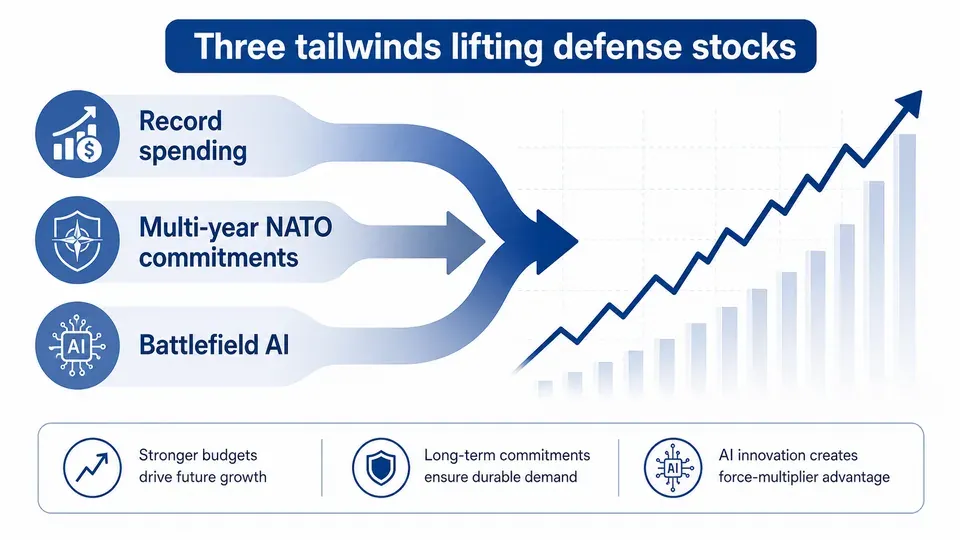
Three tailwinds, stacking at once
Most sector rallies rest on a single story. This one has three, and they reinforce each other.
1. Record global spending. The Stockholm International Peace Research Institute (SIPRI) counted $2,887 billion — roughly $2.9 trillion — in world military expenditure for 2025, a 2.9% real increase over 2024 and an all-time record. This is the baseline: the total pie is bigger than it has ever been.
2. Binding political commitments. At the 2025 Hague summit, NATO allies agreed to raise defense spending to 5% of GDP by 2035 (more on the structure below). And for the first time, all 31 NATO allies with a defense budget met the older 2% of GDP commitment in 2025 — with European allies and Canada lifting spending about 20% year-over-year. These aren't forecasts; they're pledges with timelines.
3. A new category: battlefield AI. The race to put autonomy, drones, and AI-driven intelligence into the field created spending that barely existed as a distinct line a few years ago. The Pentagon's fiscal 2026 request gives autonomy its own dedicated budget section for the first time — a structural signal, not just a bigger number.
Stack those and you get why the tape looks the way it does. The iShares U.S. Aerospace & Defense ETF (ITA) — BlackRock's fund tracking large and small U.S. aerospace and defense names, holding names like GE Aerospace, Boeing, RTX, and Howmet across 47 holdings and about $13.5 billion in assets — reached its first intraday record high in four months and sits up roughly 13.7% year-to-date.
## NATO's 5% pledge, decoded
The "5% of GDP" number gets thrown around as if it's one giant weapons budget. It isn't — and understanding the split matters for which companies benefit.
At the Hague summit, allies agreed the 5% target breaks into two buckets:
- 3.5% of GDP for "core defence requirements" — the traditional stuff: hardware, personnel, munitions, meeting NATO capability targets. This is the bucket that flows most directly to prime contractors and weapons makers.
- 1.5% of GDP for broader defence- and security-related investments — protecting critical infrastructure, defending networks, civil preparedness and resilience, innovation, and strengthening the defense industrial base.
That second bucket is the quiet story. A lot of it is dual-use — cybersecurity, infrastructure hardening, industrial capacity — which widens the set of beneficiaries well beyond classic tank-and-jet makers into software, networking, and infrastructure. And because the target runs to 2035, it frames a decade of rising budgets rather than a one-year bump. For investors, "multi-year policy floor" is a very different quality of tailwind than "this quarter's headline."
The new line item: AI and autonomy get their own budget
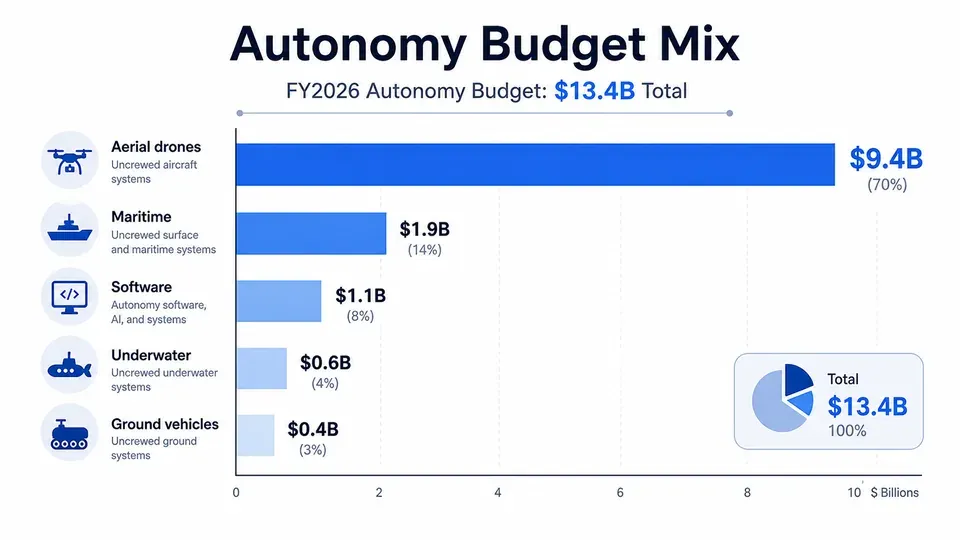
The most structurally interesting shift is the smallest number. In its fiscal 2026 request, the Pentagon carved out $13.4 billion specifically for autonomy — a category that until this year lived scattered across dozens of separate program lines. Giving it a dedicated section is how bureaucracies signal a category has graduated from experiment to priority.
Here's where that money goes:
| Autonomy segment (Pentagon FY2026 request) | Amount |
|---|---|
| Unmanned / remotely operated aerial vehicles | $9.4 billion |
| Maritime autonomous systems | $1.7 billion |
| Supporting software & cross-domain integration | $1.2 billion |
| Underwater capabilities | $734 million |
| Autonomous ground vehicles | $210 million |
Two things stand out. First, aerial drones dominate — $9.4B of the $13.4B — reflecting how central unmanned aircraft have become to modern doctrine. Second, there's a real software line ($1.2B for integration), which is why AI-software names get pulled into the defense trade at all. Palantir, for instance, accounts for roughly 6% of one major defense ETF, giving that fund direct exposure to AI-driven battlefield intelligence and logistics rather than just metal-bending. Broader estimates put AI-enabled battlefield technology at around $2 trillion in cumulative spending across North America, Europe, and Asia — a pool that spans hardware and software both.
All of this sits inside a much larger envelope: the FY2026 national defense budget runs to roughly $1.01 trillion, about 13% above the prior year's enacted level. The autonomy line is small against that total — which is exactly why its dedicated status matters more than its size. It's the seed line, not the harvest.
## How investors are playing it — and the bear case
The most common way to express the theme is broad rather than single-stock: sector ETFs like ITA spread exposure across primes (aerospace, missiles, shipbuilding) so no single contract or earnings miss sinks the position. Funds with a heavier software tilt lean more toward the AI-battlefield angle. The appeal is the buyer profile: governments don't cancel multi-year procurement when the consumer gets nervous, which makes defense revenue less cyclical than most equity themes.
But records cut both ways, and the honest bear case is real:
- Pledges aren't cash. A 5%-by-2035 commitment is a political promise across many governments and many elections. Budgets get watered down, delayed, or reprioritized — the gap between "agreed target" and "appropriated money" can be wide.
- Valuations already price optimism. After a strong run, a lot of the good news may be in the price. New highs mean you're paying up, not buying a dip — and individual defense names have pulled back sharply from peaks before even as the theme stayed intact.
- Peace is a risk to this trade. It's uncomfortable to say, but the thesis is partly a bet that geopolitical tension persists. Genuine de-escalation would undercut the urgency funding the whole rally.
- Execution and politics. Procurement is slow, programs get cut, and defense budgets are perennial political footballs. The category can be right and a specific stock still disappoint.
The balanced read: the drivers here are unusually durable for a momentum sector — record budgets, a decade-long policy floor, and a brand-new AI category all pulling the same direction. That's a stronger engine than a typical hot-sector run. But "durable tailwind" and "cheap entry point" are not the same thing, and at record highs the second one is the harder question to answer.
Frequently Asked Questions (FAQ)
Why are defense stocks going up in 2026? Three stacking drivers: record global military spending (~$2.9T in 2025 per SIPRI), NATO's pledge to reach 5% of GDP by 2035, and new dedicated funding for battlefield AI and autonomy — including a first-ever $13.4B Pentagon autonomy line.
What does NATO's 5% target actually mean? It splits into 3.5% of GDP for core defense (hardware, personnel, munitions) and 1.5% for broader security investments (infrastructure, networks, industrial base), to be reached by 2035 — a multi-year commitment, not a one-time increase.
How can I invest in the defense theme? Many investors use sector ETFs like the iShares U.S. Aerospace & Defense ETF (ITA) for diversified exposure rather than betting on a single contractor. Funds with a software tilt add more exposure to the AI-battlefield angle. This is context, not investment advice — do your own due diligence.
Is it too late to buy defense stocks? The tailwinds (multi-year budgets, policy floors, new AI spending) are durable, but the sector is at record highs, so a lot of optimism is already priced in. Durable theme and cheap entry are different questions.
What's the biggest risk to the defense trade? That pledges don't convert to appropriated cash, that rich valuations disappoint, or that genuine geopolitical de-escalation removes the urgency behind the spending.
Key Takeaways
- Defense stocks are hitting records on three stacked tailwinds, not one — record spending, NATO's 5% pledge, and new battlefield-AI budgets.
- World military spending reached a record ~$2.9 trillion in 2025 (+2.9% real, per SIPRI); NATO targets 5% of GDP by 2035 (3.5% core + 1.5% broader).
- For the first time, the Pentagon gave autonomy its own $13.4B budget line — dominated by $9.4B for aerial drones — inside a ~$1.01 trillion total request.
- ITA, a leading defense ETF, is up roughly 13.7% YTD and hit a new intraday record; software names like Palantir ride the AI-battlefield angle.
- The bear case is real: pledges aren't appropriated cash, valuations are rich at record highs, and the thesis quietly assumes tensions persist.
How this was written Research and a first draft came together with AI's help; verification and the final pass were entirely human.
References
- Yahoo Finance: "Defense stocks surge as governments boost spending on weapons, AI battlefield technology" — https://finance.yahoo.com/markets/article/defense-stocks-surge-as-governments-boost-spending-on-weapons-ai-battlefield-technology-132142444.html
- NATO: "Defence investment and NATO's 5% commitment" — https://www.nato.int/en/what-we-do/introduction-to-nato/defence-expenditures-and-natos-5-commitment
- CNBC: "NATO allies agree to higher 5% defense spending target" — https://www.cnbc.com/2025/06/25/nato-allies-agree-to-higher-5percent-defense-spending-target.html
- CDO Magazine: "Pentagon Seeks $13.4 bn for AI and Autonomy FY 2026 Budget Request" — https://www.cdomagazine.tech/us-federal-news-bureau/pentagon-seeks-13-4-bn-for-ai-and-autonomy-fy-2026-budget-request
- MeriTalk: "Pentagon Unveils $1.01T FY2026 Budget with Cyber, Space, AI Focus" — https://www.meritalk.com/articles/pentagon-unveils-1-01t-fy2026-budget-with-cyber-space-ai-focus/
- 24/7 Wall St.: "3 Defense ETFs to Buy as NATO Spending Hits Record Highs in 2026" — https://247wallst.com/investing/2026/04/16/3-defense-etfs-to-buy-as-nato-spending-hits-record-highs-in-2026/



Comments ()