Washington Owns 9.9% of Intel and Stakes in 4 More Companies. Is Big AI Next?
Washington Owns 9.9% of Intel and Stakes in 4 More Companies. Is Big AI Next?
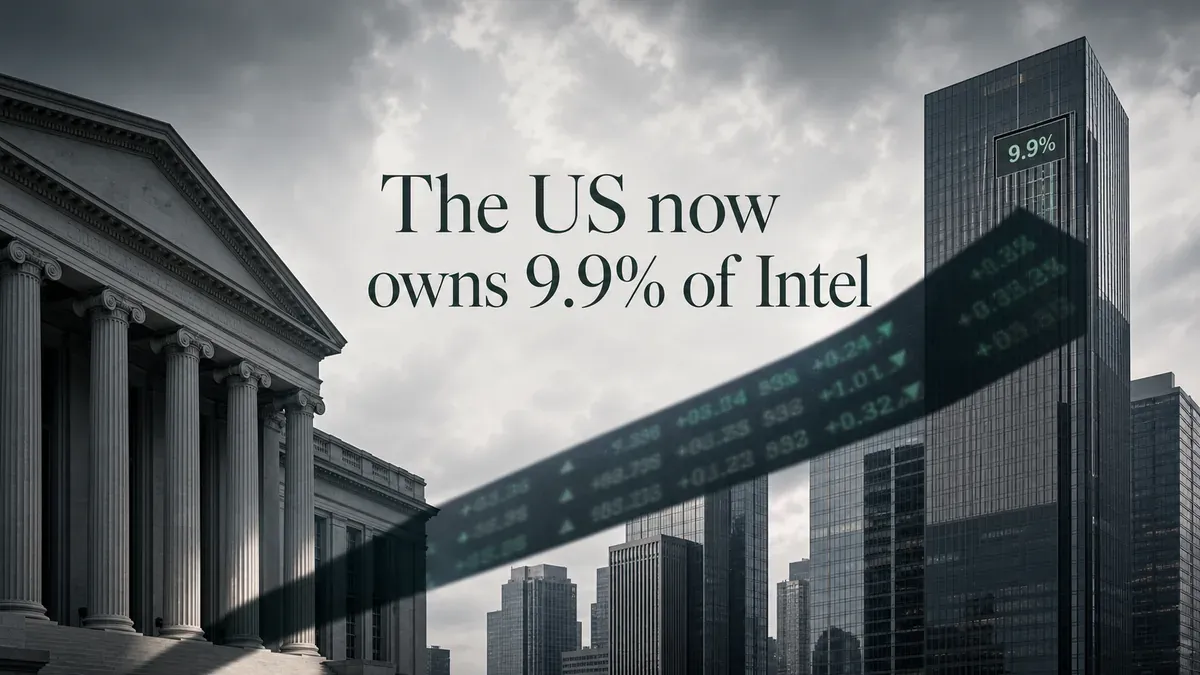
Since mid-2025 the U.S. government has taken direct equity in at least five public companies — including a 9.9% stake in Intel worth $8.9 billion. Now officials are openly weighing stakes in frontier AI firms, and OpenAI has reportedly floated 5%. Here is what Washington actually owns, why it's doing it, and what a government stake in Big AI would really mean.
For most of modern American history, the government's relationship with big companies ran through taxes, subsidies, and regulation — not ownership. That line has moved. Starting in 2025, the U.S. government began taking direct equity stakes in private companies, and by mid-2026 it holds positions in at least five public firms. The marquee example: a 9.9% stake in Intel, an $8.9 billion position. Now the same playbook is being pointed at artificial intelligence — with the administration signaling interest in stakes in "all the big" AI companies and OpenAI reportedly weighing an offer of about 5%. This post lays out exactly what the government owns, the logic behind it, and the case for and against extending it to AI.
What the government actually owns now
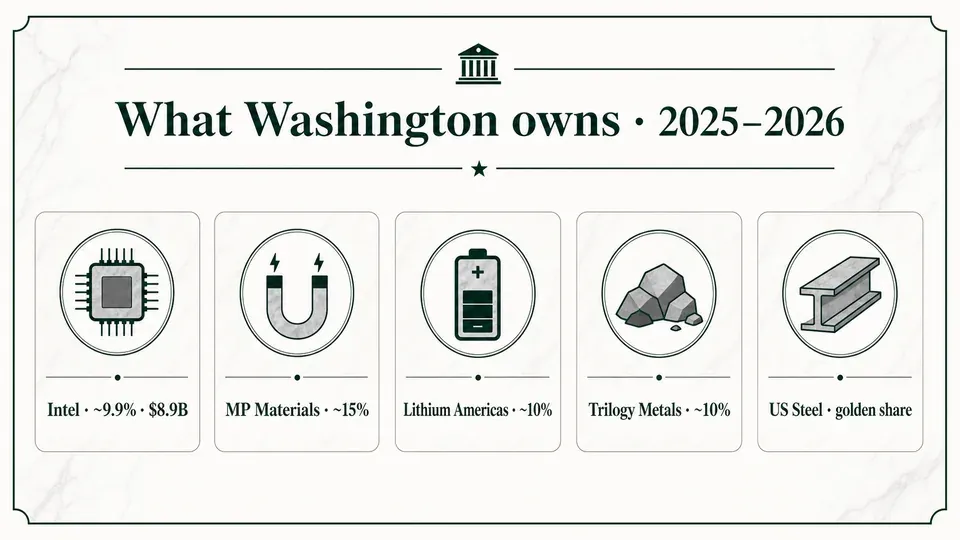
This is not a vague trend; it is a concrete and growing portfolio. The stakes were built through different mechanisms — converting grants to equity, defense partnerships, loan restructurings — but the direction is one-way.
| Company | Stake | Value / terms | Mechanism (date) |
|---|---|---|---|
| Intel (INTC) | ~9.9% | $8.9B; 433.3M shares at $20.47 | CHIPS Act grants converted to equity (Aug 22, 2025) |
| MP Materials (MP) | ~15% | Potentially largest shareholder | Dept. of Defense partnership (Jul 11, 2025) |
| Lithium Americas (LAC) | ~10% | Part of $2.26B loan restructuring | Federal loan deal (Oct 1, 2025) |
| Trilogy Metals (TMQ) | ~10% (+7.5% warrants) | ~$35.6M | White House direct investment |
| U.S. Steel | "Golden share" | Veto over HQ moves, offshoring, closures | Nippon Steel deal (Jun 18, 2025) |
Two details matter. First, the Intel stake was explicitly structured as passive — no board seats, no governance rights — and funded by converting $5.7 billion in remaining CHIPS Act grants plus $3.2 billion from a separate program, rather than fresh cash. It's a repackaging of money Intel was already promised, into ownership. Second, the U.S. Steel "golden share" is a different animal entirely: not a financial stake but a permanent veto over the company's biggest strategic decisions. Together they show the toolkit's range — from passive investor to strategic gatekeeper.
## Why is Washington doing this?
The stated logic is national security dressed as investment. Every company on that list sits on a supply chain the U.S. worries about controlling: advanced chips (Intel), rare earths (MP Materials), lithium for batteries (Lithium Americas), copper-zinc (Trilogy), and steel (U.S. Steel). The through-line is countering Chinese dominance in strategically critical materials and manufacturing, and keeping production onshore.
But there's a second, less-discussed motive that connects directly to the AI debate: capturing upside for the taxpayer. If the government is going to pour subsidies and loans into these industries anyway, equity means that when the companies succeed, the public treasury benefits — not just the private shareholders. The administration has framed potential AI stakes around exactly this idea: arranging things so ordinary Americans "can benefit from the success of AI." That is, whether you like it or not, a sovereign-wealth-fund instinct — using state ownership to socialize some of a boom's gains.
That instinct is worth pausing on, because it arrives from an unexpected direction. A voluntary government equity stake pursued by a Republican administration and a forced 50% public stake pushed by Senator Bernie Sanders are political opposites in style — but both answer the same question: should the public own a slice of the companies capturing the AI windfall? We mapped the compulsory version in our piece on the AI sovereign wealth fund 69% of Americans said they'd back. The equity-stakes playbook is the market-friendlier cousin of the same idea.
Is Big AI next — and what would it mean?
The signals are explicit. The administration has said it expects to meet with "all the big ones," and reporting indicates OpenAI has considered offering the government roughly a 5% stake, with Sam Altman in preliminary talks about distributing AI gains to the public. Nothing is finalized, and these figures are reported, not official — but the direction of travel is clear.
If it happens, here's what a government stake in a frontier AI lab would actually change:
- Aligned incentives — and a conflict of interest. If the Treasury owns 5% of a leading AI company, the government profits when that company wins. That aligns the state with AI success — but it also makes the regulator a shareholder. The body writing AI safety and antitrust rules would have a direct financial stake in the outcome. That is the sharpest objection, and it is not a small one.
- A revenue stream, realistically modest at first. A 5% stake is a claim on future value, not a cash windfall today — most frontier labs are deeply unprofitable. The public benefit shows up years out, if the company both survives and eventually pays out.
- A precedent that's hard to reverse. Once the government is a shareholder in the most powerful AI firms, unwinding that is politically and financially messy. The "temporary, strategic" framing tends to become permanent.
The strongest case for it is simple: AI may generate enormous concentrated wealth off a foundation of public data, public research, and public disruption, and equity is a clean way to route some of that back to citizens. The strongest case against is equally simple: a government that owns the companies it regulates has compromised its ability to regulate them. Both are true at once, which is why this is the debate to watch rather than a settled question.

## Frequently Asked Questions
How much of Intel does the U.S. government own? About 9.9% — an $8.9 billion stake (433.3 million shares at $20.47), created in August 2025 by converting remaining CHIPS Act grants and other funds into equity. It's a passive stake with no board seats.
Which companies does the government hold stakes in? At least five: Intel (~9.9%), MP Materials (~15%), Lithium Americas (~10%), Trilogy Metals (~10% plus warrants), and a "golden share" in U.S. Steel that grants veto power over major decisions.
Is the government actually going to take a stake in AI companies? It's under active discussion, not done. Officials have signaled interest, and OpenAI has reportedly weighed offering about 5%. Treat specific figures as reported, not finalized.
Why take equity instead of just giving subsidies? Two reasons: national-security control of critical supply chains, and capturing financial upside for taxpayers so the public — not only private shareholders — benefits when subsidized companies succeed.
What's the main risk of a government AI stake? Conflict of interest. If the government owns part of the AI firms it also regulates for safety and competition, its role as a neutral referee is compromised.
Key Takeaways
- Since 2025 the U.S. government has taken direct equity in at least five public companies, headlined by a 9.9% / $8.9B stake in Intel.
- The stakes span strategic supply chains — chips, rare earths, lithium, copper, steel — and are justified mainly as countering China and onshoring.
- A second motive, capturing upside for taxpayers, is a sovereign-wealth instinct that mirrors (from the opposite political direction) forced-public-stake proposals.
- Big AI is openly in scope: officials want to meet "all the big ones," and OpenAI has reportedly weighed offering ~5%.
- The core tension: a government stake aligns the state with AI success but turns the regulator into a shareholder — a real conflict of interest.
How this was written AI helped research this piece, but every source, fact, and sentence was checked and finalized by hand.
References
- Benzinga, "Trump Administration Now Holds Stakes In 5 Public Companies: Here's A List—INTC, MP, LAC And More": https://www.benzinga.com/markets/equities/25/10/48061018/trump-administration-now-holds-stakes-in-5-public-companies-heres-a-list-intc-mp-lac-and-more
- Yahoo Finance, "Intel announces $8.9 billion investment from US government, which will own 9.9% of chipmaker": https://finance.yahoo.com/news/intel-announces-89-billion-investment-from-us-government-which-will-own-99-of-chipmaker-180452175.html
- Intel Newsroom, "Intel and Trump Administration Reach Historic Agreement…" (Aug 22, 2025): https://newsroom.intel.com/corporate/intel-and-trump-administration-reach-historic-agreement
- Fortune, "Trump's new corporate playbook: Why the administration is taking equity stakes in companies like Intel": https://fortune.com/2026/05/18/trump-corporate-playbook-administration-equity-stakes-companies-intel/
- The Washington Post, "Trump says he's considering government stake in top AI companies" (June 5, 2026): https://www.washingtonpost.com/politics/2026/06/05/tech-leaders-will-discuss-government-stakes-top-ai-firms-trump-says/

Comments ()