200 Economists, 16 Nobel Laureates, and the 4% Warning Sign in AI Jobs Data
200 Economists, 16 Nobel Laureates, and the 4% Warning Sign in AI Jobs Data
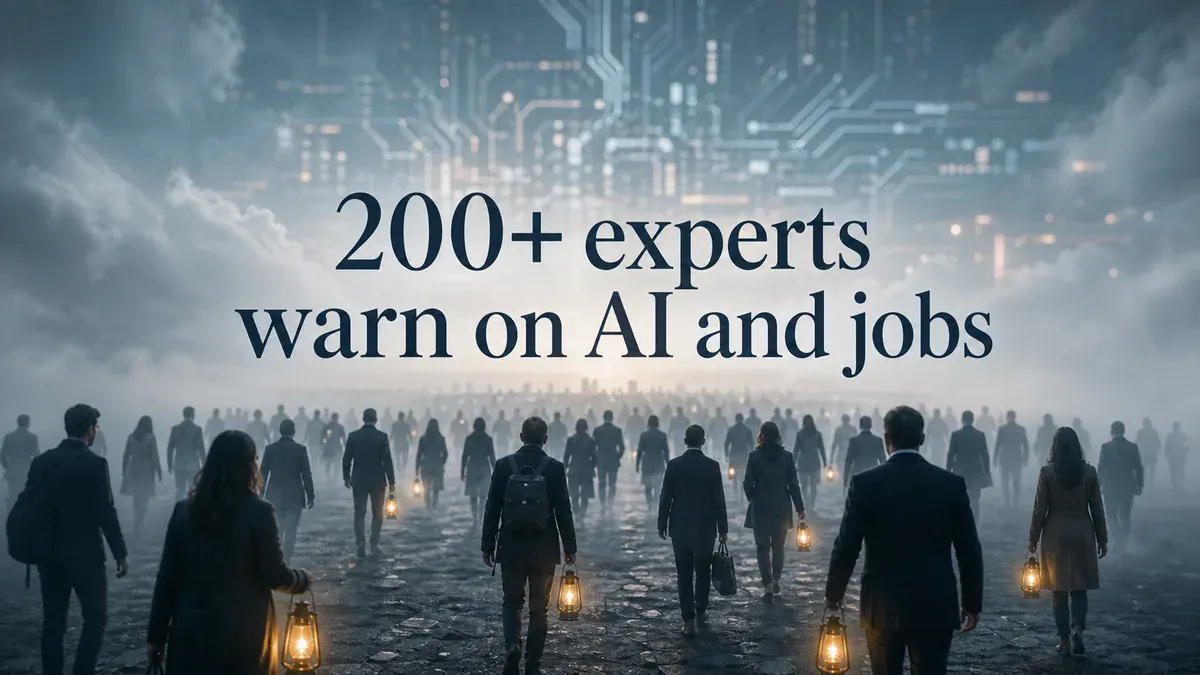
On July 13, 2026, more than 200 economists and AI researchers — including 16 Nobel laureates — released "We Must Act Now," warning that AI could reshape the economy faster than the Industrial Revolution. Here is what the statement actually claims, the real jobs data behind it, and the awkward gap it leaves: urgency without a single concrete policy.
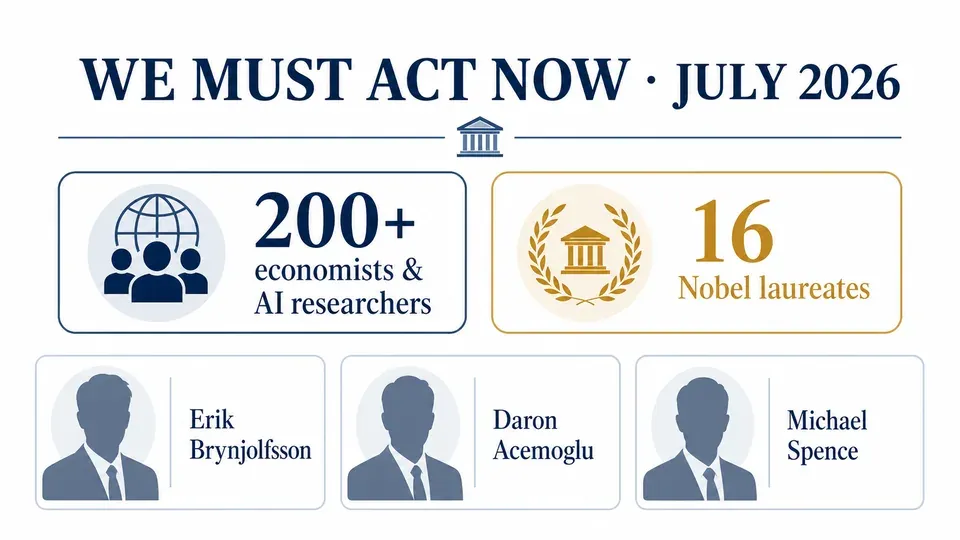
Economists almost never agree on anything, so when 16 Nobel laureates and more than 200 researchers sign the same one-page warning, it is worth reading carefully. On July 13, 2026, the group published "We Must Act Now: A Statement on AI's Transformation of the Economy," organized through Stanford's Digital Economy Lab. The headline claim is stark: AI "may give us only a few years" to adapt to a shift that took "steam, electricity, and computers" decades. But a warning is only as useful as what it asks you to do — and this is where the statement gets interesting, and frustrating. This post breaks down who signed, the actual data driving the alarm, and why the letter stops short of naming solutions.
What the statement actually says
Strip out the drama and the letter makes three moves. First, it argues AI "may become radically more powerful over the next 10 years" and could drive a transformation "larger than the Industrial Revolution, but unfolding over a vastly shorter time frame." Second, it names both sides of the ledger — "large-scale job displacement" as a risk, "major gains in living standards" as an opportunity. Third, it calls on economists, policymakers, and technology leaders to deepen research and build "incentives, guardrails, and institutions" so AI complements rather than replaces workers.
The signatory list is the real weight here. It spans people who usually disagree sharply:
| Signatory | Affiliation | Notable for |
|---|---|---|
| Erik Brynjolfsson | Stanford (organizer) | Long-run productivity and AI research |
| Daron Acemoglu | MIT, Nobel laureate | Longtime AI-hype skeptic |
| Michael Spence | NYU, Nobel laureate | Information economics |
| Simon Johnson | MIT, Nobel laureate | Institutions and growth |
| Anton Korinek | UVA / Anthropic (organizer) | AI and economic policy |
The most telling name is Daron Acemoglu. He has spent years arguing that much AI-productivity talk was overblown — he once dismissed a chunk of the discourse as "brainless." His signature signals a genuine shift: the skeptics are no longer confident the disruption is small. That is what makes this letter different from the usual round of AI alarms.
## The 4% signal already in the data
The alarm is not purely theoretical. Brynjolfsson's Canaries Dashboard — which tracks about 4.6 million workers across 730+ occupations — shows an early, concrete warning sign: employment for workers aged 22–25 in the most AI-exposed roles is shrinking more than 4% a year, even while the aggregate labor market looks stable.
That divergence is the whole story in one statistic. Headline unemployment can stay calm while a specific slice — young people entering exactly the jobs AI does first, like entry-level coding, support, and analysis — quietly erodes. Downturns often show up at the edges before they show up in the average, and "young workers in exposed occupations" is precisely the edge you would expect AI to hit first. It is not proof of a jobs apocalypse. It is a canary, which is exactly what the dashboard is named for.
Here is the honest complication, and the letter's own signatories admit it: the measurement is a mess. Economist Torsten Slok has identified five competing "AI exposure" frameworks that produce conflicting results — and they disagree most "exactly where the stakes are highest," for jobs like telemarketers, tax preparers, and writers. Theoretical exposure runs systematically higher than real-world adoption, because models on a benchmark ignore the messy cost of actually deploying them inside a company. So the 4% youth signal is real and worth watching, but the wider map of "which jobs, how fast" is genuinely contested.
The awkward gap: urgency without answers
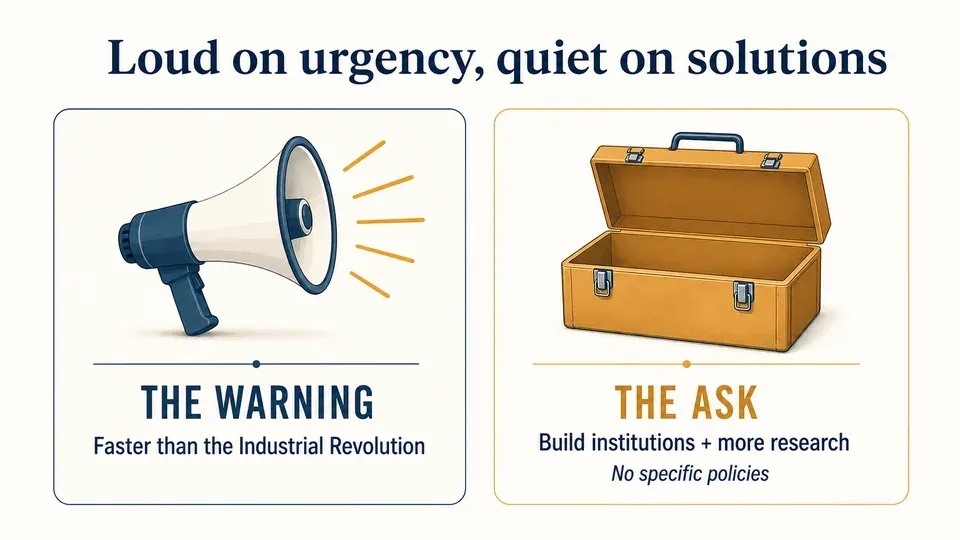
Read the statement to the end and you hit the catch. For all its force, it offers no specific policy solutions — only a call to build "institutions" and do more research. Organizer Anton Korinek put the honesty plainly: "We are driving in the fog, and it is extraordinarily difficult to anticipate what will happen next."
That is intellectually respectable and practically unsatisfying at the same time. It is respectable because pretending to certainty you don't have is how bad policy gets made. It is unsatisfying because "act now" and "we have no specific proposals" sit uneasily together — act how?
This is where the contrast with concrete proposals sharpens. Just this summer, a separate camp put forward specific — and controversial — mechanisms for sharing AI's gains, from public equity stakes to sovereign-wealth-style funds. (For one much-debated version, see our breakdown of the AI sovereign wealth fund that 69% of Americans said they'd support.) The economists' letter deliberately does not endorse any of those. It is a call to start building the toolkit, not a toolkit. Whether that restraint reads as wisdom or as a dodge depends on how much time you think "a few years" really leaves.
## What it means for you
You don't need to resolve an economists' debate to act on the useful parts:
- Watch the entry-level edge, not the headline. If you are early-career or hiring early-career talent in an AI-exposed field, the aggregate unemployment rate will hide the trend that matters to you. The youth-exposure signal is the leading indicator to track.
- Treat single "AI exposure" rankings with suspicion. With five frameworks disagreeing, any confident list of "the 20 jobs AI will kill" is overstating its certainty. Direction is clearer than magnitude.
- "Act now" mostly means adapt now. Since even the experts won't name policies yet, the individual-level version of "act now" is skill adjacency — moving toward work that uses AI as a tool rather than competes head-on with it.
Frequently Asked Questions
Who organized the statement and when? Stanford's Digital Economy Lab, with organizers including Erik Brynjolfsson, Ajay Agrawal, Anton Korinek, and Tom Cunningham. It was released July 13, 2026.
How many people signed, and who? More than 200 economists and AI researchers, including 16 Nobel laureates — among them Daron Acemoglu, Michael Spence, and Simon Johnson — plus some executives at companies including Anthropic, Google, and OpenAI.
What is the "4%" figure? Brynjolfsson's Canaries Dashboard (about 4.6 million workers, 730+ occupations) shows employment for workers aged 22–25 in the most AI-exposed roles shrinking more than 4% per year, even as the overall labor market looks stable.
Does the letter propose specific policies? No. It calls for more research and for building "incentives, guardrails, and institutions," but names no specific mechanism — a gap its own authors acknowledge.
Is this the same as predicting mass unemployment? No. The statement explicitly frames both risks (displacement) and opportunities (higher living standards). It argues for preparation under deep uncertainty, not a specific doomsday forecast.
Key Takeaways
- On July 13, 2026, 200+ economists and AI researchers — including 16 Nobel laureates — signed "We Must Act Now."
- The alarm has a data anchor: young workers (22–25) in AI-exposed roles are seeing employment shrink >4% a year, per Brynjolfsson's Canaries Dashboard.
- The map is contested — five competing "AI exposure" frameworks disagree most where the stakes are highest.
- The letter's biggest weakness is its honesty: it names no specific policies, only a call to build institutions and research.
- The signature that matters most is Daron Acemoglu's — a longtime skeptic now warning of near-term disruption.
How this was written Research and a first draft came together with AI's help; verification and the final pass were entirely human.
References
- Stanford Digital Economy Lab, "'We Must Act Now': Sixteen Nobel Laureates Join Leading Economists and AI Researchers…" (July 13, 2026): https://digitaleconomy.stanford.edu/news/wemustactnow/
- Fortune, "'We are driving in the fog': Hundreds of economists admit they're flying blind on AI" (July 13, 2026): https://fortune.com/2026/07/13/we-must-act-now-economists-ai-productivity-driving-in-fog-flying-blind/
- U.S. News / AP, "Hundreds of Economists Say 'We Must Act Now' on AI's Economic Impact and Job Displacement Risks" (July 13, 2026): https://www.usnews.com/news/technology/articles/2026-07-13/hundreds-of-economists-say-we-must-act-now-on-ais-economic-impact-and-job-displacement-risks
- PR Newswire (statement release): https://www.prnewswire.com/news-releases/we-must-act-now-sixteen-nobel-laureates-join-leading-economists-and-ai-researchers-in-call-to-prepare-for-ais-economic-transformation-302823418.html

Comments ()