69% Want an AI Wealth Fund: What a Public 50% Stake in Big AI Would Actually Do

69% Want an AI Wealth Fund: What a Public 50% Stake in Big AI Would Actually Do
A June 2026 survey found 69% of Americans support forcing big AI companies to hand 50% of their stock to a public fund. Senator Bernie Sanders introduced a bill to do roughly that, valued near $7 trillion. Here is what the idea actually is, what the numbers would mean per person, and why the polling is softer than it looks.
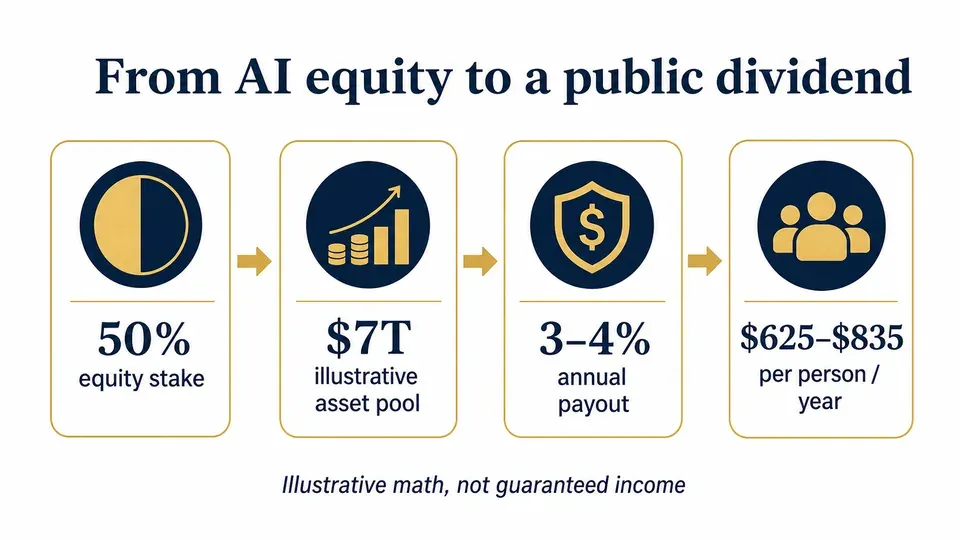
As AI-linked layoffs pile up, a once-fringe idea has gone mainstream fast: make the biggest AI companies share ownership with the public. A national survey by research firm Verasight, of 1,690 U.S. adults in June 2026, found that 69% support forcing AI firms to transfer 50% of their stock to a public sovereign wealth fund. That is not a slim majority — it is more than two out of three. In the same window, Senator Bernie Sanders introduced the American AI Sovereign Wealth Fund Act, which would give the public a 50% stake in the largest U.S. AI companies, a package reported at roughly $7 trillion. This post unpacks what a sovereign wealth fund is, what a 50% AI stake would translate to per person, and why the 69% number is more fragile than the headline suggests.
What an "AI sovereign wealth fund" actually means
A sovereign wealth fund (SWF) is a state-owned investment pool. The government owns assets — stocks, bonds, real estate — and the returns flow to public purposes. This is not a new or radical mechanism; it is how several of the world's steadiest funds already work.
| Fund | Owner | Size (approx.) | How people benefit |
|---|---|---|---|
| Norway Government Pension Fund Global | Norway | ~$1.7 trillion | Funds ~20% of the national budget |
| Alaska Permanent Fund | State of Alaska | ~$80 billion | Pays residents an annual dividend (often $1,000–$3,000+) |
| Proposed U.S. AI fund (Sanders) | U.S. public | ~$7 trillion (as framed) | 50% stake in largest AI firms; returns to the public |
The Alaska model is the one to anchor on, because Americans have lived with it since 1982: oil revenue funds a permanent investment pool, and every eligible resident gets a yearly check. The AI-fund pitch is philosophically identical, with one swap — instead of capturing the windfall from oil in the ground, it captures the windfall from AI models trained on public data and displacing public jobs. The core argument: if AI's gains concentrate in a few companies while its costs (job loss) spread across everyone, a public stake rebalances who benefits.
The mechanism in the Sanders framing is a forced equity transfer — the government would take, not buy, 50% of the largest AI companies' stock. That "forced" design is where both the appeal and the legal-economic controversy live.
## What would a 50% stake actually be worth per person?
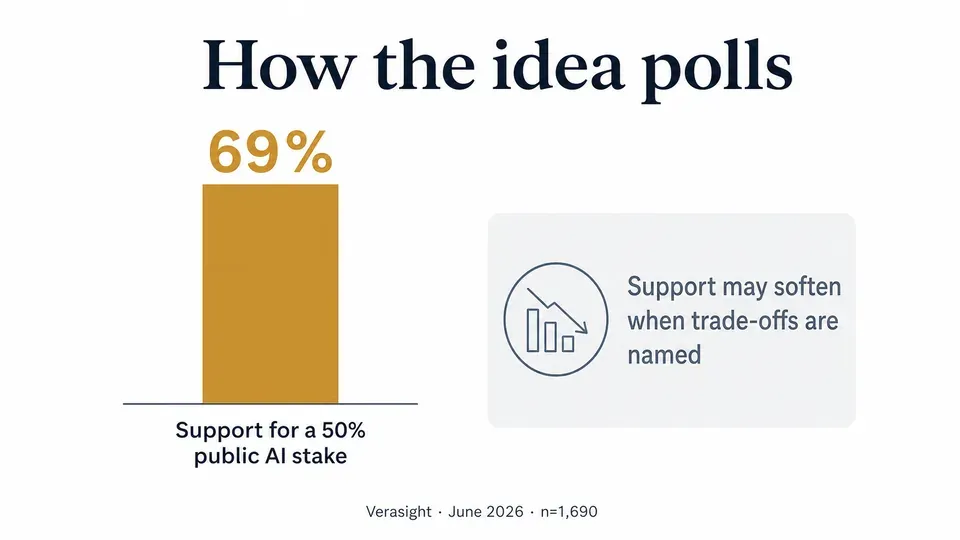
Here is where doing the arithmetic beats repeating the slogan. Take the framing's own number — roughly $7 trillion for a 50% public stake in the largest AI companies — and treat it as a rough order of magnitude, not a precise valuation (private AI company valuations swing wildly and are self-reported).
Spread across roughly 335 million Americans, $7 trillion in assets is about $20,900 per person in one-time notional wealth. But an SWF does not hand out the principal — it distributes the returns. Model it the Alaska way: if such a fund earned a sustainable payout of, say, 4% a year on $7 trillion, that is $280 billion annually, or roughly $835 per American per year — a family of four would see about $3,300 a year. At a more conservative 3% payout it is closer to $625 per person. Push the asset base down to a more defensible $3–4 trillion and the dividend falls to roughly $350–$500 per person per year.
So the honest range is: not life-changing UBI, but a meaningful Alaska-style annual dividend — somewhere between a few hundred and roughly a thousand dollars a year per person, depending entirely on the fund's true size and payout rate. Anyone promising more than that is likely inflating either the valuation or the yield. That framing matters, because a lot of the enthusiasm imagines the principal being shared rather than the returns.
## Why the 69% is softer than it looks
A two-thirds majority sounds like a mandate. It probably isn't — and the reason is a well-known polling trap. Support for abstract redistribution reliably outpolls its specifics. Ask "should AI giants share their wealth?" and approval soars. Ask "should the government seize half of a company's stock, even if it means AI investment moves to other countries?" and the number falls, sometimes sharply. Analysts of the Verasight result flagged exactly this: the word "forced," and the absence of any stated trade-off in the question, inflate the top-line figure.
The substantive objections are not trivial:
- Investment chill and offshoring. Critics argue a forced equity seizure would deter investment and push AI development to jurisdictions that don't confiscate equity. Capital is mobile; models can be trained anywhere.
- The premise may be wrong. OpenAI's Sam Altman has argued a mass "AI jobs apocalypse" is unlikely. If the labor damage is smaller than feared, a $7 trillion confiscation is a solution aimed at an overstated problem.
- Legal reality. A forced federal takeover of half of specific private companies' equity would face immediate constitutional challenges (takings, due process). Even supporters concede it is a long shot as literally written.
That said, the labor anxiety driving the poll is real, not imagined. Tech accounted for nearly one-third of U.S. layoffs in the first half of 2026, with AI increasingly named as the cause. Goldman Sachs economist Joseph Briggs estimates that more than 9% of the labor force — around 15 million workers — could lose jobs across a decade-long AI transition. Whether or not the wealth-fund mechanism survives, the pressure behind it will keep building. Sanders is not alone: Senator Ed Markey's "AI Accountability Agenda" also lists "sharing the AI wealth" as a priority.
Frequently Asked Questions
What did the survey actually find? Verasight surveyed 1,690 U.S. adults in June 2026; 69% supported forcing AI companies to transfer 50% of their stock to a public sovereign wealth fund.
What is Bernie Sanders' bill? The American AI Sovereign Wealth Fund Act, introduced in June 2026, would give the public a 50% stake in the largest U.S. AI companies. It has been framed as roughly a $7 trillion package.
How much money would an individual actually get? Not the headline trillions. Distributing returns (not principal) at a 3–4% payout on a $7 trillion fund implies roughly $625–$835 per person per year; a smaller fund implies a few hundred dollars. It resembles Alaska's dividend, not a full basic income.
Does a fund like this already exist anywhere? Yes — the Alaska Permanent Fund pays residents an annual dividend from state oil wealth, and Norway's ~$1.7 trillion fund covers a large share of its national budget. The AI proposal borrows that model.
Is it likely to pass as written? Unlikely in its literal "forced 50% transfer" form — it faces constitutional and economic objections and softer support once trade-offs are named. But the underlying pressure to "share AI's gains" is durable and bipartisan-adjacent.
Key Takeaways
- A June 2026 Verasight survey (n=1,690) found 69% support forcing AI firms to give 50% of their stock to a public fund.
- Senator Bernie Sanders' American AI Sovereign Wealth Fund Act (~$7 trillion as framed) would do roughly that; Senator Markey has a parallel priority.
- The realistic payoff is an Alaska-style dividend of roughly a few hundred to ~$835 per person per year, from returns — not the trillions in principal.
- The 69% is inflated by abstract wording; support drops once offshoring and "forced seizure" trade-offs are stated.
- The anxiety is real: tech was ~1/3 of H1-2026 U.S. layoffs, and Goldman estimates ~15 million jobs could turn over in a decade-long AI transition.
How this was written This piece was drafted with AI's research help; a human verified every fact and polished the final wording.
References
- CNBC, "Majority of U.S. workers support an AI wealth fund as tech layoffs surge, survey finds" (July 12, 2026): https://www.cnbc.com/2026/07/12/majority-of-us-workers-support-ai-fund-amid-tech-layoffs-survey.html
- The Next Web, "69% of Americans back public ownership of big AI firms": https://thenextweb.com/news/most-americans-now-say-the-public-should-own-half-of-the-big-ai-companies
- TechCrunch, "The running list: major tech layoffs in 2026 where employers cited AI" (July 6, 2026): https://techcrunch.com/2026/07/06/the-running-list-major-tech-layoffs-in-2026-where-employers-cited-ai/
- Alaska Permanent Fund Corporation (Permanent Fund Dividend background): https://apfc.org
- Norges Bank Investment Management (Government Pension Fund Global): https://www.nbim.no/en/


Comments ()