Apple vs. OpenAI: Inside the Trade-Secret Lawsuit Over a $6.5 Billion Hardware Bet
Apple vs. OpenAI: Inside the Trade-Secret Lawsuit Over a $6.5 Billion Hardware Bet
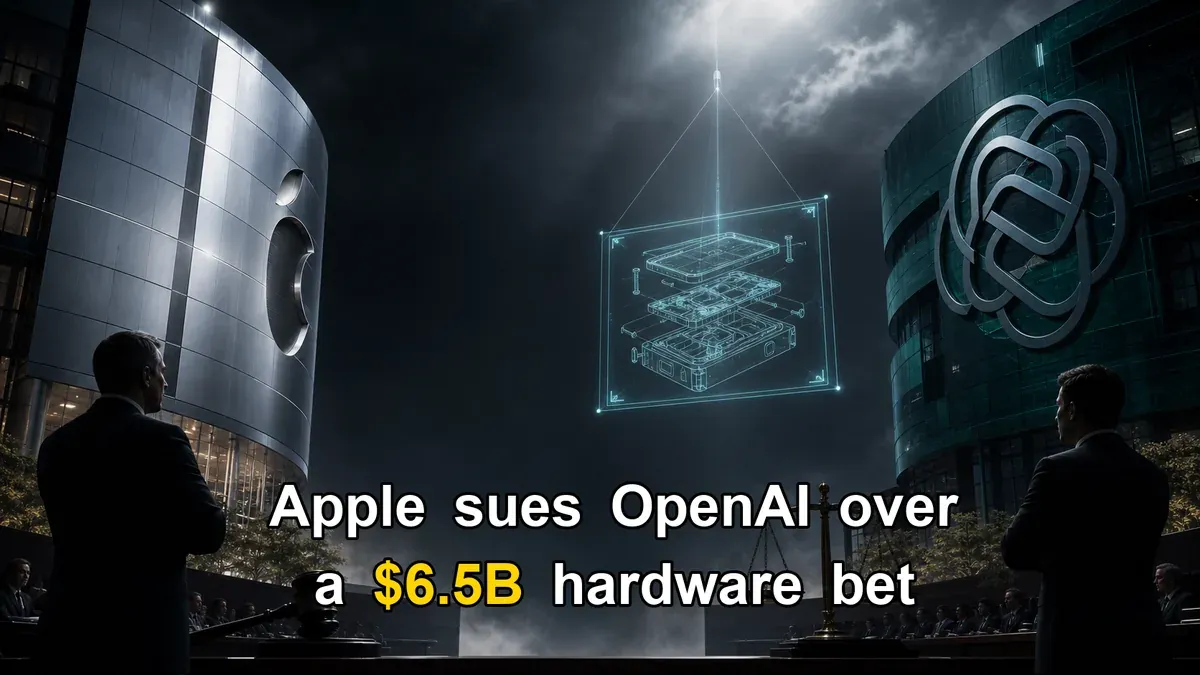
On July 10, 2026, Apple sued OpenAI in federal court, alleging a systematic pattern of trade-secret theft "at every level" as OpenAI builds its first consumer hardware. Here is what the complaint actually claims, why the $6.5 billion io acquisition sits at the center of it, and how trade-secret cases like this usually play out.
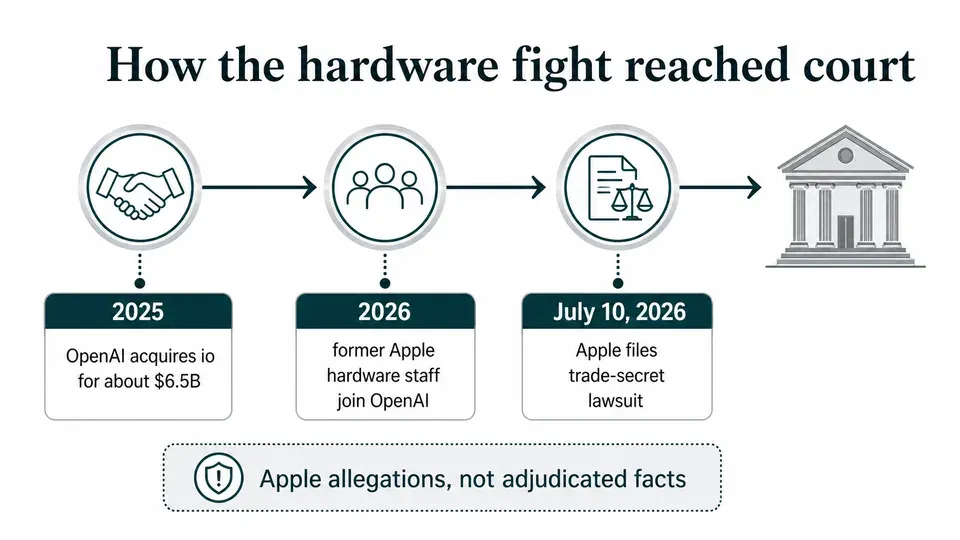
Two years ago, Apple and OpenAI were partners: ChatGPT was wired into the iPhone's operating system in a headline 2024 deal. On July 10, 2026, that relationship curdled into a lawsuit. Apple filed suit in the U.S. District Court for the Northern District of California accusing OpenAI of stealing its trade secrets to build competing hardware — a device widely reported to be an AI-native gadget aimed squarely at the iPhone. The complaint's language is unusually blunt: Apple says the theft ran "at every level, from members of its Technical Staff to its Chief Hardware Officer." This is not a patent squabble. It is an accusation that a former partner systematically raided Apple's people and files. Here is what the filing claims, and what it doesn't.
What Apple actually alleges
Strip away the drama and the complaint rests on a specific pattern of conduct, not a single stolen blueprint. Apple's core theory is that OpenAI used its hiring pipeline as an extraction machine — recruiting Apple engineers and, in the process, pulling confidential information out with them.
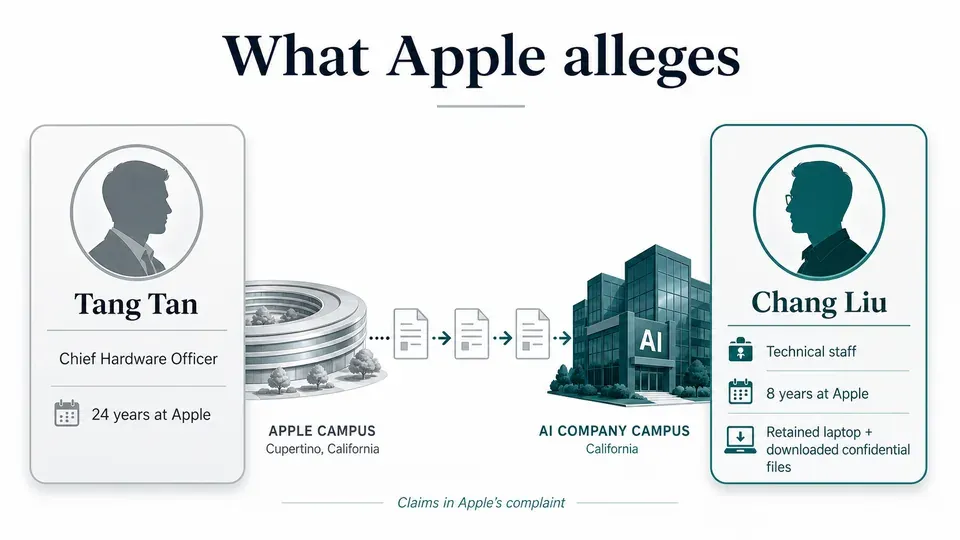
Two named individuals anchor the case:
| Person | Apple background | Role at OpenAI | Core allegation |
|---|---|---|---|
| Tang Tan | 24 years at Apple; VP of product design for iPhone and Apple Watch | Chief Hardware Officer | Allegedly directed recruiting that solicited Apple secrets, including asking candidates to bring "actual parts" from Apple to interviews |
| Chang Liu | 8 years at Apple; senior systems electrical engineer | Technical staff (hardware) | Allegedly retained an Apple-issued laptop after leaving and downloaded dozens of confidential files, many labeled confidential |
Beyond those two, Apple describes a broader playbook: using Apple's confidential project code names during recruiting, requesting candidates bring physical hardware components to interviews, coaching departing employees on how to evade Apple's exit-security procedures, and soliciting details about unreleased products. The materials at issue are described as technical specifications, engineering presentations, and proprietary data on unannounced technologies.
The remedies Apple seeks are telling. It is not primarily chasing a giant damages number in the initial filing. It asks the court to bar OpenAI from using or disclosing the trade secrets, to order the return of confidential Apple materials, and to preserve evidence. That is the profile of a company trying to stop a product before it ships, not one auctioning off a grievance.
## Why a $6.5 billion acquisition sits at the center
None of this makes sense without the hardware backstory. In 2025, OpenAI acquired io, the design startup co-founded by former Apple design chief Jony Ive, for roughly $6.5 billion. The purpose was explicit: build OpenAI's own consumer hardware. Reporting since has pointed toward a first device that leans on AI agents rather than a traditional grid of apps — a direct philosophical challenge to the smartphone Apple built its empire on.
That context reframes the lawsuit. Apple is not alleging theft of some abstract algorithm; it is alleging that a company staffing up to build an iPhone competitor did so partly by hiring the iPhone's own designers and engineers and, Apple says, their knowledge of unreleased Apple work. io itself is named in the filing, though Jony Ive personally was not accused of wrongdoing. The $6.5 billion number matters because it signals how serious OpenAI's hardware ambition is — and therefore how much Apple has to lose if a rival device ships with Apple DNA inside it.
OpenAI's response has been terse and total: "We have no interest in other companies' trade secrets." That is a denial of intent, not a line-by-line rebuttal — which is normal this early. The substantive fight happens in discovery.
## How trade-secret cases like this usually go
Here is the part news coverage tends to skip: what does Apple actually have to prove, and how do these fights resolve? Trade-secret suits in California run on two tracks — the federal Defend Trade Secrets Act (DTSA) and California's Uniform Trade Secrets Act (CUTSA). Under both, a plaintiff must show three things:
- A real trade secret — information that has independent economic value because it is secret (not just "internal" or embarrassing to lose).
- Reasonable secrecy measures — Apple's famous security culture, NDAs, and access controls help here.
- Misappropriation — acquisition by improper means, or use/disclosure of the secret.
The hardest of the three is usually the first and third together: proving the specific secret and proving it was actually used, not just that ex-employees carry general skill in their heads. Employees are legally allowed to change jobs and use their general expertise; they are not allowed to take specific confidential files. That line — "general know-how" versus "identifiable trade secret" — is where most of these cases are won or lost.
The most instructive precedent is Waymo v. Uber (2017), where Alphabet's self-driving unit accused Uber of trade-secret theft after a star engineer downloaded thousands of files before leaving. That case, despite explosive allegations, settled in 2018 — Uber handed Waymo an equity stake reported around $245 million and agreed not to use the disputed technology. The pattern is common: blockbuster filing, brutal discovery, then a settlement with equity and behavioral restrictions rather than a jury verdict. Apple's demand to bar use and return materials fits that template. A negotiated outcome that constrains OpenAI's device is a more likely endpoint than a courtroom drama.
What it means for the industry — and for you
For readers watching the AI race, three practical takeaways:
- Talent is now the frontier, and the frontier is litigated. The scarce resource in AI hardware is people who have shipped complex consumer devices — and almost all of them learned at a handful of companies. Expect more suits as AI labs poach from Apple, Google, and Meta. The "at every level" framing signals Apple wants to make an example, not just win one case.
- A denial isn't a defense yet. OpenAI's one-line statement tells you nothing about the merits. Watch for the discovery fight over that laptop and those downloaded files — forensic evidence of what was accessed is what actually moves these cases.
- The likely ending is a leash, not a knockout. If history rhymes, this ends in a settlement that restricts how OpenAI can build its device and possibly transfers value to Apple — not in OpenAI's hardware program being erased. The interesting question is how much a settlement would slow the first OpenAI device.
Frequently Asked Questions
When and where did Apple file the lawsuit? On Friday, July 10, 2026, in the U.S. District Court for the Northern District of California.
Who are Tang Tan and Chang Liu? Tang Tan is OpenAI's Chief Hardware Officer and spent 24 years at Apple as a VP of product design. Chang Liu is an OpenAI hardware staffer who spent 8 years at Apple as a senior systems electrical engineer. Both are named in Apple's complaint.
What does the $6.5 billion figure refer to? It is the reported price OpenAI paid in 2025 to acquire io, Jony Ive's design startup, to build its own consumer hardware. It is not a damages figure from the lawsuit.
Is Jony Ive being sued? His startup io is named in the filing, but Ive personally was not accused of wrongdoing in the reporting on the complaint.
How do these cases usually end? Trade-secret suits between large companies frequently settle after discovery. Waymo v. Uber, the closest analog, settled in 2018 with an equity payment and a promise not to use the disputed technology.
Key Takeaways
- Apple sued OpenAI on July 10, 2026 (N.D. Cal.), alleging trade-secret theft "at every level."
- The case centers on two ex-Apple employees now at OpenAI — Tang Tan (24 yrs at Apple) and Chang Liu (8 yrs) — and a broader recruiting-as-extraction pattern.
- It is tied to OpenAI's $6.5 billion 2025 acquisition of Jony Ive's io to build iPhone-competing hardware.
- Apple's initial demands — bar use, return materials, preserve evidence — aim to stop a product, not just collect damages.
- The closest precedent, Waymo v. Uber, settled with equity and use-restrictions; a negotiated leash is the more likely endpoint than a verdict.
How this was written AI helped research this piece, but every source, fact, and sentence was checked and finalized by hand.
References
- CNBC, "Apple sues OpenAI alleging trade secret theft, says scheme was 'at every level'" (July 10, 2026): https://www.cnbc.com/2026/07/10/apple-openai-lawsuit-trade-secrets.html
- TechCrunch, "Apple sues OpenAI over alleged trade secret theft" (July 10, 2026): https://techcrunch.com/2026/07/10/apple-sues-openai-over-alleged-trade-secret-theft/
- Fortune, "Apple accuses OpenAI, and former design star Jony Ive's io Products firm, of stealing hardware trade secrets" (July 10, 2026): https://fortune.com/2026/07/10/apple-openai-lawsuit-trade-secrets-theft-allegations/
- CNN Business, "Apple accuses OpenAI of using stolen trade secrets to create its upcoming AI gadgets" (July 10, 2026): https://www.cnn.com/2026/07/10/tech/apple-openai-devices-lawsuit
- Bloomberg, "Apple Sues OpenAI for Trade Secret Theft Over AI Hardware Designs" (July 10, 2026): https://www.bloomberg.com/news/articles/2026-07-10/apple-sues-openai-for-trade-secret-theft-in-blockbuster-case

Comments ()