Oil at $100 Meets a Tech Selloff: Why the Dow Fell 507 Points on Two Different Fears

Oil at $100 Meets a Tech Selloff: Why the Dow Fell 507 Points on Two Different Fears
On July 23, 2026, U.S. stocks fell as two unrelated pressures hit at once: Brent crude crossed $100 a barrel for the first time since May on Middle East supply fears, and a wave of Big Tech earnings reignited worries about runaway AI spending. The Dow lost 506.93 points; the Nasdaq dropped 2.15%. This post separates the two forces — an oil-and-inflation shock versus an AI-capex doubt — because they push markets down through completely different mechanisms.
When the market falls on a day like this, the temptation is to find one villain. There were two, and they had nothing to do with each other. One was a barrel of oil breaking $100 on Red Sea tanker attacks; the other was investors reading Alphabet's and Tesla's results and deciding record AI spending isn't paying off fast enough. Understanding why each one drags stocks down — through different channels — is more durable than any single day's headline.
Table of Contents
- The Day, in Numbers
- Fear One: Oil at $100 and the Inflation Channel
- Fear Two: The AI-Capex Doubt
- Why the Two Fears Compound Each Other
The Day, in Numbers
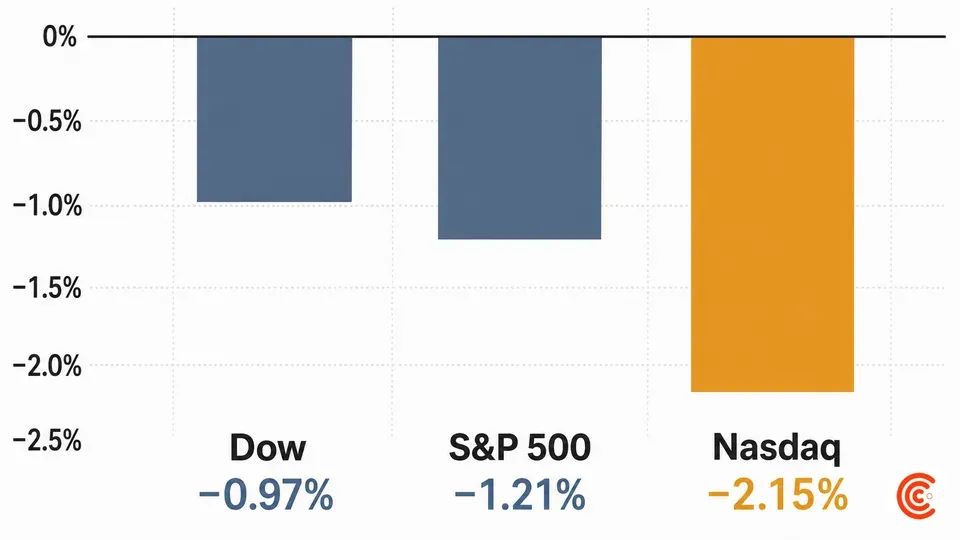
The three major U.S. indexes all closed lower on July 23, 2026:
| Index | Change | Close |
|---|---|---|
| Dow Jones Industrial Average | −506.93 (−0.97%) | 51,711.65 |
| S&P 500 | −1.21% | 7,408.30 |
| Nasdaq Composite | −2.15% | 25,137.69 |
The spread itself is the first clue. The tech-heavy Nasdaq fell more than twice as hard as the Dow (−2.15% vs −0.97%). That gap tells you the selling was concentrated in technology — which points to the earnings story — while the broader, more industrial Dow took the milder, market-wide hit you'd expect from an oil and inflation scare. Two different fears, two different footprints in the tape.
## Fear One: Oil at $100 and the Inflation Channel
Brent crude jumped about 6% to $100.50 a barrel, crossing $100 for the first time since May 26. The trigger was geopolitical: attacks on tankers in the Red Sea — after Iran-backed Houthi rebels struck two Saudi Arabian ships — plus President Trump's threat of strikes on Iranian infrastructure. Supply-route risk, not a demand surge, drove the move.
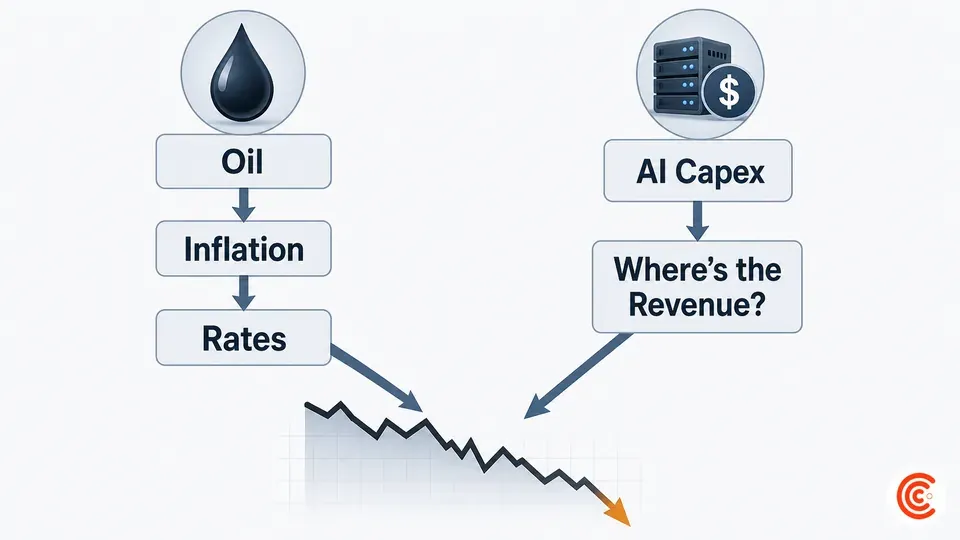
Oil at $100 pressures stocks through the inflation channel, a chain worth memorizing because it recurs:
- Higher crude raises the cost of fuel, shipping, and petrochemical inputs across the economy.
- That feeds into broader inflation, which makes it harder for the Federal Reserve to cut interest rates — or gives it reason to hold them higher for longer.
- Higher-for-longer rates lower the present value of future corporate earnings, which is exactly what stock prices represent.
So an oil spike is really a bet about rates, transmitted through inflation. It also hits specific sectors directly: airlines are the textbook casualty, since jet fuel is one of their largest costs — which is why "$100 oil" and "airline stocks in trouble" tend to trend together on the same day.
Fear Two: The AI-Capex Doubt
The second fear came from the earnings themselves, and it is the one that gnawed at tech specifically. Alphabet fell about 6% after raising its 2026 capital-spending forecast to as much as $205 billion — and investors, rather than cheering the ambition, questioned whether the payoff justifies the bill. Tesla tumbled roughly 14% after its free cash flow turned negative in the second quarter.
This is a different mechanism entirely. It is not about rates or oil — it is about return on invested capital. Big Tech has been spending historic sums on AI infrastructure, and the market has shifted from rewarding the spending to interrogating it: where is the revenue? When Alphabet lifts capex again and the stock drops, the message is that "spend more on AI" is no longer an automatic applause line. Investors want the monetization to show up on the same page as the invoice.
This doubt didn't appear overnight. It is the running tension behind Big Tech's collective $725 billion AI capex plan for 2026 — a 77% jump — and the recurring question of whether the revenue is arriving fast enough to justify it. We unpacked that gap here: Big Tech Will Spend $725 Billion on AI in 2026 — Up 77%. Is the Revenue Actually Showing Up?. July 23 was that same anxiety, priced into a single session.
## Why the Two Fears Compound Each Other
Separately, each fear is manageable. Stacked, they reinforce one another in an unlucky way.
The AI-capex doubt is fundamentally a question about future earnings — will the spending pay off later? The oil-and-inflation shock raises the discount rate applied to those future earnings by keeping rate cuts at bay. So the same macro move that punishes any richly valued stock lands hardest on exactly the AI names whose valuations depend most on distant, not-yet-arrived profits. The oil story makes the future worth less in today's dollars at the precise moment the tech story is asking whether that future arrives at all.
That is why a day like July 23 feels worse than the sum of its parts, and why the Nasdaq led the fall. It also points to what to watch next: whether crude holds above $100 (an inflation and rates problem) and whether the next round of Big Tech earnings finally pairs the capex with convincing revenue (a valuation problem). Neither fear is a verdict on its own — but when a rate-sensitive market meets rate-raising oil, the high-multiple corner gets repriced first.
Frequently Asked Questions
How much did the market fall on July 23, 2026? The Dow lost 506.93 points (−0.97%) to 51,711.65, the S&P 500 fell 1.21% to 7,408.30, and the Nasdaq Composite dropped 2.15% to 25,137.69.
Why did oil hit $100? Brent crude rose about 6% to $100.50 — its first close above $100 since May 26 — on Middle East supply fears: attacks on tankers in the Red Sea after Houthi rebels struck two Saudi ships, plus a U.S. threat of strikes on Iranian infrastructure. It was a supply-risk move, not a demand boom.
Why does higher oil push stocks down? Through inflation and rates. Costlier oil feeds inflation, which makes the Fed more likely to hold rates higher for longer, which lowers the present value of future corporate earnings — and stock prices are those future earnings discounted to today.
What spooked tech investors specifically? Earnings. Alphabet fell ~6% after raising 2026 capex to as much as $205 billion, and Tesla dropped ~14% on negative Q2 free cash flow. The worry is return on AI spending — whether the revenue justifies the capex — which is a different issue from oil.
Why did the Nasdaq fall more than the Dow? Because the two fears have different footprints. The oil/inflation scare is market-wide (the Dow's milder drop), while the AI-capex doubt is concentrated in technology (the Nasdaq's steeper drop). High-multiple tech is also the most sensitive to the higher-rate implication of an oil spike, so it gets hit twice.
Key Takeaways
- On July 23, 2026, the Dow fell 506.93 (−0.97%) to 51,711.65, the S&P 500 −1.21%, and the Nasdaq −2.15% — the tech index falling more than twice as hard.
- Fear one: Brent crude hit $100.50 (+~6%), its first cross of $100 since May 26, on Red Sea tanker attacks and Iran tensions — an inflation-and-rates shock.
- Fear two: an AI-capex doubt — Alphabet −6% after guiding 2026 capex to as much as $205B, Tesla −14% on negative Q2 free cash flow — a return-on-investment question.
- The two are unrelated in cause but compound each other: the oil shock raises the discount rate on the very future earnings the AI-capex doubt is already questioning.
- The takeaway for readers: oil spikes hit stocks via rates, AI-capex worries hit via valuation of future profits — and high-multiple tech sits in the crosshairs of both.
How this was written: AI assisted with gathering sources and structuring a first draft — fact-checking and final edits were done by a person.
References
- Stock market news for July 23, 2026 — CNBC
- Oil Prices Hit $100 a Barrel While Tech Selloff Deepens — MarketScreener
- Wall Street Falls as Big Tech Earnings Rekindle AI Spending Worries, Oil Hits $100 — GV Wire
- Market Indexes Sink as Oil Tops $100 Amid Rising AI Costs — The Motley Fool
- If Oil Hits $100, Delta and United Are in Trouble — Yahoo Finance


Comments ()