Alphabet's Cloud Grew 82%. Its Free Cash Flow Went to -$5.9B. Both Are the Same Story.
Alphabet's Cloud Grew 82%. Its Free Cash Flow Went to -$5.9B. Both Are the Same Story.
Alphabet's Q2 2026 showed Google Cloud revenue up 82% and a record $514B backlog, but a record $44.9B in quarterly capital spending pushed free cash flow to -$5.9B. The market punished the stock anyway. Here is why the two numbers are inseparable.
Alphabet reported one of the strongest quarters in its history and the stock sank. That contradiction is the whole story of hyperscaler investing in 2026: demand for AI cloud capacity is real and accelerating, but the capital required to serve it now consumes every dollar of operating cash a company generates — and then some.
Table of Contents
- What Alphabet actually reported
- Why cloud growth and negative cash flow are one number
- What the raised guidance signals
- How to read the next hyperscaler print
What Alphabet actually reported
For the quarter, Alphabet posted total revenue of $119.8 billion, up 24% year over year, with operating income of $40.8 billion (up 30%) and an operating margin that expanded to 34%. On the top line and on profit, this beat expectations.
The standout was Google Cloud:
| Metric | Q2 2026 | Year-ago | Change |
|---|---|---|---|
| Cloud revenue | $24.8B | ~$13.6B | +82% |
| Cloud operating income | $8.8B | $2.8B | ~3.1× |
| Cloud operating margin | 35.6% | ~11% | +25 pts |
| Cloud backlog | $514B | — | +$50B QoQ |
An 82% growth rate at a $100-billion-a-year revenue run rate is extraordinary. A $514 billion backlog — commitments customers have already signed — is a forward demand signal that dwarfs a single quarter's revenue.
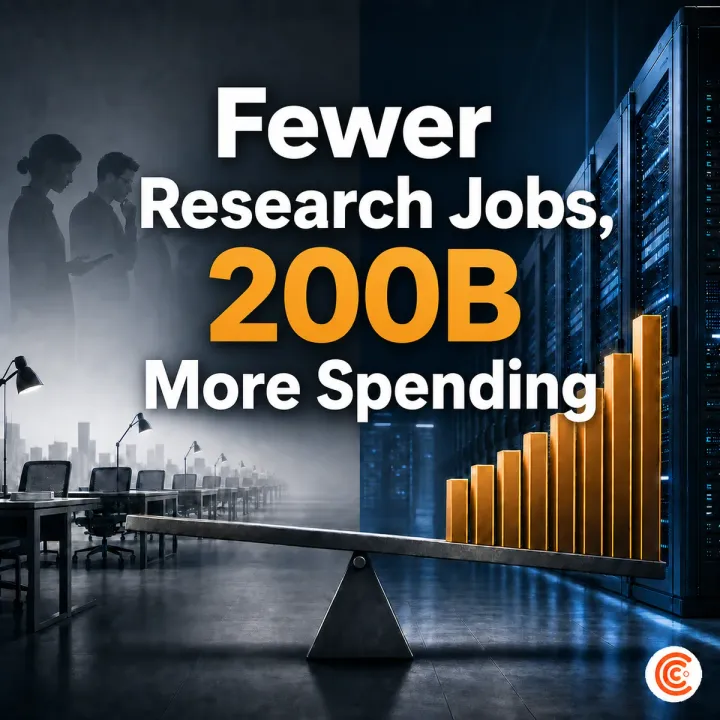
Then came the other line. Capital expenditures were $44.9 billion for the quarter, nearly double the $22.4 billion Alphabet spent a year earlier, poured almost entirely into data centers, AI servers, and computing infrastructure. That spend pushed quarterly free cash flow to roughly -$5.9 billion. A company printing $40 billion in operating income generated negative free cash — because it reinvested more than all of it into physical capacity.
Why cloud growth and negative cash flow are one number
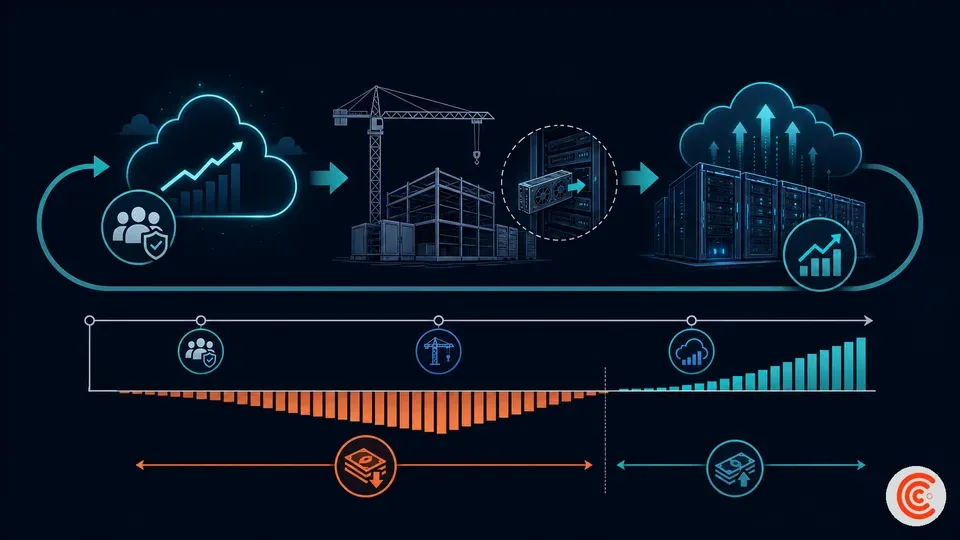
It is tempting to read these as a good number (cloud) and a bad number (cash flow). They are the same number seen from two ends.
Cloud revenue grows only if the capacity exists to sell. GPUs, custom accelerators, power, cooling, and buildings all have to be paid for before the revenue they enable shows up. So a quarter of 82% cloud growth and a record $514B backlog is precisely what forces a quarter of record capex. The backlog is a promise; the capex is the bill for keeping it.
The mechanism is a timing mismatch:
- Capex is recognized now, as cash out the door and — over years — as depreciation.
- The revenue and margin it unlocks arrive later, spread across the life of the contracts sitting in that $514B backlog.
That is why the market's reaction was not irrational. Investors were not disputing that demand is real. They were repricing when the payoff arrives and how much capital gets consumed in the meantime — especially when management signals the spending is going up, not down.
What the raised guidance signals
The detail that moved the stock was not the quarter. It was the outlook. Alphabet raised full-year 2026 capex guidance to $195–205 billion, up from a prior range of $180–190 billion, and indicated 2027 would step up again. Management also flagged modest cloud margin pressure in the third quarter, because it is renting third-party capacity as a bridge while its own buildout catches up to demand.
Read plainly, that is a company saying: demand is outrunning our ability to build, so we will spend more, sooner, and lean on rented capacity in the gap. For a business with Alphabet's balance sheet, that is a defensible bet. But it changes the shareholder proposition. Cash that might have funded buybacks or dividends is instead being converted into concrete, silicon, and power contracts whose returns depend on AI demand staying on its current curve for years.
How to read the next hyperscaler print
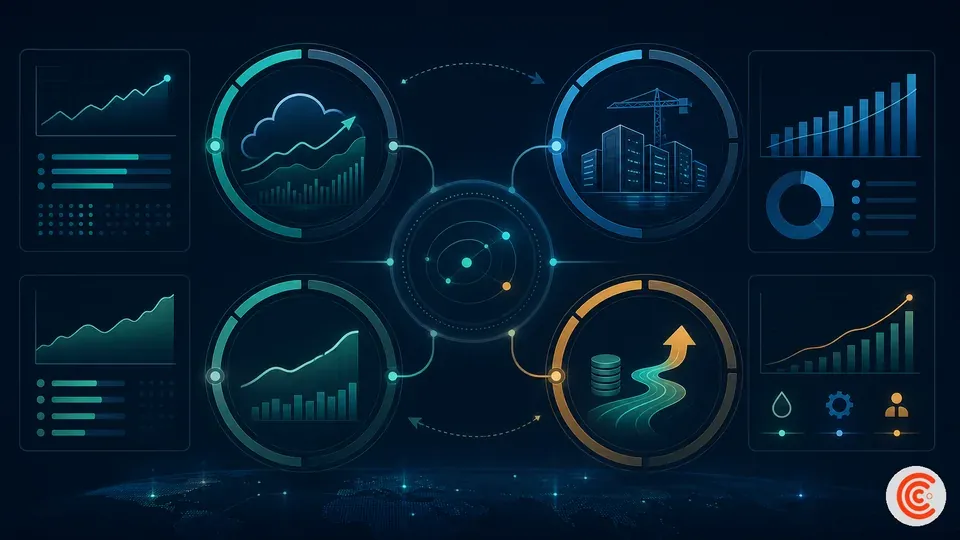
Alphabet reports early in the megacap earnings season, and the same tension will define the prints that follow. A practical checklist for reading them:
- Pair growth with capex, never in isolation. A cloud acceleration with flat capex is a margin story; a cloud acceleration with rising capex is a duration story. They demand different valuations.
- Watch the backlog, not just the quarter. Backlog is the cleanest read on whether the spending is chasing real, contracted demand or speculative capacity.
- Track the guidance delta. The market reacted to the raised number, not the reported one. The direction of capex guidance is the sentiment driver.
- Note where capacity is rented. Reliance on third-party capacity as a "bridge" is a tell that demand is ahead of a company's own buildout.
Frequently Asked Questions
Did Alphabet have a bad quarter? No. Revenue, operating income, margin, and cloud growth all beat. The stock fell on raised capex guidance, which pressures near-term free cash flow — a reaction to the outlook, not the results.
How can operating income be $40B while free cash flow is negative? Operating income excludes the full cash cost of building data centers. Free cash flow subtracts capital expenditures. When capex ($44.9B) exceeds the operating cash generated, free cash flow turns negative even with strong profits.
Is the $514B backlog the same as revenue? No. Backlog is contracted future commitments that convert to revenue over time. It is a demand signal, not a booked result, and its conversion depends on Alphabet building the capacity to deliver it.
Why does capex matter more than usual right now? Because AI infrastructure spending has scaled to the point where it can consume all of a hyperscaler's free cash flow. That shifts these stocks from cash-return stories to long-duration reinvestment bets.
Key Takeaways
- Alphabet's Q2 2026: revenue $119.8B (+24%), Google Cloud $24.8B (+82%), cloud backlog $514B — all strong.
- Record $44.9B quarterly capex drove free cash flow to roughly -$5.9B despite $40.8B in operating income.
- Cloud growth and negative cash flow are the same event: capacity must be paid for before it earns.
- The stock fell on raised full-year capex guidance ($195–205B), not on the quarter itself.
- These are now duration bets: returns depend on AI demand holding its curve for years.
How this was written
I compiled Alphabet's reported Q2 2026 figures from multiple independent outlets covering the July 2026 earnings release and cross-checked the headline numbers (revenue, cloud growth, capex, free cash flow, and raised guidance) for consistency across sources before drafting the analysis.
References
- Yahoo Finance — Alphabet Q2 2026 earnings: revenue up 24%, Cloud surges 82%
- CNBC — Alphabet earnings takeaways: Q2 revenue beats, stock sinks on 2026 capex hike
- Search Engine Journal — Google Q2 earnings show $5.85 billion negative free cash flow
- Investing.com — Alphabet Q2 2026 slides: 24% revenue growth, cloud surges despite capex


Comments ()