Big Tech Will Spend $725 Billion on AI in 2026 — Up 77%. Is the Revenue Actually Showing Up?

Big Tech Will Spend $725 Billion on AI in 2026 — Up 77%. Is the Revenue Actually Showing Up?
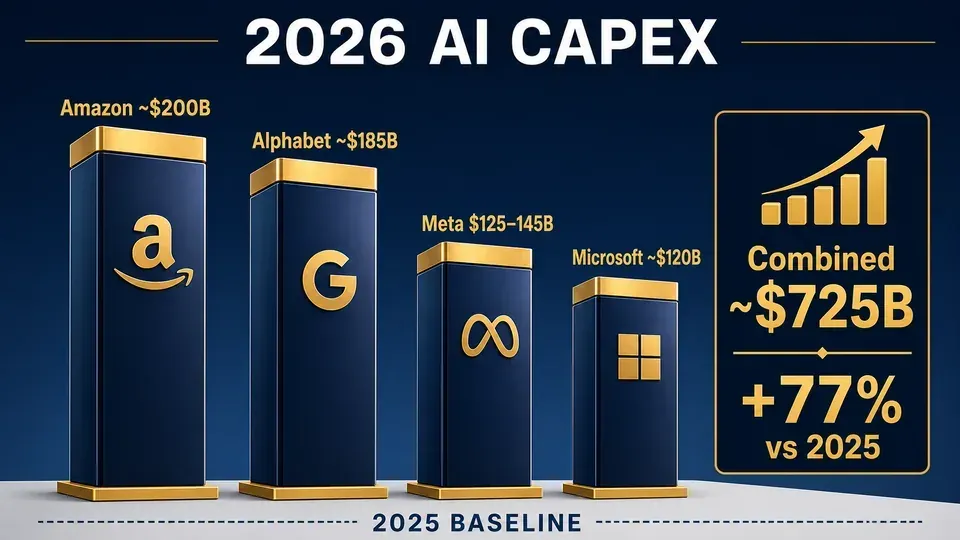
Amazon, Microsoft, Alphabet, and Meta are on track to spend roughly $725 billion on capital expenditure in 2026 — about 77% more than 2025's ~$410 billion, most of it AI data centers. The debate isn't whether the money is being spent; it's whether the revenue is arriving fast enough to justify it. This post breaks down who's spending what, where the revenue signal is real versus thin, and the one number that separates the two camps.
Every earnings season now runs on the same tension. The four hyperscalers keep raising their spending guidance into the hundreds of billions, and every quarter investors ask the same question louder: is any of this paying off yet? The honest answer in mid-2026 is "partly, and unevenly." Cloud revenue is genuinely accelerating at some of these companies and merely promised at others — and the market is starting to reward or punish them based on which. Here's the money map, the revenue reality, and why the gap between the two is the whole story.
Table of Contents
- Who Is Spending What
- Where the Revenue Is Real — and Where It Isn't
- The Number That Settles the Debate
Who Is Spending What
The combined 2026 capital-expenditure plans of the four largest AI spenders come to roughly $725 billion, up about 77% from ~$410 billion in 2025. The bulk of that is AI infrastructure: data centers, chips, power, and networking. Here's the approximate breakdown by company:
| Company | 2026 capex (approx.) | Primary use |
|---|---|---|
| Amazon | ~$200 billion | AWS data centers (plus logistics) |
| Alphabet / Google | ~$185 billion | Cloud + AI infrastructure |
| Meta | $125–145 billion | AI compute (near double its 2025 spend) |
| Microsoft | ~$120 billion | Azure + AI capacity |
| Combined | ~$725 billion | Mostly AI infrastructure |
Two things stand out. First, the rate of increase — 77% year over year — is far faster than any of these companies' revenue is growing, which is precisely why the sustainability question exists. Second, this isn't the ceiling: analysts have projected combined Big Tech capex could top $1 trillion in 2027. When spending compounds like that, even small doubts about the payback period translate into large swings in the stocks.
## Where the Revenue Is Real — and Where It Isn't
This is where the four companies split apart. The market has stopped treating "AI capex" as one story and started grading each on whether the spending shows up as cloud revenue.
The clearest positive signal is Google Cloud, whose revenue jumped about 63% to ~$20 billion in a quarter, with a reported backlog approaching $460 billion — a pipeline of contracted future work that makes the spending look demand-driven rather than speculative. AWS continues to monetize at scale, with Amazon pointing to capacity being sold roughly as fast as it's installed and an annualized revenue run-rate around $142 billion still growing in the mid-20% range. Microsoft Azure has been growing in the neighborhood of 40%, keeping it firmly in the "demand exceeds supply" camp.
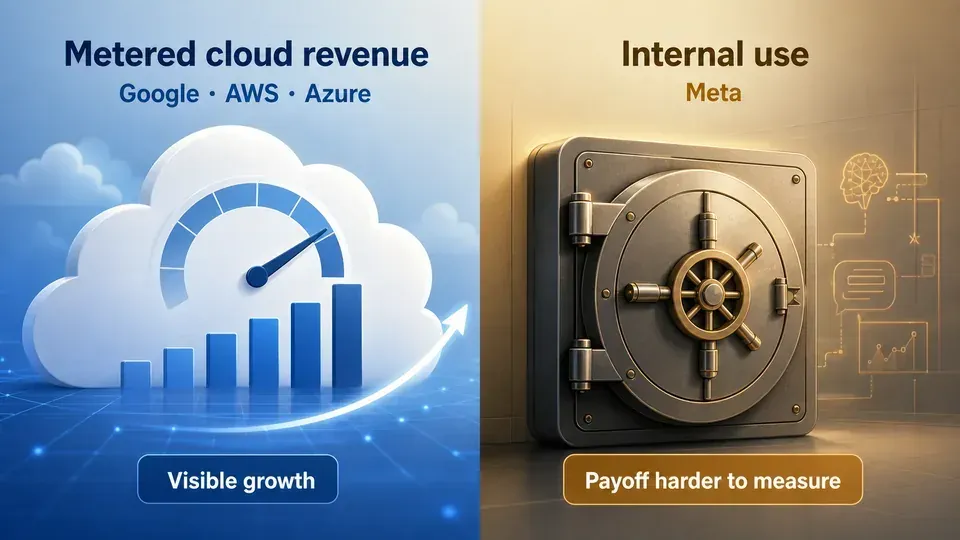
The contrast is Meta, which doesn't sell cloud capacity — its AI spend feeds internal products (ads, recommendations, assistants) rather than a metered revenue line investors can point to. That's exactly why the market punished Meta by roughly 6% after it raised capex guidance without a proportional, visible revenue proof, while rewarding Google's cloud strength. Same spending category, opposite market reaction — because one has an external revenue meter and the other asks investors to trust the internal payoff.
## The Number That Settles the Debate
If you want one figure to watch, it isn't the $725 billion headline — it's the ratio of capex growth to cloud-revenue growth. Capex is climbing ~77% a year. Cloud revenue at the leaders is growing in the 40–63% range. As long as those revenue lines keep accelerating and the backlogs keep filling, the spending reads as chasing real demand. The moment cloud growth flattens while capex keeps climbing, the same numbers flip from "land grab" to "overbuild."
That's the actual bull-versus-bear line, stripped of drama:
- Bull case: Backlogs (Google's ~$460B) and run-rates (AWS ~$142B) prove demand is contracted years out; today's capex is buying capacity that's already sold. Underspending would be the real risk.
- Bear case: Capex is growing far faster than revenue, a chunk of the "demand" is other AI companies renting compute in a circular loop, and depreciation on all this hardware will hit earnings long before the revenue fully materializes.
Both camps are looking at the same $725 billion. The difference is whether you trust the revenue trajectory to catch up to the spending level. For a global reader with money in an S&P 500 or Nasdaq index fund, this matters directly: these four companies are a large slice of those indexes, and their capex-versus-revenue gap is now one of the biggest single swing factors in the whole market. Watch the cloud growth rates each quarter — not the capex announcements — because the growth rates are what tell you which way the gap is closing.
Frequently Asked Questions
What is capex, and why does AI need so much of it? Capital expenditure (capex) is money spent on long-lived physical assets — here, mostly data centers, AI chips, and the power and networking to run them. AI training and inference require vast amounts of specialized compute, so building that capacity shows up as enormous capex.
Is $725 billion confirmed or a forecast? It's an aggregated 2026 forecast based on the four companies' own guidance and analyst tracking. Actual figures shift as each company updates guidance through the year, which is why ranges (e.g., Meta's $125–145B) appear.
Why did the market reward Google but punish Meta for spending? Google's spending pairs with fast-growing, externally-billed cloud revenue and a large backlog. Meta's AI spend feeds internal products without a separate revenue meter, so investors can't yet see a proportional payoff — same spending, less visible return.
Does this mean AI is a bubble? Not necessarily. The bull case says spending is backed by contracted demand (backlogs, run-rates); the bear case says capex is outrunning revenue and depreciation will bite. The evidence is genuinely mixed, which is why it's a debate rather than a verdict.
How does this affect ordinary investors? These four companies are a heavy weighting in major U.S. indexes. Whether their AI spending pays off is now one of the largest single factors moving broad-market index funds.
Key Takeaways
- Four hyperscalers plan ~$725B in 2026 capex, up ~77% from ~$410B in 2025 — mostly AI infrastructure.
- Rough split: Amazon ~$200B, Alphabet ~$185B, Meta $125–145B, Microsoft ~$120B.
- Revenue signal is real but uneven: Google Cloud +63% to ~$20B (backlog ~$460B), AWS ~$142B run-rate, Azure ~40% growth — Meta lacks an external meter.
- The market rewarded Google, punished Meta ~6% for the same spending category — visible revenue is the difference.
- The number to watch is capex growth vs cloud-revenue growth, not the headline capex figure.
How this was written: This piece was drafted with AI's research help; a human verified every fact and polished the final wording.
References
- Google, Microsoft, Meta, and Amazon capex spending to hit $725 billion in 2026, up 77% — Tom's Hardware
- AI Spending Tracker 2026: $725B Total — Amazon, Google, Meta & Microsoft — ValueAdd VC
- Big Tech set to spend $650 billion in 2026 as AI investments soar — Yahoo Finance
- AI boom: Big Tech capital expenditures now seen topping $1 trillion in 2027 — CNBC
- AI Capex 2026: The $690B Infrastructure Sprint — Futurum


Comments ()