
Is AI Actually Taking Jobs Yet? The 2026 Data Shows a Split Verdict

TL;DR — The honest answer is: not much yet at the economy-wide level, but real damage is already concentrated in specific corners. Overall unemployment for AI-exposed jobs is actually lower than for less-exposed ones, and 90% of firms report no measurable AI productivity impact. But recent college graduates in AI-exposed fields face 5.6% unemployment, coder employment growth has slowed 3% since generative AI tools arrived, and finance/tech payrolls are shrinking by 28,000 jobs a month. Both things are true at once — here's how to read the split.
The Headline Numbers Don't Show a Jobs Apocalypse (Yet)
Economists who've actually looked at Bureau of Labor Statistics data find the aggregate picture is calmer than the panic suggests. A labor economist who previously headed the BLS put it bluntly: "All of the available evidence to date suggests that AI's impact on current labor market conditions is likely small right now."¹ Analysis of BLS data shows unemployment for jobs most exposed to AI is actually lower than for less-exposed occupations — the opposite of what a straightforward displacement story would predict.¹
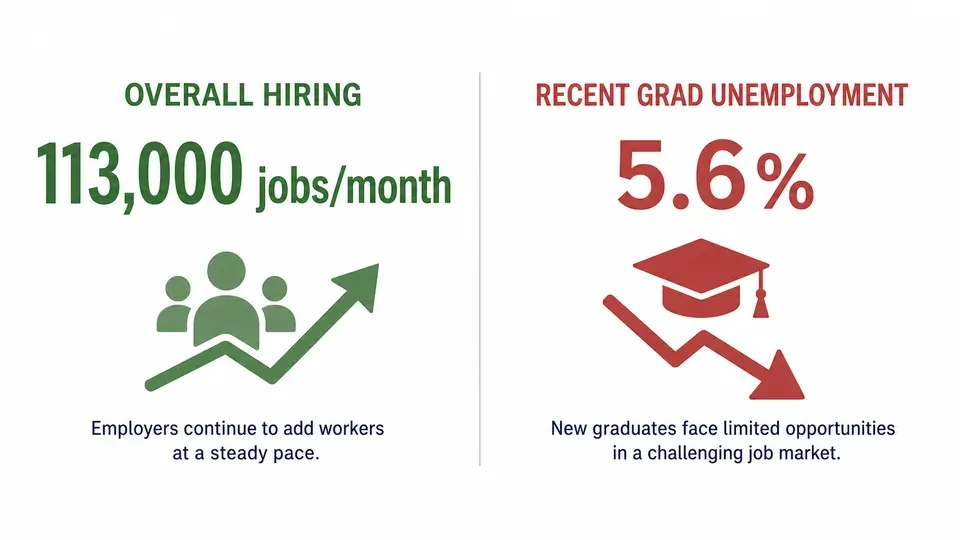
Overall hiring is still healthy: the US economy created more than 113,000 jobs monthly through May 2026.¹ That robustness is exactly what makes the pockets of weakness stand out.
Where the Damage Is Real: Entry-Level and Coding Jobs
This is where the debate stops being theoretical. Recent college graduates now face 5.6% unemployment — a rate not seen since the pandemic and the years right after the 2008 recession — and researchers link part of this specifically to AI-exposed fields like software development.¹ A Federal Reserve study found coder employment growth has slowed by about 3% since generative AI tools became widely available.¹ Separately, University of Pittsburgh research found recent graduates saw a 16% salary loss, more than double the 7% overall rate, and graduates in AI-exposed fields spent almost a month longer job-hunting than peers in less-exposed fields — though that researcher also cautioned the shift coincided with the ChatGPT-era rise in interest rates, which muddies the causal story.¹
| Group | Signal | Source |
|---|---|---|
| All AI-exposed occupations | Unemployment lower than less-exposed jobs | BLS data¹ |
| Recent college grads (overall) | 5.6% unemployment | Multiple 2026 reports¹ |
| Coders specifically | Employment growth down ~3% since GenAI | Federal Reserve study¹ |
| Recent grads, AI-exposed fields | 16% salary loss vs. 7% overall | Univ. of Pittsburgh¹ |
| Finance/tech/info sector payrolls | -28,000 jobs/month average, 2026 | Yale Budget Lab¹ |
## The Layoff Numbers Directly Attributed to AI
Outplacement firm Challenger, Gray & Christmas tracks layoffs where employers explicitly cite AI as a cause. Their data: nearly 55,000 job cuts in 2025 were directly attributed to AI, out of 1.17 million total layoffs — the highest AI-attribution level since the 2020 pandemic.² In just the first two months of 2026, technology firms alone announced 32,000 job losses, with tech accounting for a third of all 2026 layoffs so far.² Challenger's CEO summed it up: "It's certainly making an impact as we speak in a way that no technology has before."²
This tracks with a pattern we've covered before: companies that fired workers citing AI have, in a number of cases, ended up quietly trying to rehire them once the AI-only approach didn't hold up — suggesting some of these cuts were premature bets on AI capability rather than proven replacements.
The Forecasts Disagree by an Order of Magnitude
Long-range projections vary enormously depending on methodology, which is itself a sign of how unsettled this is:
- Goldman Sachs Research: mild and short-lived impact — about 2.5% of US employment at risk of displacement (up to 6–7% with wide adoption), unemployment rising roughly 0.5% during the transition, offset by a ~15% labor productivity gain.²
- World Economic Forum: up to 92 million jobs displaced globally by 2030, alongside substantial new job creation.²
- McKinsey: current technology could automate 57% of US work hours (44% via software agents, 13% via robots) — a ceiling on technical potential, not a prediction of actual near-term job loss.²
Which Sector Is Next?
Finance is the sector most analysts flag as the coming exposure point. Office and administrative roles — customer service reps, bank tellers, insurance claims processors — make up about a quarter of financial-sector employment, a larger share than any other major industry.² Executives aren't being coy about it either: senior leaders at JPMorgan Chase, Citigroup, and Goldman Sachs have publicly acknowledged the technology will eliminate some roles.²
Frequently Asked Questions
Is AI already causing mass unemployment in 2026? No, not at the economy-wide level — overall US job creation remains robust (113,000+ monthly through May 2026) and unemployment for AI-exposed occupations is actually lower than for less-exposed ones. The damage so far is concentrated in specific groups, especially recent graduates and coders.
Why are recent college graduates struggling more than the overall labor market? Recent graduates face 5.6% unemployment, and researchers link part of this to AI-exposed entry-level fields like software development, where coder employment growth has slowed about 3% since generative AI tools arrived. Rising interest rates during the same period may also be a contributing factor.
How many layoffs have actually been attributed to AI? Challenger, Gray & Christmas tracked about 55,000 AI-attributed layoffs in 2025 (out of 1.17 million total layoffs), and 32,000 tech-sector job losses in just the first two months of 2026.
Which industries are most at risk going forward? Finance is the most frequently cited next-exposure sector, given that office and administrative roles make up about a quarter of its workforce. Bank executives at JPMorgan Chase, Citigroup, and Goldman Sachs have publicly acknowledged AI will eliminate some jobs.
Why do job-loss forecasts vary so widely (2.5% vs. 57%)? Because they measure different things. Goldman Sachs estimates actual near-term displacement risk (2.5–7% of employment), while McKinsey's 57% figure measures the technical ceiling of work hours that current AI could theoretically automate — not a prediction that this will actually happen soon.
Key Takeaways
- Aggregate labor data shows no broad AI jobs crisis yet: unemployment for AI-exposed jobs is lower than for less-exposed ones, and overall hiring remains strong.
- The real, measurable damage is concentrated in recent graduates (5.6% unemployment) and coders specifically (employment growth down ~3% since GenAI).
- About 55,000 layoffs were directly attributed to AI in 2025, with tech accounting for a third of all 2026 layoffs so far — but some AI-driven cuts have already led to quiet rehiring.
- Long-range forecasts disagree by an order of magnitude (2.5% vs. up to 57% of work automated), largely because they measure different things — actual displacement risk vs. technical automation ceiling.
- Finance is the most-cited next sector at risk, given how much of its workforce sits in office/administrative roles.
Sources 1. MIT Technology Review: A reality check on the AI jobs hysteria 2. Insurance Journal: Tech and Finance Sectors Losing 28,000 Jobs Monthly Show AI Impact on Labor
Tags: #AI #Jobs #LaborMarket #FutureOfWork #Economy #Explainer


Comments ()