
64 DNA Strands on One Chip: Why Harvard's Water-Based DNA Printer Could Cut Synthesis Costs
64 DNA Strands on One Chip: Why Harvard's Water-Based DNA Printer Could Cut Synthesis Costs
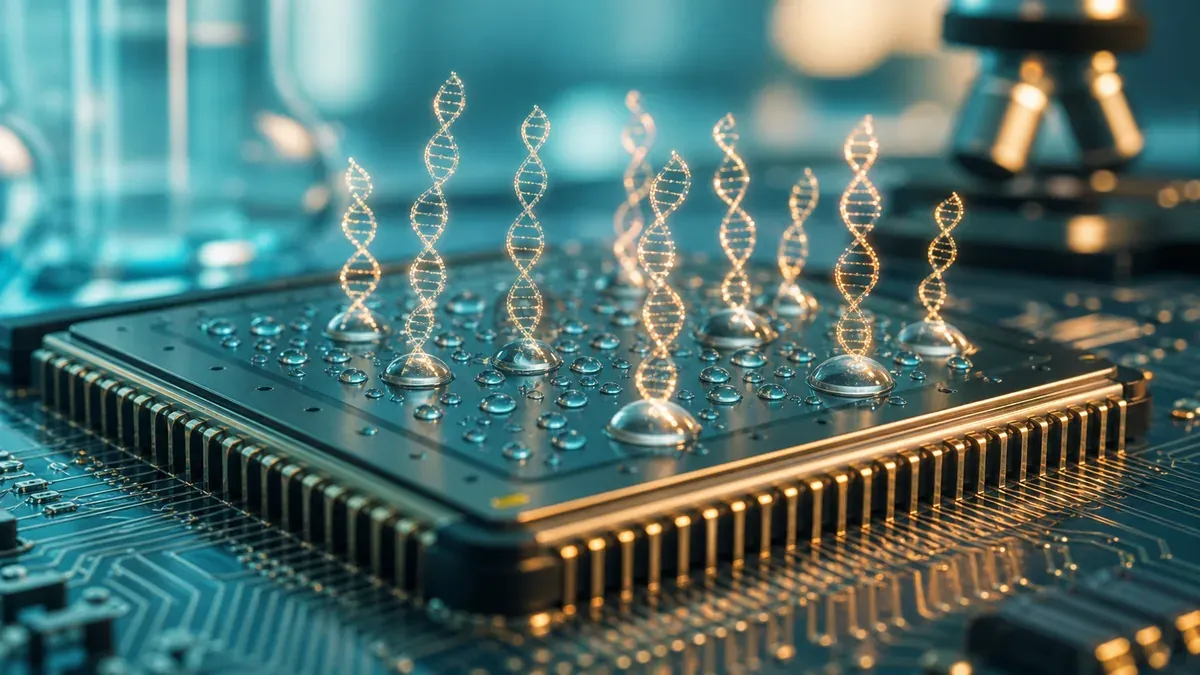
A Harvard-led team built a silicon chip that writes 64 different DNA sequences at once using electricity and water — no harsh solvents. Here is what the breakthrough does, how it differs from today's DNA manufacturing, and why cost is the real story.
Making custom DNA is one of the quiet bottlenecks behind modern medicine — it underpins gene therapies, personalized vaccines, and biological research. But the dominant method is chemistry-heavy, solvent-intensive, and hard to scale cheaply. In a study published in Nature Electronics, a Harvard-led team unveiled a silicon chip that synthesizes 64 distinct DNA sequences in parallel using a water-based enzymatic process driven by electric current. This post explains what the chip does, how it compares to conventional synthesis, and why the headline number that matters isn't 64 — it's cost.
What the chip actually does
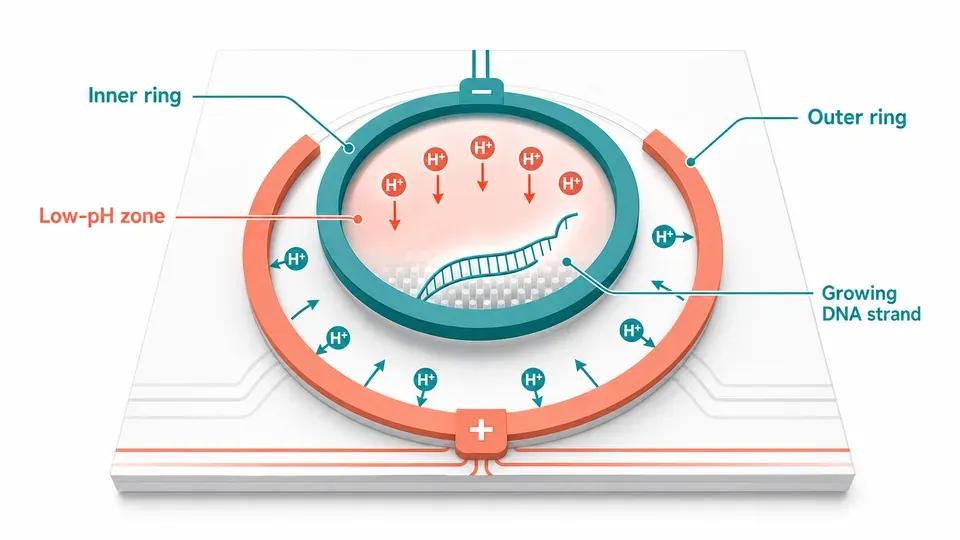
The chip writes DNA enzymatically — using enzymes in water — rather than through the solvent-heavy chemistry that dominates custom DNA manufacturing today. The clever part is control. Enzymatic DNA elongation needs a precise low-pH zone right at each growing strand, and the chip creates that electrically:
- Current driven into an inner ring generates protons, lowering the pH exactly where the DNA strands are so the enzyme can extend them.
- Current pulled from an outer ring consumes diffusing protons, keeping the low-pH zone from spreading and bleeding into neighboring sequences.
That electrical "fence" is what lets 64 separate reactions run side by side on one surface without interfering. Each of the 64 sequences reached up to 39 nucleotides in length.
## Enzymatic-on-chip vs. conventional DNA synthesis
The advance is easiest to grasp as a direct contrast with how DNA is made today and with earlier enzymatic attempts:
| Dimension | Conventional (phosphoramidite chemistry) | Prior enzymatic methods | Harvard chip (Nature Electronics) |
|---|---|---|---|
| Chemistry | Solvent-heavy, harsh reagents | Water-based enzymes | Water-based enzymes |
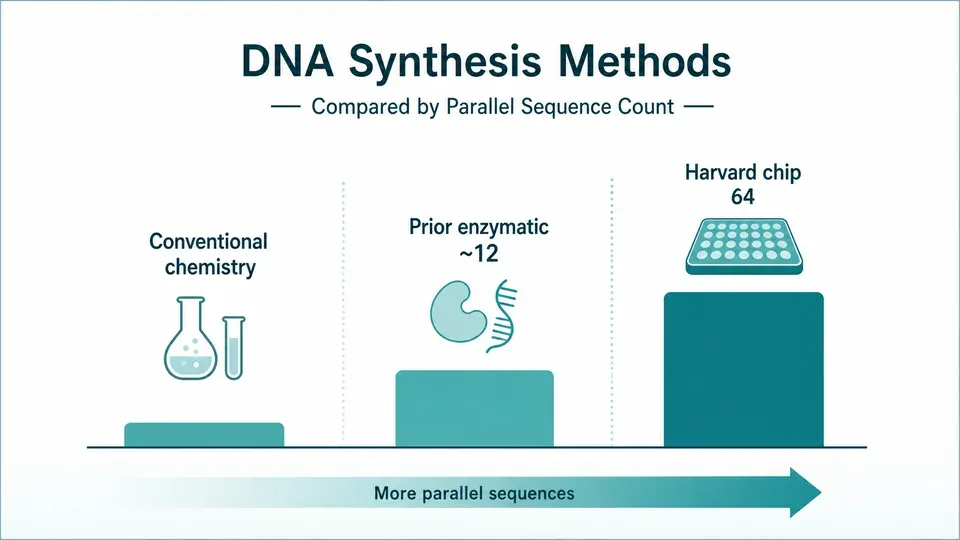
| Parallel sequences | Established at scale but reagent-intensive | ~a dozen at once | 64 at once |
| Control mechanism | Chemical cycles | Limited spatial control | Electrical pH control (inner/outer rings) |
| Sequence length demonstrated | Long, mature | Shorter | up to 39 nucleotides |
| Environmental profile | Solvent waste | Cleaner | Cleaner, chip-integrated |
The leap worth underlining: enzymatic approaches had been stuck at roughly a dozen simultaneous sequences. This chip pushes that to 64 — a rough 5x step-up in parallelism — while doing it in water instead of solvents. That combination of more parallel and cleaner is the point.
## Why cost — not the demo — is the real story
Sixty-four sequences of 39 nucleotides is a lab milestone, not a factory. So why does it matter? Because the most immediate implication is cost at scale. If chip-based enzymatic synthesis can drive down the price of producing synthetic DNA, the downstream economics of medicine shift:
- Gene therapy becomes viable for a broader range of health systems and patients when the DNA input is cheaper.
- Personalized vaccine manufacturing — where each batch may need bespoke sequences — benefits directly from cheap, parallel, on-demand synthesis.
- Cleaner manufacturing removes solvent handling and waste, lowering the environmental and facility burden of scaling up.
The honest caveat: this is an early demonstration. Sequence length (39 nucleotides) is short compared with what many applications need, and going from a 64-site research chip to industrial throughput is a long road. The significance is directional — it shows a semiconductor-manufacturing playbook (parallelism, electrical control, integration) can be pointed at biology. If that playbook scales the way silicon usually does, the cost curve for synthetic DNA could bend the way compute did.
Frequently Asked Questions
What did the Harvard chip actually achieve? It synthesized 64 distinct DNA sequences in parallel on a silicon surface, each up to 39 nucleotides long, using a water-based enzymatic process controlled by electric current. The work was published in Nature Electronics.
How is this different from how DNA is normally made? Conventional custom DNA synthesis relies on solvent-heavy chemistry. This chip uses enzymes in water and controls the reaction electrically, making it cleaner and more parallel than prior enzymatic methods.
Why is 64 sequences a big deal? Earlier enzymatic methods were limited to about a dozen sequences at once. Reaching 64 is roughly a 5x jump in parallelism, and it's done without harsh solvents.
Could this make gene therapy cheaper? Potentially. The most immediate implication is reducing the cost of synthetic DNA at scale, which could make gene therapy and personalized vaccines economically viable for more patients — but this is still an early-stage demonstration.
What are the limits right now? Sequences reached only up to 39 nucleotides, and scaling a research chip to industrial production is a significant challenge. The result is a proof of concept, not a commercial product.
Key Takeaways
- A Harvard-led team built a silicon chip that writes 64 DNA sequences in parallel using water-based enzymes and electrical pH control, published in Nature Electronics.
- It roughly 5x's the parallelism of prior enzymatic methods (which topped out around a dozen), with sequences up to 39 nucleotides.
- The strategic significance is cost: cheaper synthetic DNA could make gene therapy and personalized vaccines viable for far more patients.
- It's an early demonstration — short sequences, research-scale — but it points a proven semiconductor playbook at biology.
How this was written Research and a first draft came together with AI's help; verification and the final pass were entirely human.
References
- ScienceDaily, "Harvard scientists turn a silicon chip into a DNA writing machine": https://www.sciencedaily.com/releases/2026/07/260708022202.htm
- Harvard SEAS, "Making DNA on a semiconductor chip": https://seas.harvard.edu/news/making-dna-semiconductor-chip
- Phys.org, "Semiconductor chip writes 64 DNA sequences in water, setting new enzymatic benchmark": https://phys.org/news/2026-06-semiconductor-chip-dna-sequences-enzymatic.html
- Interesting Engineering, "Silicon chip creates 64 DNA sequences in parallel using electric currents and water": https://interestingengineering.com/innovation/silicon-chip-w64-dna-sequences-electric-currents
- Medical Daily, "Harvard Built a Silicon Chip That Writes DNA Using Electricity and Water": https://www.medicaldaily.com/harvard-silicon-chip-dna-synthesis-gene-therapy-2026-476033


Comments ()