AI Drug Discovery Hits 80% in Phase 1 and 40% in Phase 2: What the Numbers Really Say
AI Drug Discovery Hits 80% in Phase 1 and 40% in Phase 2: What the Numbers Really Say
On July 20, 2026, Bristol Myers Squibb said it would build one of the life-science industry's most powerful AI systems on Nvidia's new Vera Rubin hardware — the latest sign that big pharma is betting enormous sums on AI drug discovery. Yet zero AI-designed drugs have been approved by the FDA. The clearest data we have shows AI-discovered molecules clear Phase 1 safety trials at an 80–90% rate versus roughly 50% historically, then fall back to about 40% in Phase 2 — the same as everyone else. This post explains what that gap actually means.
The money says AI is transforming how drugs get made. A peer-reviewed look at the clinical data says AI has transformed the first half of the process — the cheap, fast part — while leaving the expensive, slow part almost untouched. Both statements are true at once, and holding them together is the only way to read headlines like Bristol Myers Squibb's new supercomputer without getting fooled in either direction. Here's what the hardware buys, what the trial data shows, and where AI genuinely moves the needle versus where biology still refuses to be rushed.
Table of Contents
- What Bristol Myers Squibb Actually Bought
- The 80% / 40% Split, Explained
- Why the Second Half Is So Much Harder
- Who's Closest to the First Approval
What Bristol Myers Squibb Actually Bought
On July 20, 2026, Bristol Myers Squibb announced it will deploy an Nvidia DGX SuperPOD built on the new DGX Vera Rubin NVL72 systems — what the companies describe as the most powerful and energy-efficient single-owned Nvidia infrastructure in life sciences. Nvidia claims the Vera Rubin generation delivers up to 10x the performance per megawatt of the hardware it replaces, which matters because a data center's real constraint is increasingly power, not floor space.
Keep the marketing and the mechanism separate. The verified, concrete part is that BMS is buying serious compute and pointing it at drug R&D across oncology, hematology, cardiovascular, immunology and neurology. The softer part is the payoff claim: BMS says AI agents that automate target identification already save its scientists "weeks" of manual work, and that the goal is an integrated system spanning target discovery through clinical proof of concept. Those are company statements in a launch announcement, complete with the usual forward-looking-statement disclaimers. Faster target identification is real and useful — but notice where in the pipeline it sits: the very beginning, before a molecule ever touches a patient. That placement is the whole story.
## The 80% / 40% Split, Explained
Here's the number that cuts through the hype. A peer-reviewed analysis published in Drug Discovery Today examined the real clinical track record of AI-discovered molecules, drawing on pipeline data from more than 100 AI-focused biotechs. By 2023, those companies and their pharma partners had advanced 75 molecules into the clinic, with 67 in active trials. The headline finding:
| Trial stage | AI-discovered molecules | Historical industry baseline | What it tests |
|---|---|---|---|
| Phase 1 | ~80–90% success | ~50% | Safety in humans |
| Phase 2 | ~40% success | ~40% | Whether the drug actually works |
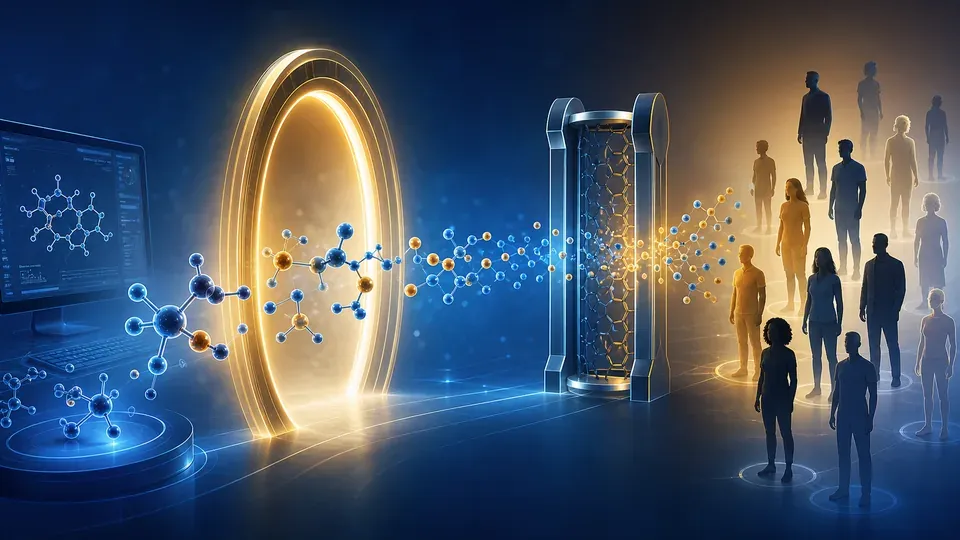
Read those two rows together and the picture snaps into focus. In Phase 1 — is this molecule safe and drug-like? — AI-designed candidates massively outperform history. In Phase 2 — does it actually treat the disease? — they perform like everyone else. AI has gotten dramatically better at designing molecules that behave well as chemistry. It has not gotten better at the harder question of whether the biological target was the right one to aim at in the first place.
That's not a knock on AI; it's a precise map of its current reach. Molecule design is a pattern problem — the kind machine learning eats for breakfast. Picking the right target in a poorly understood disease is a problem of biological truth, and you generally only find out you were wrong when the drug fails in patients, years and hundreds of millions of dollars later. AI compressed the part that was already the cheapest and fastest.
Why the Second Half Is So Much Harder
This is where the Bristol Myers Squibb news and the trial data connect. When BMS touts faster target identification, it's operating in exactly the zone where AI already shines — and, notably, also nudging at the harder target-selection problem, which is where the real prize sits. The Phase 1 numbers prove AI can generate excellent molecules quickly. The Phase 2 numbers prove that generating molecules was never the binding constraint on getting drugs approved.
An analogy: AI drug discovery today is like a GPS that finds the fastest route in seconds but can't tell you whether you're driving to the right city. Speeding up molecule design when your target might be wrong just means you fail faster and cheaper — genuinely valuable, because a cheaper failure frees resources for the next attempt, but not the same thing as a higher chance of curing the disease. The compute BMS is buying, and the "weeks saved" it advertises, mostly make the early stages faster and cheaper. Whether all that translates into more approved drugs depends on cracking target biology, which no amount of raw GPU throughput automatically solves.
The investment wave assumes the whole pipeline will eventually bend. The data says only the front of it has bent so far. Both can be true, and the honest position is to watch Phase 2 and Phase 3 readouts — not funding rounds or hardware announcements — for evidence the back half is moving too.
## Who's Closest to the First Approval
No AI-designed drug has FDA approval yet, but the frontier is moving. The candidate most often named as the likely first is Takeda's zasocitinib, an AI-designed molecule that, in results reported in December 2025, eased the severity of plaque psoriasis in two late-stage trials — putting it in position to potentially become the first FDA-approved AI-discovered drug. Meanwhile Isomorphic Labs, the Alphabet-owned spinout built around AlphaFold, has raised about $2.1 billion and is targeting first-in-human trials by the end of 2026.
The pattern holds beyond drugs, too. On the same day as the BMS news, materials-discovery startup CuspAI raised a $450 million round at a $2.6 billion valuation — teaming with Nvidia to hunt for new chipmaking materials. Same thesis, different molecules: use AI to search vast chemical space fast. And the same caveat applies — searching faster is only half the problem; the discovered candidate still has to survive contact with physical reality, whether that's a patient or a fab.
So where does that leave a reader trying to size up "AI is revolutionizing medicine"? Roughly here: the revolution in early discovery is real and measurable, the spending is enormous and accelerating, and the proof that matters — an approved, effective, AI-designed drug — hasn't landed yet but is plausibly close. The 80% and 40% aren't a contradiction. They're a status report on exactly how far the revolution has actually traveled.
Frequently Asked Questions
Has the FDA approved any AI-designed drug? Not as of mid-2026. Several candidates are in late-stage trials — Takeda's zasocitinib is frequently cited as the likely first — but none has crossed the finish line yet.
What does the 80% vs 40% actually mean? AI-discovered molecules pass Phase 1 (safety) at an ~80–90% rate versus ~50% historically, but pass Phase 2 (efficacy) at ~40%, the normal industry rate. AI improved molecule quality, not the odds that the chosen biological target treats the disease.
Does Bristol Myers Squibb's supercomputer change those odds? Not directly. More compute speeds up early stages like target identification and molecule design — where AI already helps. It doesn't automatically solve the target-biology problem that decides Phase 2 outcomes.
Is "10x performance per megawatt" a real number? It's Nvidia's claim for its Vera Rubin generation versus the prior hardware, stated in the BMS announcement. Treat it as a vendor spec, useful for scale but not independently benchmarked here.
Why do investors keep pouring money in if drugs aren't approved yet? Because faster, cheaper early-stage discovery has real value even before approvals, and because a single first approval could validate the entire approach. The bet is on the back half of the pipeline eventually bending too.
Key Takeaways
- Bristol Myers Squibb is building one of life science's most powerful AI systems on Nvidia's Vera Rubin hardware (up to 10x performance per megawatt, per Nvidia).
- A peer-reviewed analysis found AI-discovered molecules pass Phase 1 at ~80–90% vs ~50% historically — but fall to ~40% in Phase 2, the normal rate.
- AI has transformed molecule design (fast, cheap, pattern-based) but not target selection (the hard biology that decides efficacy).
- Zero AI-designed drugs are FDA-approved yet; Takeda's zasocitinib is a leading candidate to be the first.
- The spending is real and huge (Isomorphic ~$2.1B raised; CuspAI $450M at $2.6B) — but the proof point is a Phase 2/3 win, not a funding round.
How this was written: AI assisted with gathering sources and structuring a first draft — fact-checking and final edits were done by a person.
References
- Bristol Myers Squibb Building Life Science Industry's Most Advanced AI Factory on NVIDIA Vera Rubin — NVIDIA Blog
- Bristol Myers Squibb Deploys NVIDIA DGX Vera Rubin Systems to Advance AI Drug Discovery — HPCwire
- How successful are AI-discovered drugs in clinical trials? A first analysis and emerging lessons — Drug Discovery Today (ScienceDirect)
- Bezos backs CuspAI as startup teams up with Nvidia to hunt for chipmaking materials — CNBC
- Isomorphic Labs & AlphaFold: AI Drug Discovery in Trials — IntuitionLabs

Comments ()