US Lawmakers Want to Ban Chinese Memory Chips: CXMT's 8% Share vs a Shortage With No Relief
US Lawmakers Want to Ban Chinese Memory Chips: CXMT's 8% Share vs a Shortage With No Relief
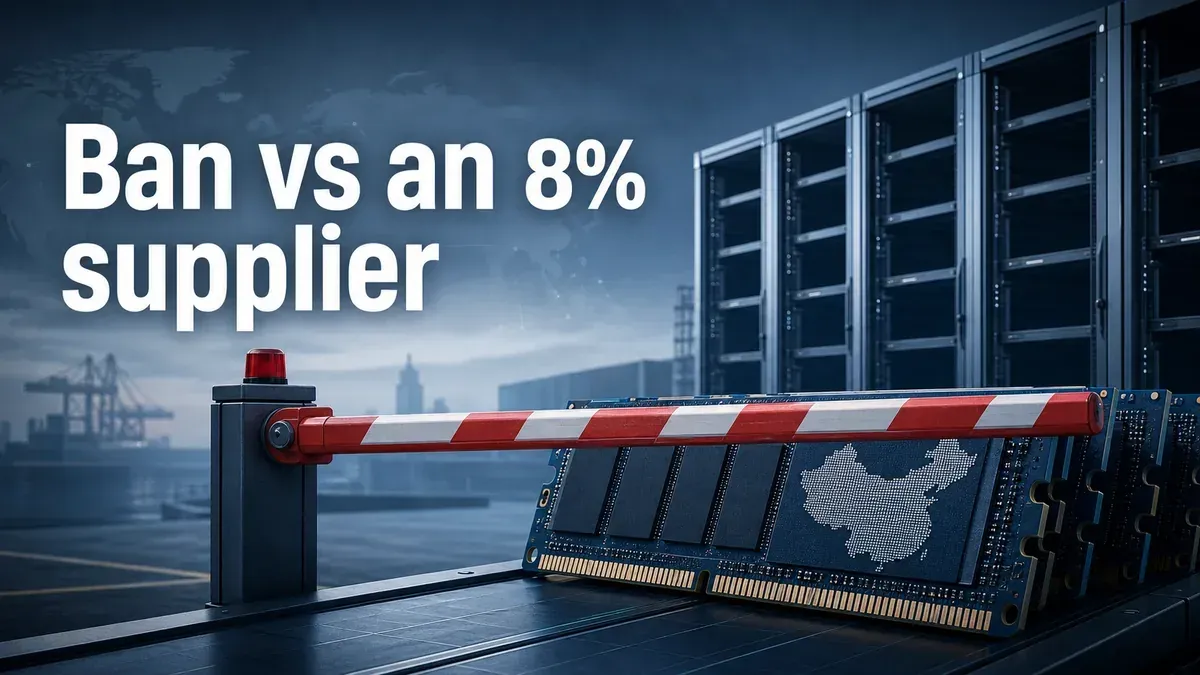
On July 17, 2026, two US lawmakers — Rep. John Moolenaar (R-MI), who chairs the House Select Committee on the Chinese Communist Party, and Rep. George Whitesides (D-CA) — urged the Trump administration to bar US companies from buying memory chips made by China's CXMT and YMTC, calling reliance on them "an unacceptable risk" to national, economic, and supply-chain security. The timing is the whole story: CXMT has climbed from 4% to 8% of the global DRAM market in a year, and it's doing so during the worst memory shortage in memory — the exact moment cheap Chinese supply is most tempting, and most dangerous.
This is a fight about dependence, and it lands at the worst possible time for buyers. Memory prices have roughly doubled in 2026 on AI demand, pushing companies as large as Apple to look at Chinese suppliers whose pricing undercuts Samsung, SK Hynix, and Micron. Lawmakers see that temptation as the trap: let Chinese state-subsidized chips into Western supply chains now, and you build a dependence that can be weaponized later. Here's exactly what the letter asks for, the numbers behind it, and the catch that makes it hard.
Table of Contents
- What the Letter Actually Asks For
- The Numbers: CXMT, YMTC, and the Big Three
- The Catch: Banning Relief During a Shortage
What the Letter Actually Asks For
This isn't a bill or a rule yet — it's a formal letter from two members of Congress to Commerce Secretary Howard Lutnick, pressing the administration to act through existing executive authority. The specific asks are concrete:
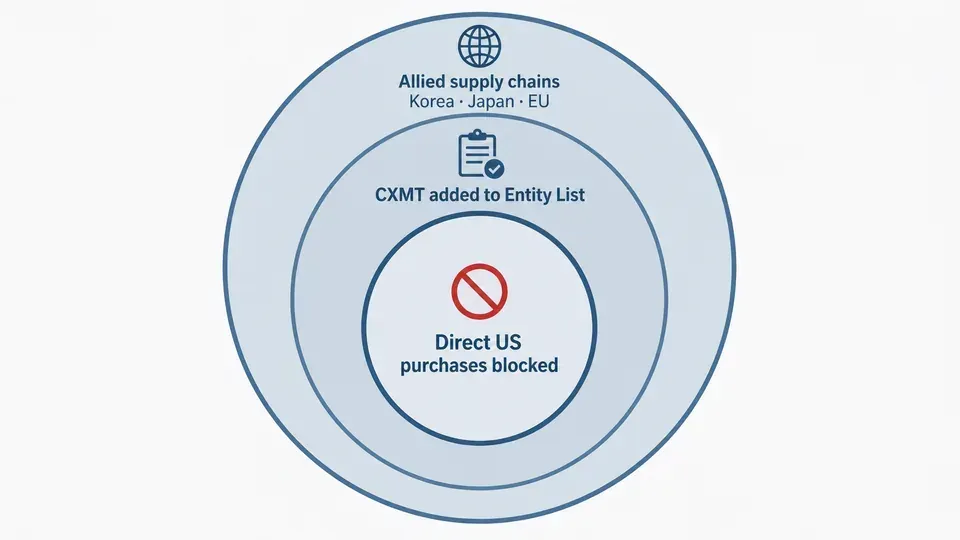
- An executive order or agency directive prohibiting US persons and US-incorporated entities from procuring memory components from YMTC, CXMT, or any entity already on the BIS Entity List or the Defense Department's Section 1260H list.
- Adding CXMT to the Entity List, and imposing additional restrictions on YMTC (which is already listed).
- Coordinating with South Korea, Japan, and the European Union to keep CXMT and YMTC out of allied supply chains — closing the back door where a banned chip enters through a partner country's products.
The rationale the lawmakers give is a pattern-recognition argument. They contend CXMT and YMTC could run China's playbook from solar, steel, telecom, and EVs: use state subsidies to undercut foreign rivals, drive down their investment and margins, and then exploit the resulting dependence for leverage — while the revenue helps subsidize the People's Liberation Army. Whether or not you buy the framing, the ask is unusually broad: it targets not just direct US purchases but the allied supply chains that route around them.
## The Numbers: CXMT, YMTC, and the Big Three
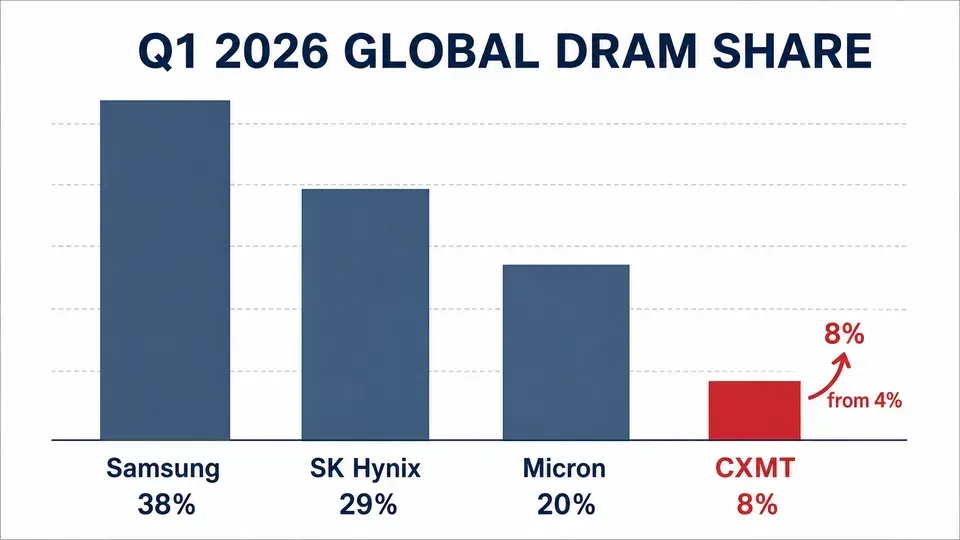
To see why this letter exists now and not a year ago, look at how fast CXMT has moved up the DRAM table. This is the global DRAM market share as of Q1 2026.
| Supplier | Country | Q1 2026 DRAM share | Trajectory |
|---|---|---|---|
| Samsung | South Korea | ~38% | Market leader |
| SK Hynix | South Korea | ~29% | HBM/AI-memory leader |
| Micron | United States | ~20%+ | Only US-based maker |
| CXMT | China | ~8% | 4% (Q2 2025) → 8% now → ~12% projected 2027 |
CXMT is now the fourth-largest DRAM maker in the world, having doubled its share in roughly a year, with projections pointing to about 12% by 2027 and a stated internal target near 17% by 2028 — closing in on Micron's wafer capacity. YMTC plays the same role in NAND flash. That growth curve is exactly what alarms the lawmakers: a state-backed newcomer scaling into a strategic market at the moment demand is white-hot.
And demand has never been hotter. The memory "supercycle" pushed conventional DRAM contract prices up roughly 90–95% in Q1 2026 (far above the original 55–60% forecast), with NAND flash up about 55–60%. Samsung's average memory selling prices jumped around 146% versus the 2025 full-year average. When incumbent prices double, a cheaper Chinese alternative stops being a curiosity and starts being a procurement decision — which is precisely the door the letter tries to shut. For the market backdrop behind these prices, see our breakdown of why the memory trade broke even as AI demand stayed strong.
## The Catch: Banning Relief During a Shortage
Here is the tension the letter can't wish away. The world is in a severe memory shortage. Cheap Chinese DRAM and NAND are, for many buyers, the only near-term relief valve — and a ban would slam it shut. As one industry read put it bluntly, a Chinese memory ban "would cut off RAMpocalypse relief." That's the trade-off in one line: security versus supply.
The costs land unevenly. For incumbents — Samsung, SK Hynix, Micron — a ban is a gift: it removes a fast-growing, price-cutting rival from the biggest market and helps keep prices elevated. For buyers — from hyperscalers to PC and phone makers, and yes, Apple — it removes the cheapest option in the middle of a shortage, locking in higher prices for longer. And for the policy itself, the hardest part is the allied-supply-chain ask: banning direct US purchases is straightforward, but keeping Chinese memory out of components assembled in Korea, Japan, or Europe requires cooperation the US can request but not command.
So the realistic outcome isn't a clean on/off switch. It's a negotiation over scope: which entities get listed, how "US-incorporated entity" is defined, whether allies actually align, and how much price pain the administration is willing to accept to reduce dependence. The letter is a marker — a signal that the political will is hardening even as the shortage makes a ban more expensive to enforce. Watch for whether CXMT actually lands on the Entity List; that single move would tell you which way the trade-off is being resolved.
Frequently Asked Questions (FAQ)
Is there an actual ban on Chinese memory chips now? No. As of July 17, 2026, it's a formal letter from two lawmakers urging the Trump administration to act — not a law or a finalized rule. It asks for an executive order or directive and for CXMT to be added to the Entity List.
What are CXMT and YMTC? CXMT (ChangXin Memory Technologies) is China's leading DRAM maker, now the world's fourth largest at about 8% share. YMTC is its NAND flash counterpart. Both are seen by the lawmakers as state-subsidized and strategically risky.
Why now? Because a global memory shortage has roughly doubled prices in 2026, making cheap Chinese chips tempting — even Apple has looked at Chinese suppliers. Lawmakers want to block that dependence before it takes hold.
Who benefits from a ban and who gets hurt? Incumbents Samsung, SK Hynix, and Micron benefit, since a rival is removed and prices stay high. Buyers — hyperscalers, device makers, and consumers — get hurt, because the cheapest relief valve during a shortage disappears.
What's the hardest part to enforce? Coordinating with South Korea, Japan, and the EU to keep Chinese memory out of allied supply chains. Blocking direct US purchases is simple; stopping Chinese chips inside components assembled abroad requires cooperation the US can ask for but not force.
Key Takeaways
- Reps. John Moolenaar (R-MI) and George Whitesides (D-CA) urged the Trump administration on July 17, 2026 to bar US companies from buying memory from China's CXMT and YMTC.
- The asks: an executive order/directive, adding CXMT to the BIS Entity List, and coordinating with Korea, Japan, and the EU to close allied supply-chain back doors.
- CXMT has doubled its DRAM share from 4% to ~8% in a year (now #4 worldwide, behind Samsung 38%, SK Hynix 29%, Micron 20%+), projected toward ~12% by 2027.
- It's happening during a memory supercycle: DRAM contract prices rose ~90–95% in Q1 2026, NAND ~55–60% — which is exactly why cheap Chinese chips are tempting.
- The catch: a ban is relief for incumbents but higher prices for buyers, and the allied-supply-chain piece is the hardest to enforce. Watch whether CXMT actually lands on the Entity List.
How this was written Research and a first draft came together with AI's help; verification and the final pass were entirely human.
References
- Financial Times — US lawmakers urge Trump administration to ban Chinese memory chips
- Tom's Hardware — Lawmakers want US government to ban memory chips from China, even in allied supply chains
- House Select Committee on the CCP — Moolenaar, Whitesides to Secretary Lutnick: Hold Firm on Chinese Memory Chips Ban
- The Register — Chinese memory ban would cut off RAMpocalypse relief
- Counterpoint Research — Global DRAM and HBM Market Share: Quarterly
- TrendForce — Memory 1Q26 Price Surge: Samsung Flags 146% ASP Jump, SK hynix Sees Mid-60% DRAM Gains



Comments ()