Apple Just Passed Nvidia at $4.88 Trillion: What the Market-Cap Flip Says About the AI Trade
Apple Just Passed Nvidia at $4.88 Trillion: What the Market-Cap Flip Says About the AI Trade
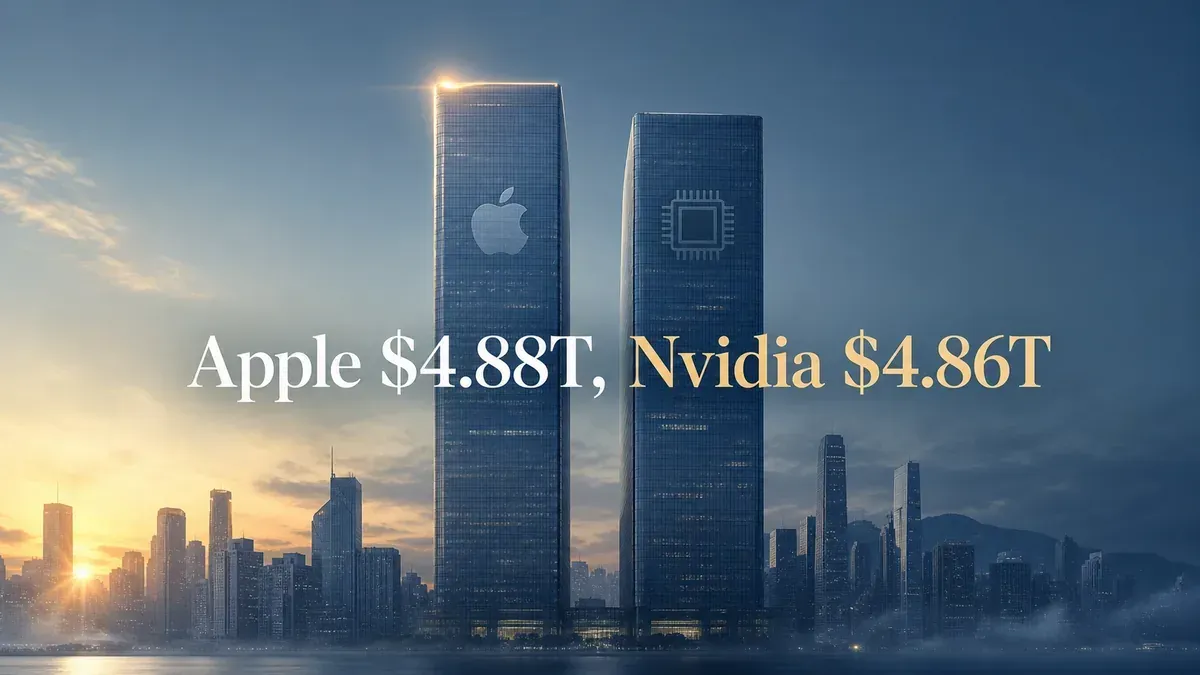
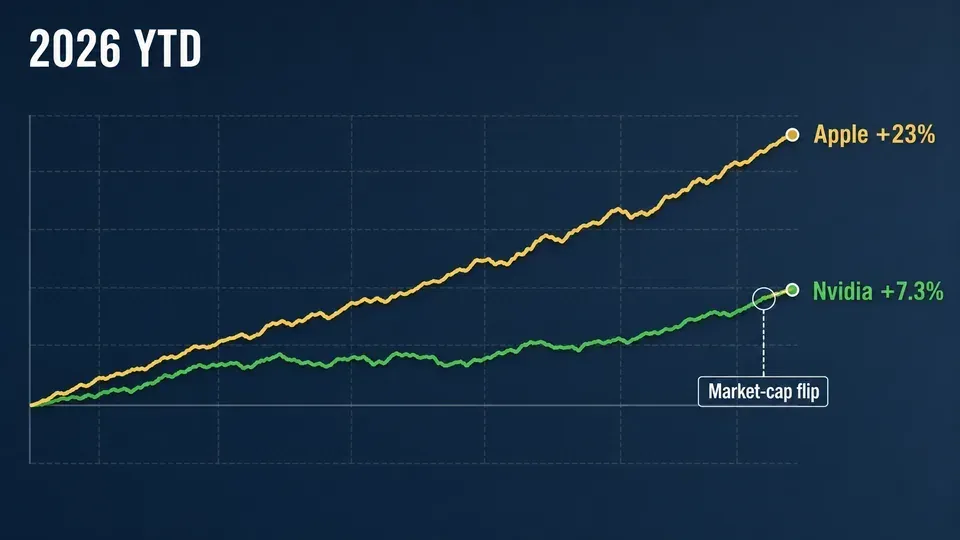
On Friday, July 17, 2026, Apple briefly overtook Nvidia to become the world's most valuable company, closing around $4.88 trillion versus Nvidia's roughly $4.86 trillion after Nvidia's stock fell about 3.5%. The lead later flipped back, with Nvidia finishing just above. The number that actually matters isn't the crown — it's the gap: Apple is up nearly 23% this year while Nvidia has gained just 7.3%. That divergence, not the one-day headline, is what tells you how the market is re-pricing the AI trade.
For most of 2026, the "most valuable company" title had a single owner. Nvidia took it from Microsoft in June 2025, rode the AI boom to a $5 trillion valuation in October 2025, and looked untouchable. Then on July 17, 2026, Apple — a company many investors had written off as an AI laggard — quietly pulled level and, for part of the session, ahead. Neither company is at $5 trillion right now; both sit in the $4.8–4.9 trillion range, close enough that a single bad day can swap the ranking. But under the noise, the two stocks have moved in opposite directions all year, and that split is the real story.
Table of Contents
The Flip, by the Numbers
A market-cap crown that changes hands intraday is less interesting than the trajectory behind it. Here is what separates the two most valuable companies on Earth as of mid-July 2026.
| Metric | Apple (AAPL) | Nvidia (NVDA) |
|---|---|---|
| Market cap (July 17, 2026) | ~$4.88 trillion | ~$4.86 trillion |
| 2026 year-to-date stock move | ~ +23% | ~ +7.3% |
| Move on July 17 | Higher (took the lead intraday) | ~ −3.5% |
| Last held "most valuable" title | April 2025 (before this) | June 2025 → mid-2026 |
| Peak valuation reached | approaching $5T now | $5T in October 2025 |
Two things jump out. First, the actual valuation difference on the day — about $20 billion on a base near $4.87 trillion — is a rounding error, well under half a percent. This is a photo finish, not a blowout. Second, and more importantly, Apple's roughly 23% gain has far outpaced the tech-heavy Nasdaq this year, while Nvidia's 7.3% has trailed it. The crown swapped hands because one stock has been steadily climbing while the other has stalled — Nvidia's 3.5% drop on Friday was just the moment the two lines finally crossed.
## Why the Lead Changed Hands
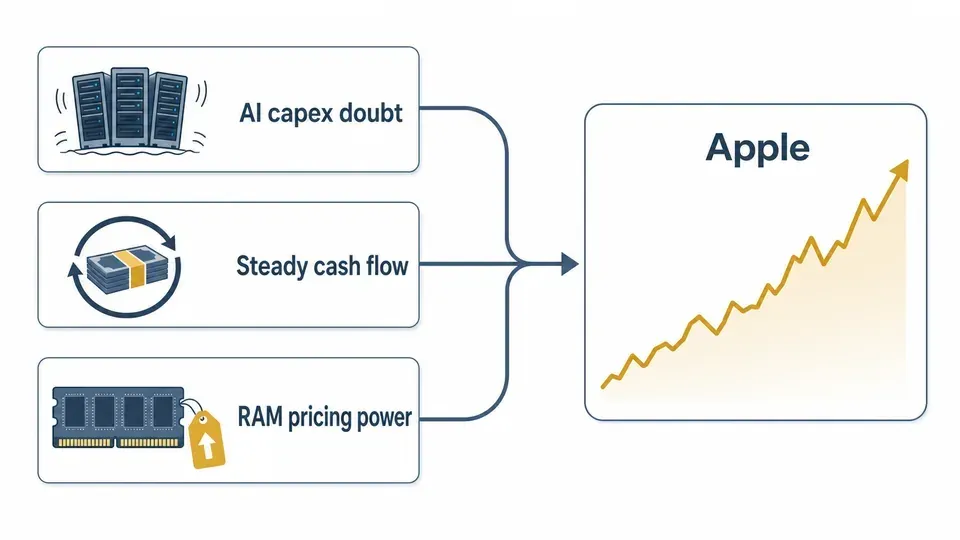
The flip comes down to a rotation in what the market is willing to pay up for. Three forces did the work.
1. Doubt about the pace of AI infrastructure spending. Nvidia's valuation is a direct bet on hyperscalers pouring capital into AI data centers quarter after quarter. Through mid-2026, Wall Street has grown less certain that spending will keep accelerating at the pace priced in — the same unease that has rattled the broader AI-chip and memory complex. When investors question the rate of AI capex growth, the most capex-sensitive stock on the board — Nvidia — is the one that gets marked down first.
2. Apple's own AI acceleration and product strength. Apple spent 2025 being mocked as the big-tech name that "missed" AI. In 2026 that narrative softened as the company accelerated its own AI plans and delivered the kind of steady, cash-generative results that look attractive precisely when the high-flying AI names get shaky. Money didn't leave technology — it rotated toward a mega-cap seen as more insulated from a data-center spending slowdown.
3. An unexpected tailwind hiding in a headwind — the RAM shortage. The global memory shortage that has hammered memory buyers pushed Apple to raise prices on Macs, iPads, and other products. The stock dipped on the announcement, then more than recovered within a week, because higher prices on inelastic hardware can protect margins. The same shortage that pressures the AI-hardware supply chain became, for Apple, a pricing-power story.
## What It Means for the AI Trade
It would be easy to read "Apple beats Nvidia" as "the AI trade is over." That's the wrong takeaway. Nvidia is still up on the year, still within a whisker of the most valuable company on the planet, and still selling every chip it can make. What changed is narrower and more useful to understand: the market is no longer paying an unlimited premium for pure AI-infrastructure exposure, and it is rewarding mega-caps that generate cash regardless of how fast data-center spending grows.
This is a rotation within big tech, not an exit from it. For anyone watching the AI trade, the signal is that leadership is broadening out from the single name most levered to AI capex toward companies with more diversified, less capex-dependent earnings. The most valuable-company title will likely keep changing hands for a while — the two are simply too close for it to settle. The durable insight is the 15-point performance gap underneath it: in 2026, "steady and diversified" started beating "maximum AI beta," and that is a meaningful shift in how the market is pricing the boom.
Frequently Asked Questions (FAQ)
Did Apple permanently pass Nvidia as the most valuable company? No. Apple briefly took the lead intraday on July 17, 2026, closing around $4.88 trillion, but the ranking flipped back with Nvidia finishing just above. The two are within a fraction of a percent of each other, so the title is likely to trade back and forth.
How much is each company worth right now? Both are in the $4.8–4.9 trillion range as of mid-July 2026. Neither has reclaimed the $5 trillion mark; Nvidia last touched $5 trillion in October 2025.
Why is Apple's stock beating Nvidia's in 2026? Apple is up about 23% year-to-date versus roughly 7.3% for Nvidia. Investors have grown cautious about the pace of AI data-center spending (which Nvidia depends on) and rotated toward Apple's steadier, more diversified cash flows.
Does this mean the AI boom is cracking? Not exactly. It signals the market is no longer paying an unlimited premium for pure AI-infrastructure exposure. It's a rotation within big tech, not a collapse — Nvidia is still up on the year and still selling out its chips.
How did the RAM shortage help Apple? The memory shortage forced Apple to raise prices on Macs, iPads and other products. After an initial dip, the stock recovered within a week because higher prices on hardware people still buy can protect margins — turning a supply-chain headwind into a pricing-power story.
Key Takeaways
- On July 17, 2026, Apple briefly overtook Nvidia as the world's most valuable company, ~$4.88T vs ~$4.86T, after Nvidia fell about 3.5%. The lead later flipped back.
- The real story is the trajectory: Apple is up ~23% in 2026 while Nvidia is up ~7.3% — a 15-point gap that finally let the lines cross.
- The driver is a re-pricing of the AI trade: doubt about the pace of AI capex hits Nvidia hardest, while Apple's diversified cash flows look safer.
- The global RAM shortage became a pricing-power tailwind for Apple even as it pressures the broader AI-hardware chain.
- This is a rotation within big tech, not the end of the AI boom — leadership is simply broadening beyond maximum AI beta.
How this was written This piece was drafted with AI's research help; a human verified every fact and polished the final wording.
References
- Reuters — Apple unseats Nvidia to become world's most valuable company as AI bets shift
- Forbes — Apple Becomes World's Largest Company—Surpassing Nvidia
- CNBC — Apple, Nvidia vie for title of world's most valuable company
- 9to5Mac — Apple overtakes Nvidia as world's most valuable company as it barrels toward $5T
- Fox Business — Apple briefly overtakes Nvidia as world's most valuable company amid AI investment doubts


Comments ()