
One Injection, 375 Million Patients: What Stanford's Arthritis Reversal Study Actually Shows
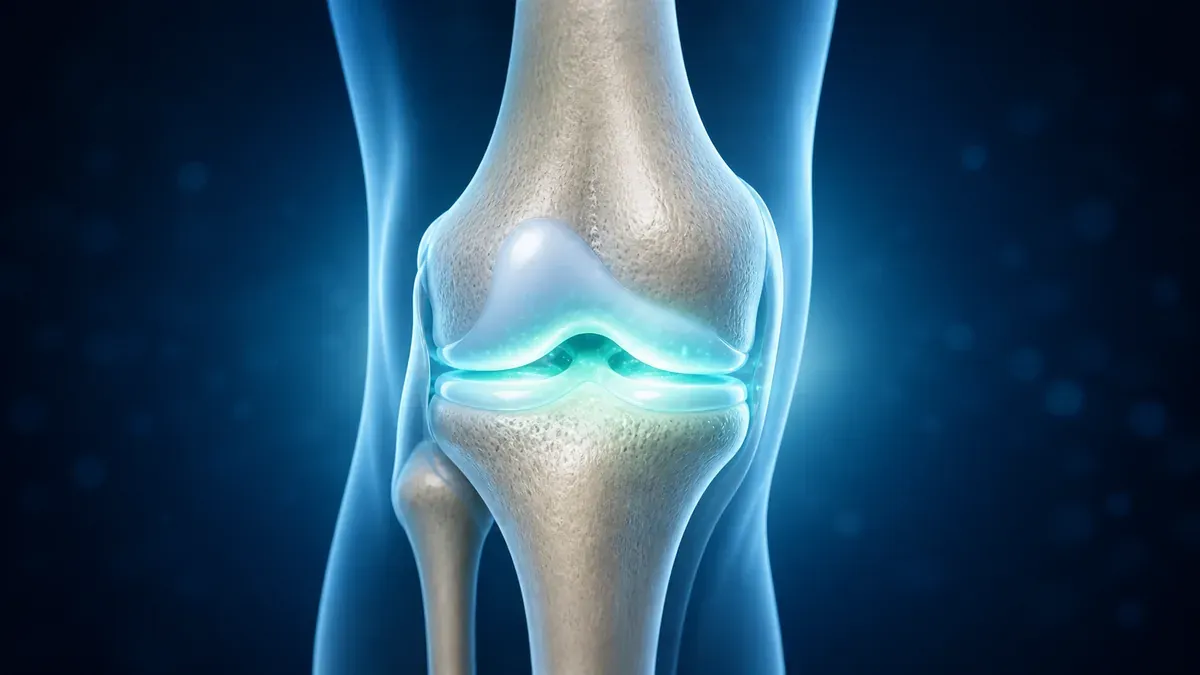
A Stanford Medicine study published in Science on June 12, 2026 showed that blocking a single aging-related protein — 15-PGDH — reversed cartilage loss in old mice, prevented post-injury arthritis, and triggered cartilage regrowth in human knee tissue in the lab. That's genuinely a big deal for a disease affecting roughly 375 million people. But "worked in mice and human tissue" is not "available at your clinic," and the gap between those two is the whole story. Here's what the study actually proved, and how far it is from your knee.
Osteoarthritis has always been treated as one-way: cartilage wears down, and the only real fixes are pain management or replacing the joint with metal and plastic. A study suggesting that damage can be reversed with an injection is exactly the kind of finding that gets flattened into "scientists cure arthritis." So let's separate the real result from the headline — what happened, why it might work, and the honest timeline to a treatment.
The claim vs. the caveat
The claim, stated carefully: in mice and in human tissue, blocking the protein 15-PGDH didn't just slow arthritis — it reversed cartilage loss that had already occurred. A single injection stopped progression and rebuilt lost cartilage. That's a meaningful step beyond today's drugs, which mostly manage symptoms.
The caveat, stated just as carefully: the cartilage results are in old mice and in human knee tissue removed during joint-replacement surgery and studied in the lab — not in living human patients. No one has yet regrown cartilage in a walking person with this approach. Both facts are true, and keeping them together is the difference between informed hope and hype.
What 15-PGDH is and why blocking it works
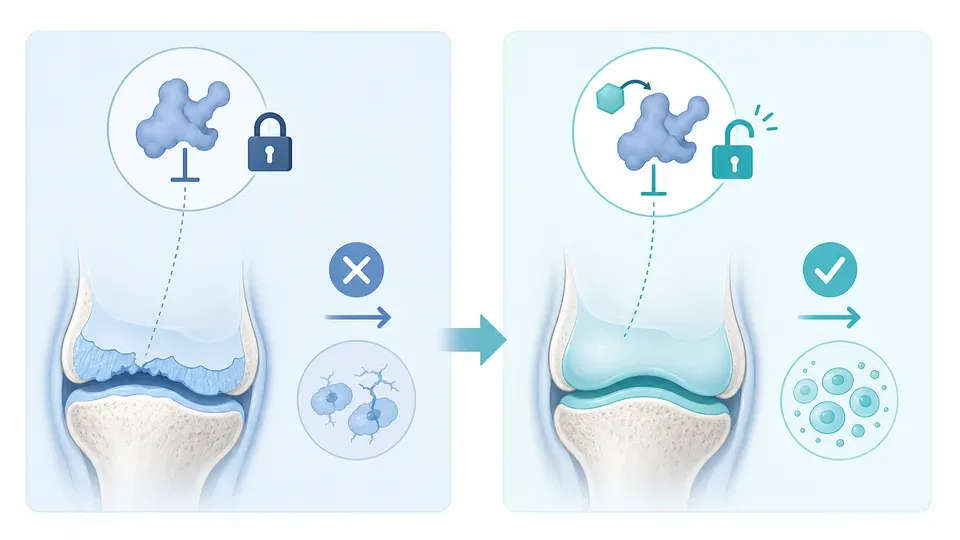
The mechanism is elegant. 15-PGDH is what researchers call a "gerozyme" — a protein whose levels rise with age and actively suppress the body's tissue-repair machinery. In mouse knee cartilage, 15-PGDH levels roughly doubled with age. As it accumulates, it effectively holds down a brake on repair.
The insight is that the body may retain more repair capacity than we assumed — it's just being suppressed. Rather than implanting new cartilage or cells, the Stanford approach releases the brake: block 15-PGDH, and the tissue's own regenerative response picks back up. That's why a single injection, rather than a permanent implant, could plausibly do the work.
## What the study actually showed
Here's the evidence, sorted by how strong it is — which is the part most coverage skips:
| Finding | Where it was shown | Evidence strength |
|---|---|---|
| Reversed age-related cartilage loss | Old mice | Strong (animal) |
| Prevented post-injury arthritis | Mice | Strong (animal) |
| Triggered cartilage regeneration | Human knee tissue (lab) | Promising (ex vivo, not in a living person) |
| Reduced pain, steadier gait, more weight-bearing | Treated mice (3 pain tests) | Strong (animal) |
| Works as a local injection or oral drug in patients | — | Not yet shown in humans |
The treated mice didn't just show better scans — they behaved better: a steadier gait, more weight placed on injured legs, and reduced pain across three well-established pain assessments. Functional improvement, not only a biomarker. The human-tissue result is the tantalizing bridge: it suggests the same repair machinery exists and responds in people, without yet proving it works in a living body.
## How far from your knee? The honest timeline
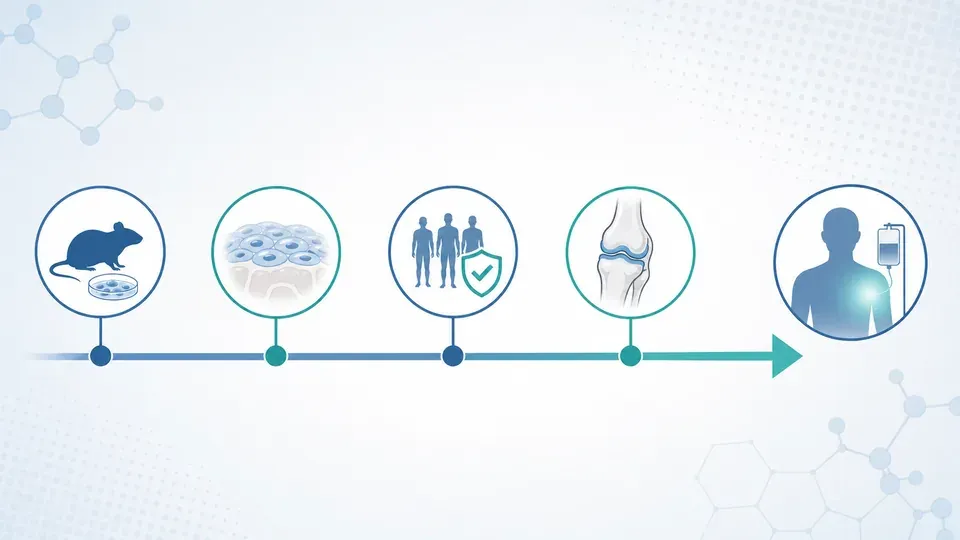
This is where cautious optimism is warranted rather than dismissal. A 15-PGDH inhibitor is not starting from zero in humans: Phase 1 clinical trials of a 15-PGDH inhibitor for muscle weakness have already shown it is safe and active in healthy volunteers. That matters because it means the drug class has cleared an early human-safety bar — researchers aren't beginning the entire regulatory journey from scratch for the cartilage use.
The researchers hope a similar trial will be launched soon to test the effect specifically on cartilage regeneration. But "hope to launch soon" is still years from an approved treatment: a dedicated cartilage trial would need to run through Phase 1/2/3 for this indication, in real patients, before anyone gets a prescription. Realistically, this is a watch-this-space result — promising enough to track closely, early enough that no one should delay a needed joint replacement waiting for it.
Why it matters: the scale of the problem
The reason this study drew so much attention is arithmetic. In 2021, knee osteoarthritis accounted for about 374.74 million prevalence cases globally — up from 159.80 million in 1990, and rising with aging populations and obesity. Because of osteoarthritis, an estimated 1 million knee and hip replacements are performed each year. Current care is largely pain control until the joint fails and gets replaced.
Against that backdrop, even a treatment that only delays replacement for a fraction of patients would be enormous — economically and in quality of life. A treatment that genuinely reverses early cartilage loss with an injection would reshape how the disease is managed. That's the prize that makes a mouse-and-tissue study front-page news — and also why it's worth being precise about how much is still unproven.
Frequently Asked Questions (FAQ)
Did Stanford cure arthritis? No. Researchers reversed cartilage loss in old mice and regrew cartilage in human tissue in the lab by blocking a protein called 15-PGDH. It has not yet been tested for cartilage in living human patients.
What is 15-PGDH? An aging-related "gerozyme" — a protein that rises with age and suppresses the body's tissue repair. Blocking it appears to release the brake on cartilage regeneration.
Was it tested in humans at all? On human tissue (knee tissue removed during joint replacements), yes, in the lab. Separately, a 15-PGDH inhibitor has passed Phase 1 human safety trials for muscle weakness — but not for cartilage.
When could this be available? Unknown, and likely years away. A dedicated human cartilage trial has not started; the researchers hope to launch one. It would still need to run through clinical phases before approval.
Should I wait for this instead of a knee replacement? No. This is early-stage research. Any decision about a needed joint replacement should be made with your doctor based on treatments available now.
Key Takeaways
- A Stanford study in Science (June 12, 2026) showed blocking 15-PGDH reversed cartilage loss in old mice and regrew cartilage in human tissue in the lab.
- 15-PGDH is a "gerozyme" that rises with age (roughly doubling in mouse knee cartilage) and suppresses repair; blocking it releases that brake.
- Treated mice improved functionally — steadier gait, more weight-bearing, less pain across three tests — not just on scans.
- The cartilage results are preclinical; no living human has regrown cartilage this way yet, though the drug class has passed Phase 1 safety for a different use.
- It matters because knee osteoarthritis affects ~375 million people and drives ~1 million joint replacements a year — but it's watch-this-space, not a treatment you can get today.
How this was written AI helped research this piece, but every source, fact, and sentence was checked and finalized by hand.
References
ScienceDaily: "Stanford scientists regrow lost cartilage and reverse arthritis in major breakthrough" — https://www.sciencedaily.com/releases/2026/06/260612021604.htm - ScienceDaily: "One injection reversed osteoarthritis in weeks" — https://www.sciencedaily.com/releases/2026/06/260619101356.htm - Medical Daily: "Stanford Scientists Reversed Arthritis and Regrew Cartilage by Blocking an Aging Protein — and It Worked in Human Tissue Too" — https://www.medicaldaily.com/stanford-cartilage-regrowth-15-pgdh-arthritis-breakthrough-science-june-2026-475691 - WHO: "Osteoarthritis" fact sheet — https://www.who.int/news-room/fact-sheets/detail/osteoarthritis - Frontiers in Medicine: "Global burden and socioeconomic impact of knee osteoarthritis: a comprehensive analysis" — https://www.frontiersin.org/journals/medicine/articles/10.3389/fmed.2024.1323091/full


Comments ()