
Scientists Built a Cell That Feeds, Grows, and Divides
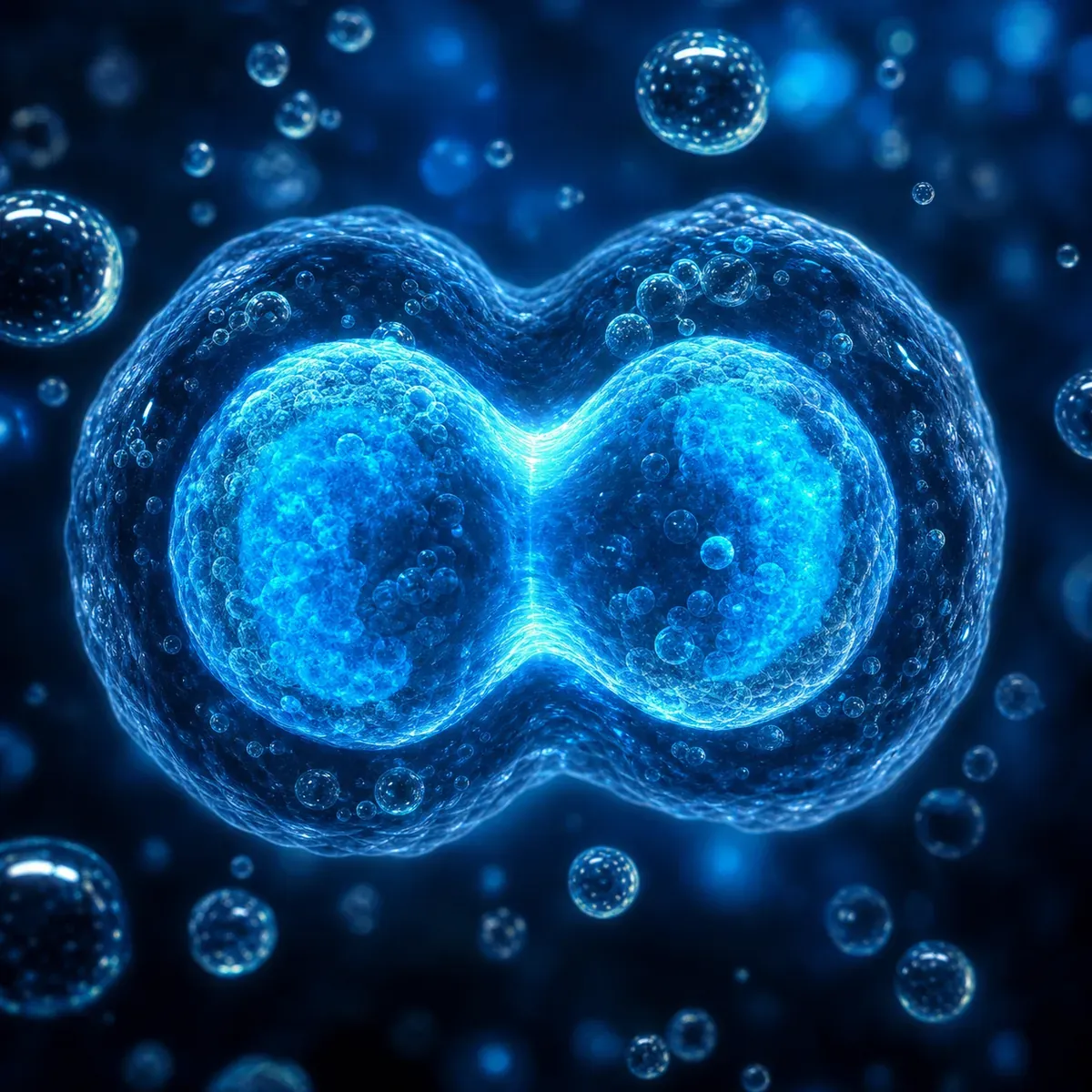
TL;DR — Researchers at the University of Minnesota have created SpudCell: the world's first synthetic cell with a complete life cycle that feeds, grows, replicates its DNA, and divides into daughter cells — all built from scratch. It isn't fully alive by the strictest biological definition, but it's the closest thing science has made yet, and the implications for medicine and engineering are significant.
For decades, scientists have been trying to answer one of biology's hardest questions: what is the minimum set of parts needed to make something alive? A team led by Kate Adamala and Aaron Engelhart at the University of Minnesota's College of Biological Sciences may have come the closest yet to an answer. Their creation, SpudCell, is a synthetic cell assembled from 36 purified enzymes, a 90,000 base pair genome spread across nine separate DNA molecules, and a lipid membrane — essentially a bag of engineered chemistry that behaves like life.
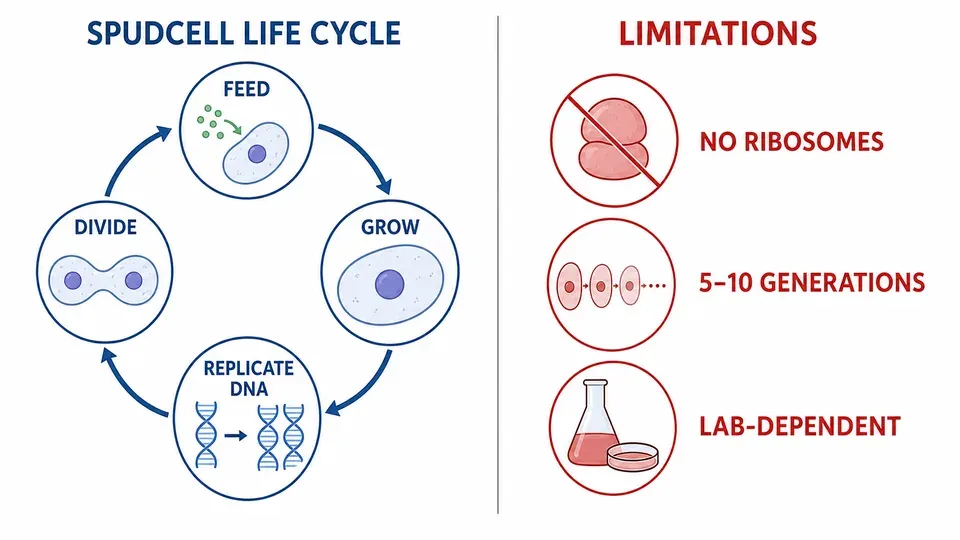
What makes SpudCell remarkable is that it doesn't just sit there. It replicates its genetic material. It grows in size. It feeds by absorbing nutrient-filled liposomes from its environment. It divides into daughter cells. And across generations, it shows selection — the fitter variants outcompete weaker ones, the core mechanism of evolution. That's not a simulation of life. That's several of the most fundamental things life does, happening in a constructed system.
So what? The honest answer depends on what you're hoping for. If you're asking whether scientists have created new life — debatable, and deliberately so. SpudCell lacks the ability to synthesize its own ribosomes (it borrows E. coli ribosomes) and can't survive more than 5 to 10 generations before degrading. About 30% of daughter cells after five generations are missing DNA and are nonviable. It can't exist outside the lab. New Scientist notes it's "not quite" a living cell by strict definitions.
But the significance isn't in the headline. It's in what SpudCell demonstrates as a platform. When you can assemble a functional, dividing cellular system from a defined list of components, you can start asking engineering questions: what happens if you swap this enzyme? Add that gene? Rebuild this pathway? Biology becomes something closer to software — a system you can debug, compile, and optimize.
| What SpudCell can do | What it can't do yet |
|---|---|
| Replicate DNA across generations | Synthesize its own ribosomes |
| Grow in size | Survive beyond 5–10 generations |
| Feed via external liposomes | Exist outside laboratory conditions |
| Divide into daughter cells | Maintain full genomic integrity (30% daughter-cell loss) |
| Show selection across generations | Function without external nutrient supply |
The medical implications are what draw the most serious attention. A synthetic cell platform means potential drug-delivery systems that can seek and divide at a tumor site, or biosensors that grow in response to a specific signal. Engineered cells that produce a therapeutic molecule on demand, in situ. These aren't applications for tomorrow — the current SpudCell degrades too quickly — but they map out the engineering direction clearly.
There's also a philosophical dimension that biology rarely makes explicit. SpudCell exists as a preprint posted to biotic.org rather than a peer-reviewed journal, which means the scientific community hasn't yet formally vetted every claim. That matters: extraordinary results need extraordinary scrutiny. The research appears solid, and the team has a track record in synthetic biology, but "peer review pending" is the honest asterisk on every claim here.
What's not in doubt is the direction of travel. Synthetic biology has been moving toward this point for two decades — from the first synthetic genome in 2010 to gradually more functional artificial cells. SpudCell isn't the destination. It's the clearest proof yet that the destination exists.
Bottom line: SpudCell doesn't cross the line into "life created from scratch," but it moves that line closer than anything before it — and that gap is where the most interesting science of the next decade will happen.
Sources: University of Minnesota press release, New York Times, New Scientist, CNN — July 1, 2026
Tags: #Science #Biology #Biotech #Innovation #SyntheticBiology
Comments ()