Inkling Isn't the Strongest Open Model — And Thinking Machines Says So on Purpose
Inkling Isn't the Strongest Open Model — And Thinking Machines Says So on Purpose
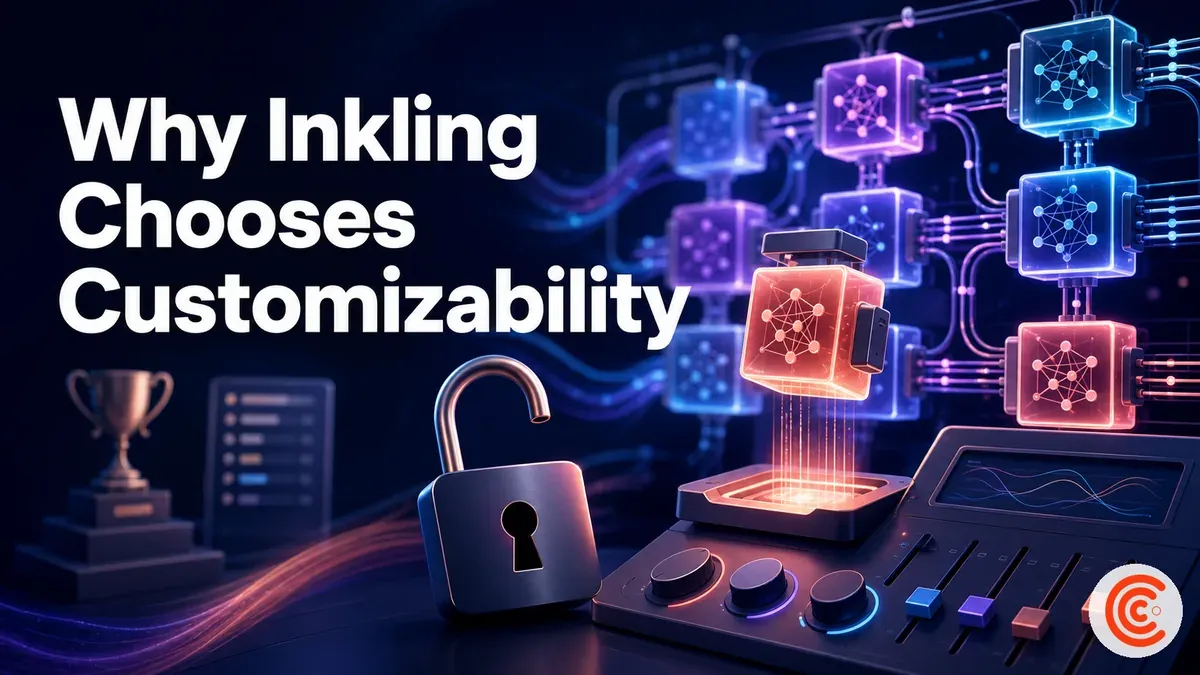
Thinking Machines Lab, the startup led by former OpenAI CTO Mira Murati, released Inkling — a 975B-parameter open-weights model under Apache 2.0. It is not the top of any leaderboard, and the company says so openly. That admission is the strategy, not a weakness.
Most model launches lead with a leaderboard win. Inkling, released in mid-July 2026, did something unusual: its makers said plainly that it is not the strongest model available. In a market where every release claims a new state of the art, choosing not to make that claim is itself the positioning. Here is what Inkling actually is, and why "customizable" may matter more than "best."
Table of Contents
- What Inkling is
- The benchmarks, in context
- Why customizability beats the leaderboard here
- What to weigh before you build on it
What Inkling is

Inkling is the first open-weights model from Thinking Machines Lab, the company founded by former OpenAI chief technology officer Mira Murati. It shipped in mid-July 2026 under an Apache 2.0 license — a genuinely permissive license that allows commercial use, modification, and redistribution.
The technical profile:
| Attribute | Inkling |
|---|---|
| Architecture | Mixture-of-Experts transformer |
| Total parameters | 975 billion |
| Active parameters per token | 41 billion |
| License | Apache 2.0 (open weights) |
| Modalities | Text, images, audio |
| Context window | 1,000,000 tokens |
Two design choices stand out. First, the Mixture-of-Experts design means that although the model holds 975B parameters, only about 41B activate for any given token — a route to large-model quality at a fraction of the per-query compute of a dense model that size. Second, the Apache 2.0 license and open weights mean anyone can download, fine-tune, and deploy it without asking permission or paying per token.
The benchmarks, in context
Inkling's public scores place it as a strong open model without topping the closed frontier:
- SWE-bench Verified: 77.6% (real software-engineering tasks)
- MMMU-Pro: 73.5% (multimodal reasoning)
- VoiceBench: 91.4% (speech understanding)
On the composite Artificial Analysis Intelligence Index, Inkling debuted around 41, reported as the top-scoring U.S. open-weights model at launch.
The honest reading: these are competitive, not chart-topping, numbers. The best closed models still lead on the hardest coding and reasoning suites. But the gap between the best open-weight models and the best closed models has compressed to single-digit percentage points on several benchmarks — which reframes the entire choice. When the quality difference is small and shrinking, factors other than raw benchmark rank start to dominate the decision.
Why customizability beats the leaderboard here
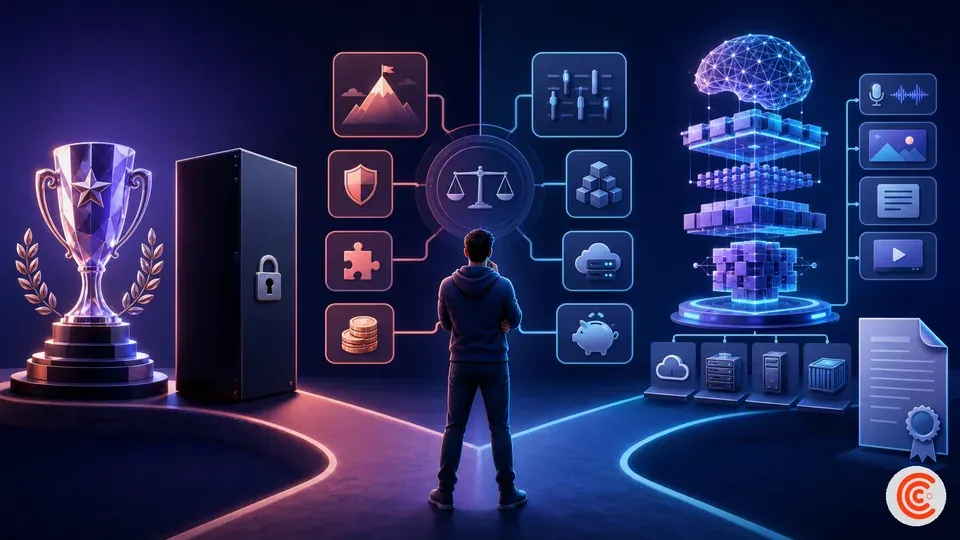
Thinking Machines is explicit that Inkling is a base to build on, not a finished product meant to win comparisons. That is a coherent bet on three structural advantages of open weights:
- Fine-tuning on your own data. With the weights in hand, a team can specialize the model for a narrow domain — legal, medical coding, a specific codebase — and often beat a larger general model on that task. A leaderboard measures general ability; production cares about your task.
- Cost asymmetry. A permissively licensed model you host yourself removes per-token API fees and, with an MoE design activating only ~41B parameters, keeps inference cost manageable. At scale, the economics can invert the "closed model is better" calculus.
- Control and portability. Open weights mean no vendor lock-in, no surprise deprecation of the model you built on, and the ability to run in your own environment for privacy or compliance reasons.
Put together, "not the strongest" is a feature pitch: the value is not in beating a benchmark out of the box, but in being the best starting point for a system you shape yourself.
What to weigh before you build on it
Open weights shift work and responsibility onto you. Before committing:
- Total cost of ownership. "No API fee" is not "free." Self-hosting a 975B-parameter MoE model requires serious GPU capacity, MLOps skill, and reliability engineering. For low or bursty volume, a closed API can still be cheaper.
- Where the gap actually bites. If your workload is exactly the hardest frontier reasoning or agentic coding, the single-digit benchmark gap may be the difference that matters. Test on your tasks, not the leaderboard.
- Safety and governance are now yours. A permissive license also means you own the guardrails, evaluation, and misuse mitigation that a hosted provider would otherwise manage.
- Longevity of the base. Building on any model — open or closed — is a bet on the ecosystem around it. Open weights protect you from deprecation but not from a stagnant community.
Frequently Asked Questions
Who makes Inkling? Thinking Machines Lab, a startup founded by Mira Murati, former chief technology officer of OpenAI. Inkling is the company's first open-weights model.
What does "open weights under Apache 2.0" mean in practice? You can download the model's trained parameters and use, modify, fine-tune, and redistribute it — including commercially — under a permissive license, rather than only calling it through a paid API.
Is Inkling better than the leading closed models? No, and the company does not claim it is. Its scores are competitive but not chart-topping. Its pitch is customizability, cost control, and portability as a base model, not raw benchmark leadership.
What is the point of 975B parameters if only 41B are active? That is the Mixture-of-Experts design: a large pool of specialized parameters, but only a subset activates per token. It aims for big-model quality at much lower per-query compute than a dense model of the same size.
Key Takeaways
- Inkling is Thinking Machines Lab's first model: 975B total / ~41B active MoE, Apache 2.0, multimodal, 1M-token context.
- Benchmarks (77.6% SWE-bench Verified, 73.5% MMMU-Pro, 91.4% VoiceBench) are strong but not frontier-leading.
- The open-vs-closed quality gap has narrowed to single digits on several benchmarks, making non-benchmark factors decisive.
- "Not the strongest" is deliberate positioning: Inkling is sold as the best base to customize, not the best out-of-the-box model.
- Open weights move cost, control, and safety responsibility to you — evaluate on your own workload before building.
How this was written
I gathered Inkling's specifications, license, benchmark scores, and the company's stated positioning from multiple independent write-ups of the mid-July 2026 launch and cross-checked the architecture and benchmark figures for consistency before drafting this analysis.
Comments ()