
A Quantum Computer Just Modeled Fusion Fuel for the First Time — and It's About Tritium

A Quantum Computer Just Modeled Fusion Fuel for the First Time — and It's About Tritium
On July 6, 2026, IBM, Oak Ridge National Laboratory, and Cleveland Clinic reported the first-known computation of a fusion fuel material — nine molecular configurations of the molten salt FLiBe — on a quantum computer. The goal is not the reactor. It is solving fusion's quietest supply problem: tritium.
Fusion's biggest obstacle is not always the plasma or the magnets. It is fuel. Most leading reactor designs need tritium, a hydrogen isotope so rare in nature that plants will have to breed their own. A team from IBM, Oak Ridge National Laboratory (ORNL), and Cleveland Clinic just took a concrete step toward that problem — using a quantum computer to model the exact material meant to make tritium possible.
Table of Contents
- What the team actually computed
- Why tritium is fusion's quiet bottleneck
- Why this is a job for quantum computers
- How much this moves the needle
What the team actually computed
The researchers calculated nine molecular configurations of FLiBe — a molten salt made of fluorine, lithium, and beryllium — on a quantum computer, which the announcement describes as the first-known instance of such computations on quantum hardware.
FLiBe is not a random molecule. It is one of the leading candidate materials to sit inside a fusion reactor and do two jobs at once: help breed tritium and help carry it out to be collected. Modeling how its electrons actually behave is a prerequisite to optimizing that process — and, historically, a very hard thing to do accurately.
The same teams have applied related quantum-simulation techniques to a 12,635-atom protein with Cleveland Clinic, part of a broader push to use what IBM calls quantum-centric supercomputing to calculate the quantum behavior of electrons in complex materials, complementing classical supercomputers rather than replacing them. The work sits under the U.S. Department of Energy's Genesis Mission, an initiative to combine high-performance computing, AI, and quantum computing to speed scientific discovery.
(The announcement did not specify which quantum processor or how many qubits were used, so those details are left out here.)
Why tritium is fusion's quiet bottleneck
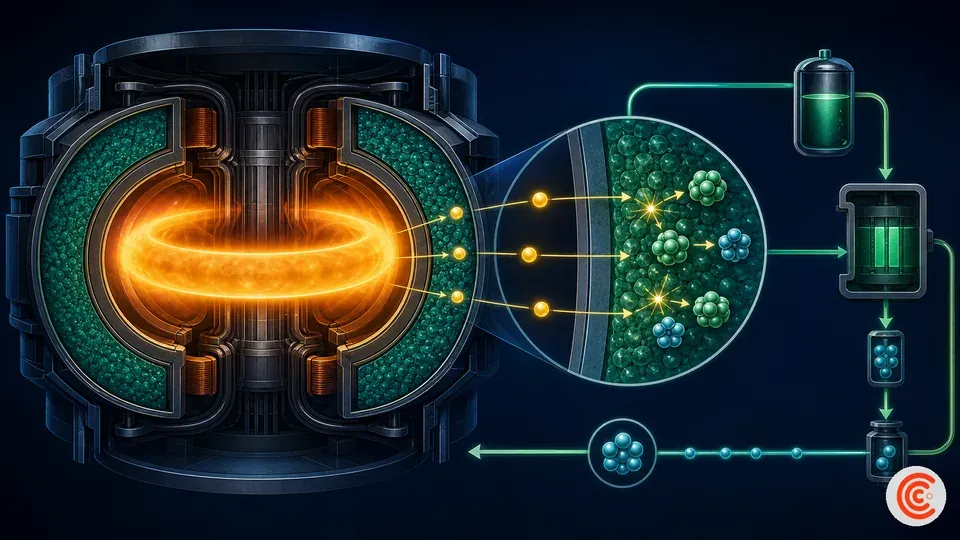
Fusion headlines usually celebrate temperature records or "net energy" milestones. Fuel supply gets less attention, and it may be the harder long-run constraint.
- The favored fuel cycle for near-term reactors fuses deuterium and tritium.
- Deuterium is abundant. Tritium is not — it is radioactive, decays with a short half-life, and exists in only trace amounts naturally.
- So a fusion plant cannot simply buy decades of fuel. It has to breed tritium on-site, typically by surrounding the plasma with a lithium-bearing "blanket" that captures neutrons and produces tritium, which must then be extracted and recycled continuously.
As the research announcement puts it, ensuring adequate supplies of tritium has long been a barrier to realizing clean, abundant fusion energy. FLiBe is attractive precisely because it can serve as both breeding medium and coolant. But designing that blanket chemistry well enough to actually close the fuel cycle requires understanding the material at the level of its electrons — which is where classical computers struggle.
Why this is a job for quantum computers
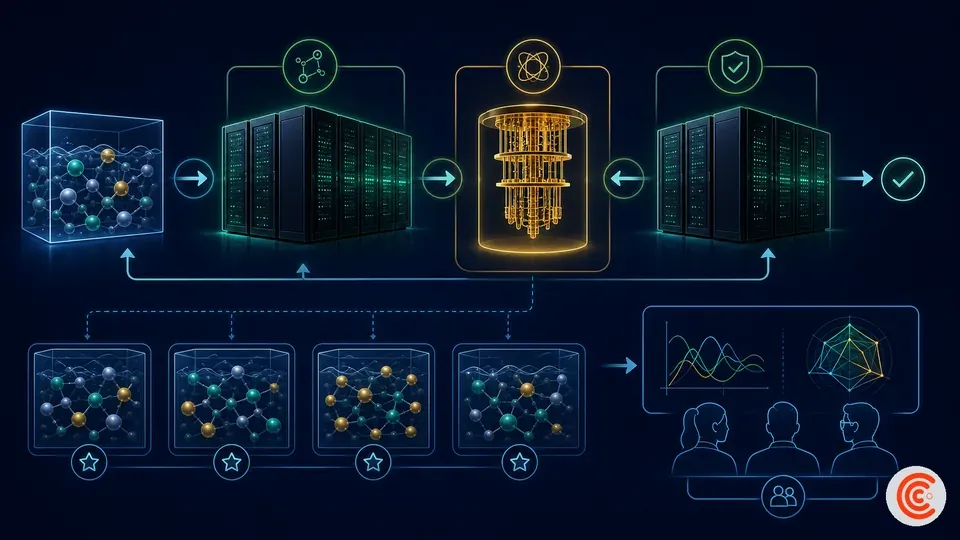
Simulating molecules is one of the few problems where quantum computers have a clean theoretical rationale, not just hype.
The behavior of electrons in a molecule is governed by quantum mechanics, and the number of interacting quantum states grows explosively with the number of electrons. Classical supercomputers handle this by approximating — and for strongly correlated systems, those approximations can break down. A quantum computer, by contrast, represents quantum states natively, so in principle it can capture electron correlation that classical methods only estimate.
That is the significance of computing FLiBe configurations on quantum hardware: it is a proof point that this class of materials chemistry — the kind that matters for a fusion fuel blanket — is now within reach of quantum-centric methods, used alongside classical supercomputers rather than instead of them. The framing throughout is complementary: quantum machines handling the electron-correlation core, classical machines doing the rest.
How much this moves the needle
It is worth being precise about the size of the claim. This is an early, foundational result — nine molecular configurations of one candidate material — not a solved fuel cycle or a working reactor. The honest way to read it:
- It is a first, not a finish. "First-known computation" marks a starting capability, not a deployed solution. Optimizing real tritium breeding will take far more than nine configurations.
- The value is the method. The durable takeaway is that quantum-centric supercomputing can now attack fusion-relevant materials chemistry at all — a capability that compounds as hardware scales.
- It reframes the timeline conversation. Fusion's fuel problem is often treated as an engineering afterthought. Bringing quantum simulation to FLiBe signals that the materials-and-fuel side is now getting serious computational attention, not just the plasma physics.
For readers tracking either fusion or quantum computing, the useful signal is convergence: two long-hyped fields producing a concrete, verifiable joint result, aimed at a real bottleneck, with the scope stated modestly.
Frequently Asked Questions
What is FLiBe and why does it matter for fusion? FLiBe is a molten salt of fluorine, lithium, and beryllium. It is a leading candidate to line a fusion reactor because it can help breed tritium fuel and act as a coolant. Understanding its chemistry is key to closing fusion's fuel cycle.
Why is tritium such a problem? Tritium is radioactive, decays quickly, and is extremely rare in nature. Reactors using the deuterium-tritium cycle must breed and continuously recycle their own tritium on-site rather than buying it, making the breeding chemistry critical.
Did this build a fusion reactor or produce energy? No. The result is a materials-simulation milestone — the first-known quantum-computer calculation of a fusion fuel material (nine FLiBe configurations) — not a reactor, a fuel-cycle solution, or an energy output.
Why use a quantum computer instead of a classical supercomputer? Simulating electron correlation in complex molecules scales badly on classical machines, which must approximate. Quantum computers represent quantum states natively, so they can, in principle, capture correlations that classical methods only estimate — used to complement, not replace, classical HPC.
Key Takeaways
- On July 6, 2026, IBM, ORNL, and Cleveland Clinic reported the first-known quantum-computer calculation of a fusion fuel material: nine molecular configurations of FLiBe.
- The target is tritium — a rare, radioactive fuel that deuterium-tritium reactors must breed and recycle on-site.
- FLiBe is a leading candidate blanket material because it can both breed tritium and act as coolant; its chemistry must be understood at the electron level.
- Molecular simulation is a natural fit for quantum computers, which represent quantum states natively and complement classical supercomputers.
- This is an early, foundational result under the DOE Genesis Mission — a first capability, not a solved fuel cycle. Qubit count was not disclosed.
How this was written
I based this analysis on the primary announcement from IBM's newsroom and corroborating coverage of the July 6, 2026 result, and deliberately omitted details the release did not state — such as the specific quantum processor and qubit count — rather than infer them.
Comments ()