
The CLARITY Act Explained: How a 20% Test Decides Whether the SEC or CFTC Regulates a Token

The CLARITY Act Explained: How a 20% Test Decides Whether the SEC or CFTC Regulates a Token
The CLARITY Act is the U.S. crypto "market structure" bill now sitting one vote away from the Senate floor. Its core mechanism is deceptively simple: a decentralization test — including a rule that no single party control more than 20% of a token's supply or voting power — that decides whether a coin is regulated as a security by the SEC or as a commodity by the CFTC. This post explains what the bill actually does, how that test works, how it differs from the GENIUS Act, and why the August calendar matters.
For years the practical question facing any U.S. crypto project has been "which regulator owns me?" — and the honest answer was "nobody knows until you get sued." The CLARITY Act (formally the Digital Asset Market Clarity Act, H.R. 3633) is Congress's attempt to replace that ambiguity with a written test. It has already cleared the House and a key Senate committee, and Treasury Secretary Scott Bessent recently called it the "1-yard line." Below is what the bill changes, the classification rule at its center, and where it stands.
Table of Contents
- What the CLARITY Act Actually Does
- The 20% Test: How a Token Becomes a Commodity
- CLARITY vs GENIUS: Two Different Jobs
- Where It Stands, and Why August Matters
What the CLARITY Act Actually Does
The bill's central move is to split jurisdiction over digital assets between two federal regulators that have spent years fighting over turf. It amends the Commodity Exchange Act to give the Commodity Futures Trading Commission (CFTC) "exclusive jurisdiction" over the spot markets for what it calls digital commodities — while leaving the Securities and Exchange Commission (SEC) in charge of tokens that function as investment contracts (securities).
That distinction sounds academic, but it decides almost everything downstream: which agency an exchange registers with, what disclosures a project must file, how brokers and custodians are supervised, and whether a token can be freely traded on U.S. spot venues. Under the pre-CLARITY status quo, the SEC pursued much of the industry through enforcement actions on the theory that most tokens are unregistered securities, while the CFTC claimed Bitcoin and Ether as commodities. The result was a decade of case-by-case litigation instead of a rulebook.
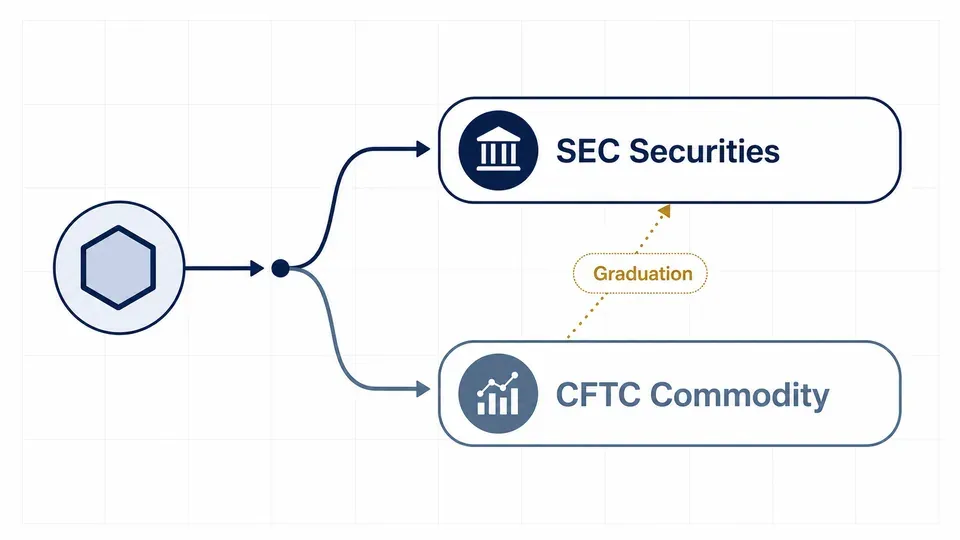
The CLARITY Act replaces that with categories written into statute. Assets whose value is "intrinsically linked to the use of a decentralized blockchain protocol" — Bitcoin and Ethereum are the textbook examples — are treated as digital commodities under the CFTC. Tokens sold through a fundraising round, where a centralized team raises capital and promises to build something (the classic ICO model), stay under the SEC as investment contract assets. Critically, the bill also builds a bridge between the two: a token can start under the SEC and later "graduate" to commodity status once its network is decentralized enough.
## The 20% Test: How a Token Becomes a Commodity
The heart of the bill is the mechanism that decides which lane a token lands in — often described as the "mature blockchain" or decentralization test. Rather than asking a court to guess whether a coin is a security under decades-old case law, CLARITY sets out concrete, checkable conditions for when a network is decentralized enough to leave SEC oversight and move to the CFTC.
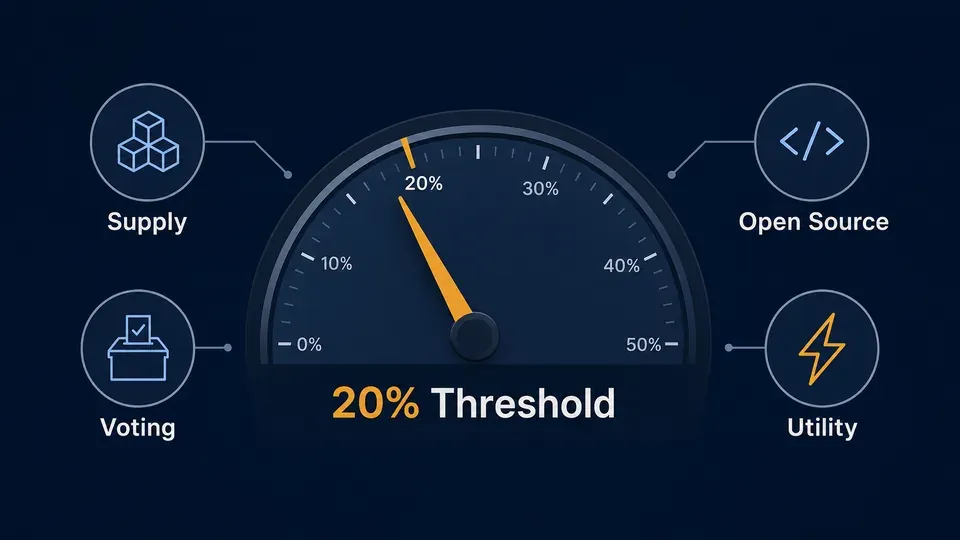
The reported criteria center on whether control is genuinely dispersed rather than held by a founding team. Key factors include:
| Factor | What the test looks for |
|---|---|
| Ownership concentration | No single person or affiliated group controls more than 20% of the token's total supply |
| Voting/governance control | No single party holds more than 20% of voting power over the network |
| Open-source code | The protocol's software is publicly available and not unilaterally controllable |
| Network utility | The token is actually used to operate the blockchain, not just to raise money |
The 20% ceiling is the number to remember because it is the most concrete: it draws a bright(ish) line between a network still effectively run by its founders and one where control is spread across many independent participants. A project that raises money via a centralized team starts life as an SEC-regulated investment contract. If, over time, its network satisfies the maturity conditions — including that no insider holds more than that 20% share — it can be certified as a digital commodity and pass to the CFTC.
This "graduation" path is the genuinely new idea. It acknowledges what the old securities framework could not: that a token's regulatory nature can change as a network decentralizes. That is also where the fights are — critics worry the thresholds could let projects engineer their way out of SEC scrutiny, while supporters argue a written test beats the current guessing game. Either way, the test converts a philosophical debate ("is this decentralized?") into an auditable checklist, which is the whole point.
## CLARITY vs GENIUS: Two Different Jobs
The two big U.S. crypto bills of this cycle are easy to confuse, so it helps to separate them cleanly. They are not competitors; they cover different slices of the market.
| GENIUS Act | CLARITY Act | |
|---|---|---|
| Scope | Payment stablecoins only | Broad digital-asset market structure |
| Core question it answers | How may a stablecoin be issued and backed? | Is a token a security (SEC) or a commodity (CFTC)? |
| Main tools | Issuer licensing, reserve requirements, consumer protections | SEC/CFTC jurisdiction split + decentralization test |
| Status | Signed into law July 18, 2025 | Passed House July 17, 2025; awaiting Senate floor vote |
The GENIUS Act is already law: it created a licensing-and-reserves regime for dollar-pegged stablecoins and is narrow by design. The CLARITY Act is the far broader piece — it governs how non-stablecoin tokens are classified and traded across the whole market. In shorthand: GENIUS handled the "digital dollars," and CLARITY is meant to handle everything else. Passing one did not resolve the other, which is why the industry treats CLARITY as the bigger unfinished item.
Where It Stands, and Why August Matters
The legislative timeline is the reason crypto prices twitch on every procedural headline. The House passed the CLARITY Act on July 17, 2025, by a strongly bipartisan 294–134 vote. The Senate Banking Committee then advanced its version on May 14, 2026, in a 15–9 vote, with 13 Republicans joined by 2 Democrats — and the bill was placed on the Senate legislative calendar in June 2026.
What remains is a full Senate floor vote, and the sticking points have narrowed to a handful of issues — notably stablecoin-yield language and how DeFi is treated. That is the context for Treasury Secretary Bessent's "1-yard line" comment and Senator Kevin Cramer's remark that a deal is "almost there." The urgency is a calendar problem: lawmakers are racing to act before the August recess (reporting has centered on an early-August deadline), and if the window closes without a floor vote, the bill's momentum could stall into 2027. That deadline pressure — not any single amendment — is why Bitcoin, trading in the mid-$60,000s, rallied when Bessent signaled the Senate was close.
For a builder or investor, the practical read is this: the CLARITY Act does not change any token's classification today. But if it passes, the "which regulator owns me?" question stops being answered by lawsuits and starts being answered by a checklist — with that 20% control threshold doing much of the deciding.
Frequently Asked Questions
What is the CLARITY Act in one sentence? It is a U.S. bill that splits oversight of crypto between the SEC (for token sales that work like securities) and the CFTC (for sufficiently decentralized tokens treated as commodities), using a written maturity test instead of case-by-case litigation.
What does the "20%" refer to? It is the reported concentration limit in the decentralization ("mature blockchain") test: broadly, no single person or affiliated group should control more than 20% of a token's supply or voting power for the network to qualify as a CFTC-regulated digital commodity.
Is the CLARITY Act law yet? No. As of late July 2026 it has passed the House (July 17, 2025) and cleared the Senate Banking Committee (May 14, 2026), but it still needs a full Senate floor vote before it can go to the President.
How is it different from the GENIUS Act? The GENIUS Act (already signed into law in July 2025) regulates payment stablecoins specifically. The CLARITY Act is much broader market-structure legislation covering how all other digital assets are classified and traded.
Does CLARITY mean my token is now a commodity? Not automatically. A token sold by a centralized team would start under SEC jurisdiction and could only "graduate" to CFTC commodity status if and when its network meets the decentralization criteria, including the ownership/voting thresholds.
Key Takeaways
- The CLARITY Act (H.R. 3633) splits crypto oversight: the CFTC gets decentralized "digital commodities," the SEC keeps token sales that function as securities.
- Its centerpiece is a decentralization test — including a rule that no single party control more than 20% of supply or voting power — that lets a token "graduate" from SEC to CFTC status.
- It is separate from the GENIUS Act, which is already law and covers only stablecoins; CLARITY covers the rest of the market.
- Legislative status: passed the House 294–134 (July 17, 2025) and cleared Senate Banking 15–9 (May 14, 2026); it still needs a Senate floor vote.
- The August recess is the pressure point — miss it and momentum may slip to 2027, which is why crypto prices react to each procedural update.
How this was written: AI helped research this piece, but every source, fact, and sentence was checked and finalized by hand.
References
- U.S. Senator: Clarity Act Is 'Almost There,' Treasury Secretary Puts It At The '1-Yard Line' — Bitcoin Magazine
- Bitcoin rallies as Bessent signals Clarity Act nearing Senate passage — Crypto Briefing
- Treasury Sec. Scott Bessent presses Congress to pass crypto rules — The Hill
- Crypto industry scores win as Clarity Act regulation bill clears Senate hurdle — CNBC
- US Crypto Policy Tracker: Legislative Developments — Latham & Watkins
- What Is the CLARITY Act? The U.S. Crypto Market Structure Bill Explained — BeInCrypto
- Crypto Legislation: An Overview of H.R. 3633, the CLARITY Act — Congress.gov (CRS)
- Senate's August Deadline Puts CLARITY Act on a Knife-Edge — Yahoo Finance



Comments ()