
Circle's National Trust Bank: What a $73B Stablecoin Issuer Can — and Can't — Do as a 'Bank

Circle's National Trust Bank: What a $73B Stablecoin Issuer Can — and Can't — Do as a "Bank"
On July 10, 2026, Circle — issuer of the USDC stablecoin — won final approval from the OCC to open a national trust bank. Headlines called it "Circle becomes a bank." That is only half true. Here is exactly what the charter allows, what it forbids, and why it still matters for the roughly $73 billion of USDC in circulation.
Circle (NYSE: CRCL), the company behind the USDC stablecoin, received final approval from the U.S. Office of the Comptroller of the Currency (OCC) on July 10, 2026 to establish First National Digital Currency Bank, N.A., operating as Circle National Trust. A lot of coverage compressed that into "the stablecoin firm got a banking license." But a national trust bank is a specific, limited kind of charter — and the gap between what people assume it means and what it actually permits is the whole story. This post lays out the powers, the limits, and the strategic payoff.
What a national trust bank actually is
A national trust bank is a federally chartered institution supervised by the OCC, the same regulator that oversees national banks. But its powers are narrow. Think custodian and fiduciary, not lender and deposit-taker.
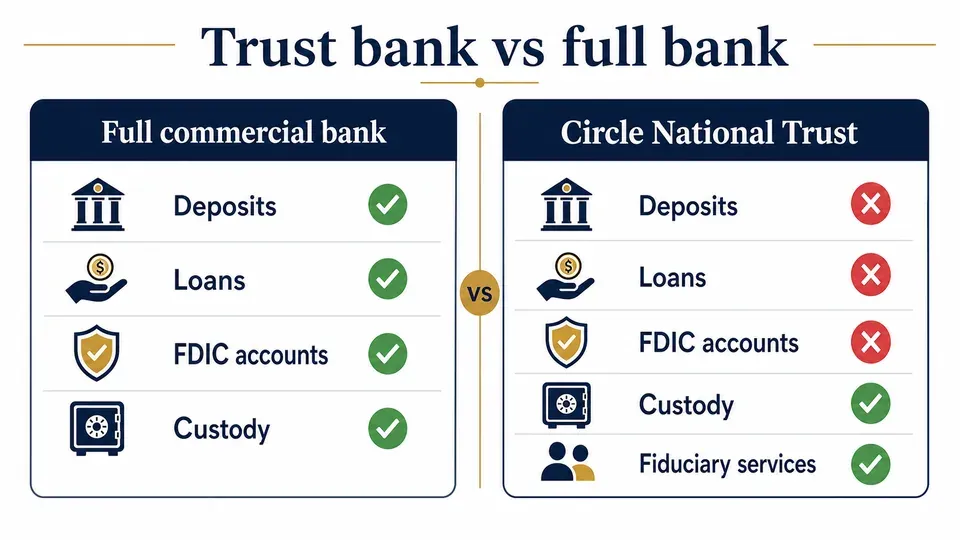
Here is the direct comparison that clears up most of the confusion:
| Capability | Full commercial bank | Circle National Trust (trust bank) |
|---|---|---|
| Safeguard/custody client assets under federal fiduciary standards | Yes | Yes |
| Act as a federally regulated fiduciary | Yes | Yes |
| Take ordinary retail deposits (checking/savings) | Yes | No |
| Make loans | Yes | No |
| Offer FDIC-insured retail accounts | Yes | No |
| Lend out customer assets to earn a spread | Yes | No |
In plain terms: Circle National Trust can hold and safeguard digital assets for clients under strict federal fiduciary rules, but it cannot take deposits, cannot make loans, and cannot offer insured checking or savings accounts. It is a federally supervised vault and fiduciary — not a retail bank. So "Circle becomes a bank" is misleading; "Circle gets a federal custody charter" is accurate.
## Why Circle wanted it anyway
If it can't take deposits or lend, why is this a milestone? Three reasons, and they compound.
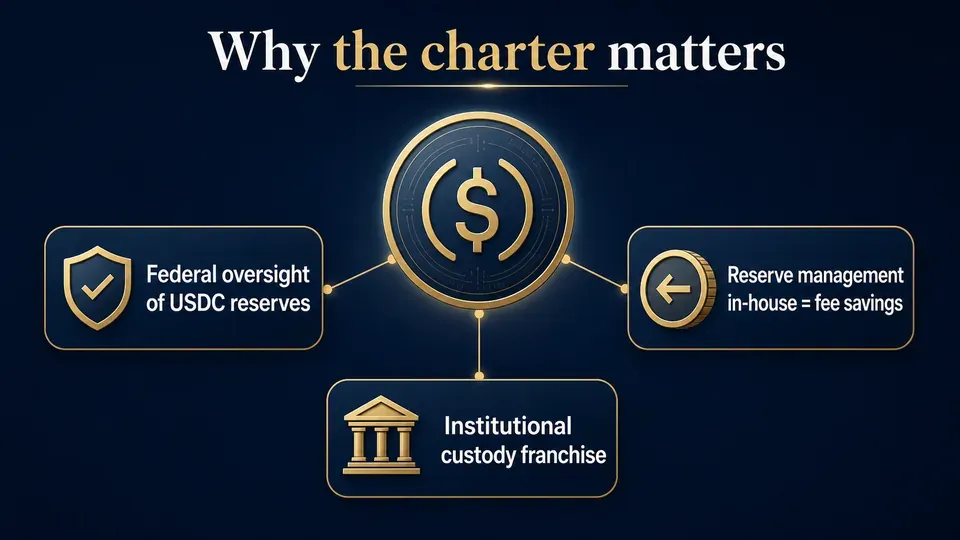
1. Federal legitimacy for the reserves. USDC is backed by reserves of cash and short-term U.S. Treasuries. Today Circle relies on outside custodians and partners to hold and manage large parts of that backing. The charter is explicitly designed to enable future management of the USDC reserve under federal oversight — bringing a core function of the world's second-largest stablecoin inside a proven federal banking framework. For a product whose entire value proposition is "one dollar, fully backed, always redeemable," federal supervision of the backing is a direct trust upgrade.
2. A new revenue lever. Circle currently pays third parties to custody and help manage its reserves. By operating its own federally chartered trust bank, it can bring more of that in-house — turning an outgoing fee into a retained one. For a public company, moving a cost line inside the walls is a margin story, not just a compliance one.
3. Institutional custody as a business. At opening, the trust will provide fiduciary digital-asset custody for Circle and its affiliates. Per its OCC-approved business plan, it may eventually offer custody directly to a limited set of institutional customers — focused on banks and other financial institutions. That opens a potential B2B custody franchise, with the OCC charter as the credential that lets regulated institutions build on public blockchains "with clarity and confidence," in CEO Jeremy Allaire's words.
## The regulatory backdrop: GENIUS Act and USDC's scale
This did not happen in a vacuum. In July 2025, Congress passed the GENIUS Act, the first federal framework for payment stablecoins. It requires issuers to hold 100% reserves in cash or short-term Treasuries and to disclose reserve composition monthly. Circle's trust-bank approval, roughly a year later, is a logical next step in that framework — moving from "issuer that complies with reserve rules" toward "issuer whose custody and reserve functions sit under direct federal bank supervision."
The scale gives it weight. USDC's market capitalization is around $73 billion, ranking it among the top handful of crypto assets and making it the largest regulated dollar stablecoin. (Its supply had actually softened modestly, down roughly 3.6% over the prior 30 days amid slower stablecoin liquidity — a reminder that the sector is not only going up.) Circle's regulatory résumé also predates this: it received New York's first BitLicense in 2015 and became the first global stablecoin issuer to comply with the EU's MiCA framework in 2024. The OCC charter is the U.S. federal capstone on that decade-long strategy.
The bigger-picture read: the line between "crypto company" and "regulated financial infrastructure" is thinning. A stablecoin issuer holding a federal fiduciary charter is exactly the kind of hybrid the GENIUS Act was designed to make possible — and it sets a template other issuers will likely follow.
Frequently Asked Questions
Did Circle become a bank? Not a full bank. It won approval to open a national trust bank, which can custody and safeguard assets under federal fiduciary standards but cannot take deposits, make loans, or offer FDIC-insured retail accounts.
What can Circle National Trust actually do? Provide federally regulated fiduciary custody of digital assets — first for Circle and its affiliates, and potentially later for a limited set of institutional customers such as banks. It is also designed to eventually manage the USDC reserve under federal oversight.
Why does this matter for USDC holders? It brings core functions of USDC — custody and, in future, reserve management — under direct federal supervision, strengthening the "fully backed and redeemable" promise that underpins the stablecoin's value.
How does the GENIUS Act fit in? The GENIUS Act (July 2025) set the first U.S. federal rules for payment stablecoins, including 100% cash/Treasury reserves and monthly disclosure. Circle's trust-bank charter extends that framework by putting custody and reserve functions under a federal bank regulator.
How big is USDC? Around $73 billion in market capitalization as of July 2026, making it the largest regulated dollar stablecoin, though its supply softened slightly in the preceding month.
Key Takeaways
- Circle won final OCC approval (July 10, 2026) to open Circle National Trust, a national trust bank — not a full commercial bank.
- It can custody digital assets under federal fiduciary standards; it cannot take deposits, make loans, or offer FDIC-insured accounts.
- The strategic payoff: federal oversight of USDC reserves, in-house reserve management (fee savings), and a potential institutional custody franchise.
- It builds on the GENIUS Act (July 2025) and applies to ~$73B of USDC, the largest regulated dollar stablecoin.
How this was written This piece was drafted with AI's research help; a human verified every fact and polished the final wording.
References
- Circle, "Circle Receives Final OCC Approval to Establish National Trust Bank" (Jul 10, 2026): https://www.circle.com/pressroom/circle-receives-final-occ-approval-to-establish-national-trust-bank
- American Banker, "Circle is granted a trust bank charter from the OCC": https://www.americanbanker.com/news/circle-is-granted-a-trust-bank-charter-from-the-occ
- CoinDesk, "Circle takes banking step with U.S. trust bank approval": https://www.coindesk.com/business/2026/07/10/circle-secures-u-s-trust-bank-approval-in-crypto-expansion
- The Motley Fool, "Circle Receives New Regulatory Approval for National Trust Bank": https://www.fool.com/investing/2026/07/10/circle-receives-new-regulatory-approval-for-national-trust-bank-heres-what-it-could-mean-for-crcl-stock/
- CoinGecko, USDC market data: https://www.coingecko.com/en/coins/usdc

Comments ()