
China Just Caught Up in AI — The Race Resets
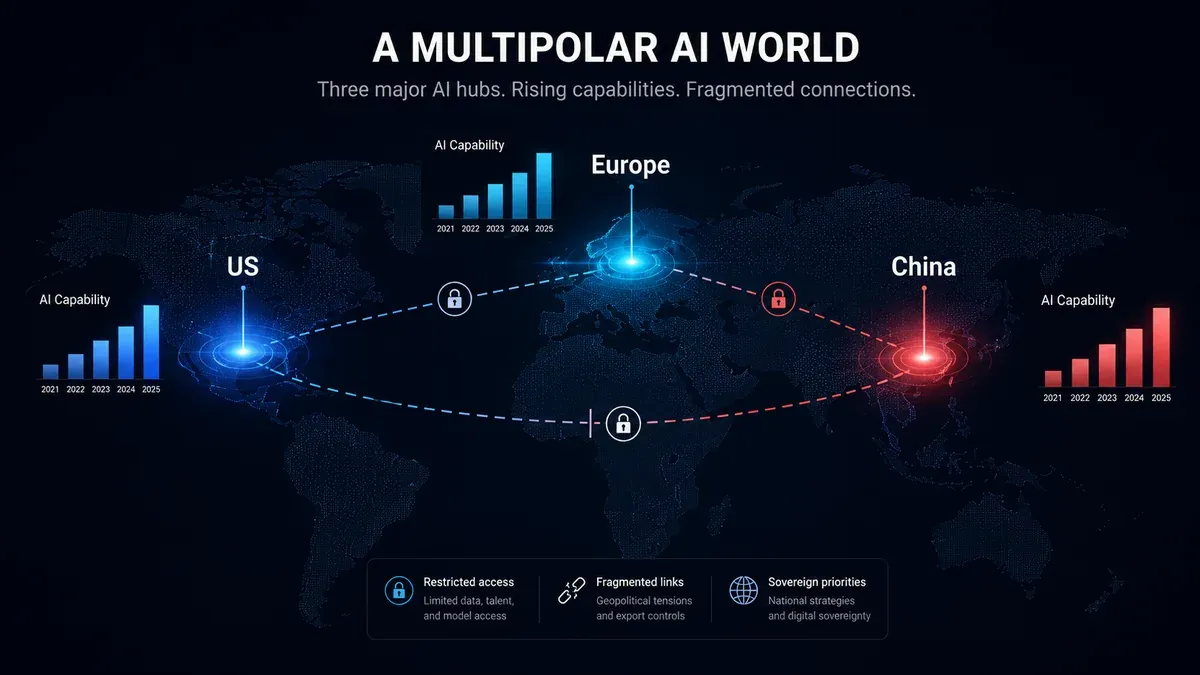
TL;DR — China has matched Anthropic on frontier cybersecurity capabilities, resetting the assumption that the US holds a comfortable lead in advanced AI, according to The Wall Street Journal. Meanwhile, US curbs on AI access have Austria urging Europe to host Anthropic itself. The "one country owns AI" story just got a lot more complicated.
For the past two years the working assumption in tech and policy circles was simple: the US is one or two steps ahead in frontier AI, and everyone else is catching up. This week that assumption took a hit. The Wall Street Journal reports that China has matched Anthropic on advanced cybersecurity capabilities — one of the most sensitive and high-stakes corners of AI — effectively resetting the race. At the same time, Bloomberg reports Austria is urging Europe to host Anthropic on European soil in response to US restrictions on who can access top American AI.
So what? Two forces are colliding. The first is capability convergence: if a Chinese effort can match a leading US lab in a domain as serious as cybersecurity, then "American AI leadership" stops being a fact you can bank on and becomes a lead you have to keep re-earning. The second is fragmentation: as the US tightens who's allowed to use its best models, other regions stop waiting in line and start building — or buying — their own. Europe wanting Anthropic on its territory is a symptom of that. Nobody wants to be a tenant in someone else's AI.
For anyone with money in the game, the investment thesis shifts. A world with one dominant AI power is a winner-take-all bet — you pile into the leader. A world with several capable players is a different market: more competition, more price pressure, more places to deploy capital, and more geopolitical risk priced into every chip and cloud contract.
| Old assumption | What this week suggests |
|---|---|
| US holds a durable AI lead | Lead is real but narrowing fast |
| Access flows freely to allies | US curbs are pushing regions to self-build |
| One winner takes the market | A multipolar AI map is forming |
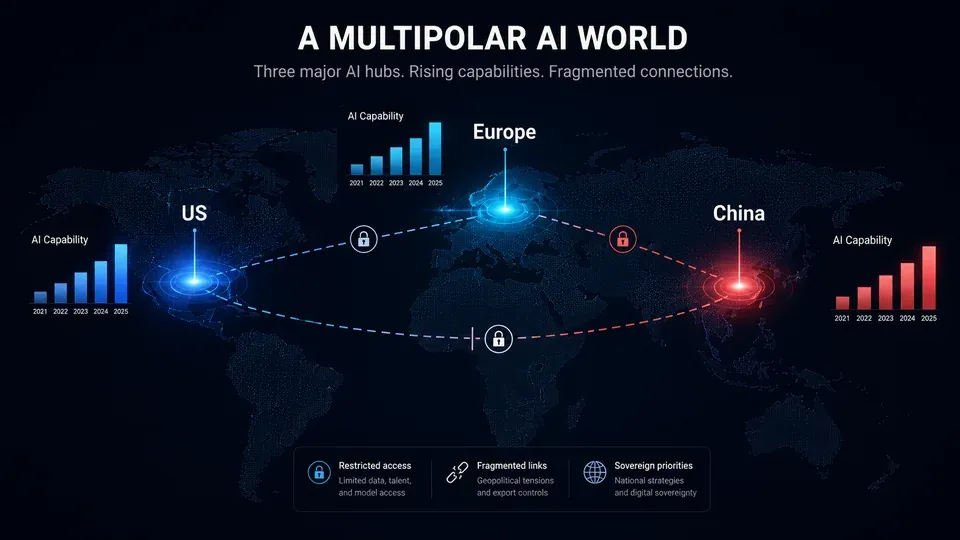
There's a security dimension here that's easy to skim past. Cybersecurity is exactly the field where matched AI capability cuts both ways — the same models that find and patch vulnerabilities can find and exploit them. A world where two rival powers both have frontier cyber-AI is more capable and more dangerous, and that tension will shape regulation, export rules, and corporate security budgets for years.
The caveat worth keeping: "matched on a benchmark" is not the same as "matched across the board." Frontier AI is a wide field, and leadership in one capability doesn't mean parity everywhere. US labs still lead on several fronts, and a single result shouldn't be read as a changing of the guard. But the direction is the story. The gap is closing, access is fragmenting, and the comfortable narrative of permanent dominance is over.
For everyone else, the practical takeaway is that AI is becoming infrastructure that nations want to control the way they control energy or telecoms. Expect more "build it here" demands, more restrictions, and more competition — which, for users, often means better and cheaper tools, even as the politics around them get tenser.
Bottom line: The age of one country quietly owning the AI frontier is ending — and a multipolar AI world is messier, more competitive, and far more interesting for everyone who isn't trying to win it alone.
Sources: The Wall Street Journal, Bloomberg, June 28, 2026
Tags: #AI #China #Anthropic #Cybersecurity #Geopolitics


Comments ()