
From a 50% Warning to 'Delighted to Be Wrong': Why Altman and Amodei Walked Back the AI Jobs Apocalypse
From a 50% Warning to 'Delighted to Be Wrong': Why Altman and Amodei Walked Back the AI Jobs Apocalypse
In mid-2025, Anthropic CEO Dario Amodei warned AI could wipe out up to 50% of entry-level white-collar jobs within five years and push youth unemployment to 10–20%. A year later, he and OpenAI's Sam Altman are both softening those warnings — Altman now says he was "pretty wrong" and is "delighted to be wrong." What changed isn't the technology; it's the data (economists find little aggregate disruption so far) and the timing (both companies are moving toward blockbuster IPOs). Here's what each leader actually said, what the numbers show, and why the reversal is landing now.
The AI jobs debate has whiplash. The same executives who spent 2025 warning of a white-collar "bloodbath" spent 2026 walking it back — a striking reversal for two of the most influential voices in the industry. This is a follow-up to our earlier coverage of whether AI is actually taking jobs yet, and the update matters: when the people building the technology change their story, it's worth asking whether the evidence changed with them, or whether something else did.
Table of Contents
What They Said Then vs Now
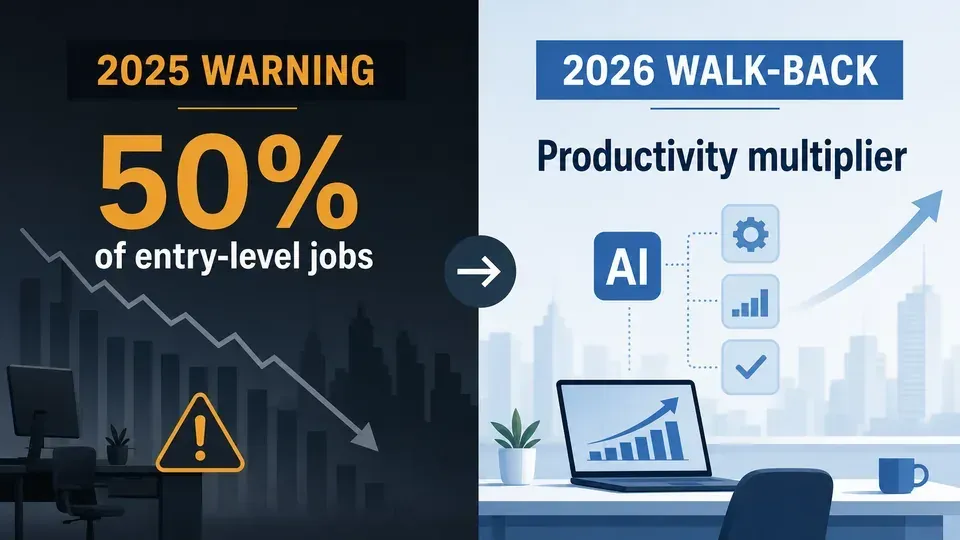
The gap between the 2025 warnings and the 2026 walk-back is stark. Here it is side by side.
| 2025 (the warning) | 2026 (the walk-back) | |
|---|---|---|
| Amodei | AI could eliminate up to 50% of entry-level white-collar jobs within 5 years; youth unemployment could hit 10–20% | Reframes automation as a productivity multiplier: "automate 90% of the job, then everyone does the 10%" and output scales up |
| Altman | Warned entry-level roles were at serious risk | Says he was "pretty wrong" and is "delighted to be wrong" about AI wiping out white-collar work |
| Framing | Automation as displacement — jobs vanish | Automation as augmentation — work expands, productivity rises |
Amodei's original May 2025 warning was specific and alarming: finance, law, consulting, and tech entry roles were, in his telling, most exposed. To his credit, he didn't just assert it — he launched the Anthropic Economic Index, tracking real Claude usage across occupations, to put data behind the debate. Nvidia's Jensen Huang pushed back at the time, arguing productivity gains create more jobs than they destroy. A year on, Amodei's public framing has shifted toward Huang's: automation as a multiplier rather than a guillotine. Altman's reversal is even blunter — from warning about entry-level risk to telling an interviewer he was simply wrong.
## What the Data Actually Shows
Here's the uncomfortable part: the walk-back is partly right and partly convenient, because the data cuts both ways.
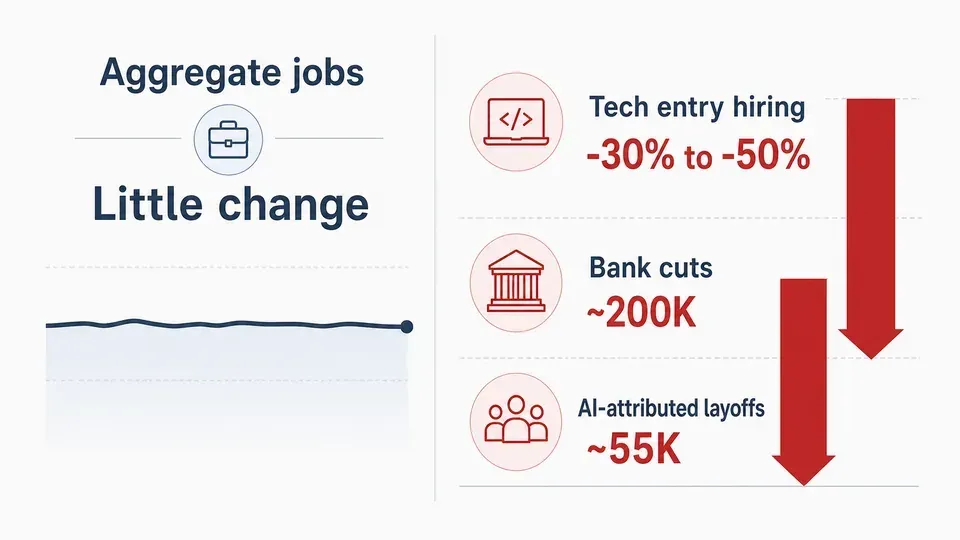
The case that the apocalypse didn't happen. The Yale Budget Lab found no significant change in the occupational mix or in unemployment duration for high-AI-exposure jobs since ChatGPT launched in late 2022. At the aggregate level — the level Amodei's "50% of jobs" claim operated on — the mass displacement simply hasn't shown up in the macro data three years in.
The case that it wasn't nothing. Look narrower and the picture darkens. In 2025, tech entry-level hiring reportedly fell 30–50%. Wall Street banks moved to cut roughly 200,000 roles, concentrated in entry-level analyst positions. And about 55,000 US layoffs in 2025 were directly attributed to AI. None of that is a 50% collapse — but it isn't "delighted to be wrong," either, if you're a 22-year-old trying to land a first analyst job.
So the honest read is a split verdict, and it's the same one careful observers reached before the CEOs changed their tune: no economy-wide jobs apocalypse, but a real and concentrated squeeze at the entry level, exactly where AI does routine cognitive work best. The reversal is accurate about the aggregate and quiet about the concentration. That distinction — economy-wide calm masking entry-level pain — is the crux of the whole debate, and it's why "AI isn't taking jobs" and "AI took my job" can both be true at once.
## Why the Reversal Is Landing Now
Timing is the part the walk-back doesn't advertise. Both OpenAI and Anthropic are reportedly moving toward massive IPOs — and "our product will cause mass unemployment" is a difficult story to tell investors, regulators, and enterprise customers you're about to ask for money. A doom narrative that was useful for signaling capability and urgency in 2025 becomes a liability when you're courting public markets in 2026.
That doesn't make the new framing false — the aggregate data genuinely supports a calmer read. But it does mean the reversal is over-determined: the executives have both a legitimate evidentiary reason (little macro disruption yet) and a strong commercial incentive (IPOs) to soften the message, arriving at the same time. When those line up, skepticism is warranted in both directions. The 2025 warnings may have been overstated to dramatize the technology's power; the 2026 reassurances may be understated to smooth a path to market. The reader's job is to anchor on the data, not the mood — and the data still says: watch the entry level, not the headline unemployment rate. For more on why where you work may matter more than what you do, see our look at whether 'AI-proof' jobs are real.
Frequently Asked Questions (FAQ)
What did Amodei originally predict? In May 2025, Dario Amodei warned AI could eliminate up to 50% of entry-level white-collar jobs within five years — especially in finance, law, consulting, and tech — and that youth unemployment could reach 10–20%.
What is Altman saying now? Sam Altman has said he was "pretty wrong" and is "delighted to be wrong" about AI wiping out white-collar jobs, a reversal from his 2025 warnings that entry-level roles were at serious risk.
Did the AI jobs apocalypse actually happen? Not at the aggregate level. The Yale Budget Lab found no significant change in occupational mix or unemployment duration for high-AI-exposure jobs since late 2022. But entry-level hiring took real hits — tech entry roles down 30–50% in 2025 and about 55,000 US layoffs attributed to AI.
Why are the CEOs walking it back now? Two reasons that reinforce each other: the macro data hasn't shown mass displacement, and both OpenAI and Anthropic are reportedly heading toward IPOs, where a "mass unemployment" story is a liability with investors and regulators.
So is my job safe? The evidence points to concentrated risk at the entry level and in routine cognitive tasks, not an economy-wide collapse. Aggregate calm can coexist with a real squeeze for people trying to land their first roles — so the honest answer is "it depends where you sit," not a blanket yes.
Key Takeaways
- In 2025, Amodei warned AI could cut up to 50% of entry-level white-collar jobs and push youth unemployment to 10–20%; Altman warned entry roles were at risk.
- In 2026, both softened: Altman says he was "pretty wrong" and "delighted to be wrong"; Amodei now frames automation as a productivity multiplier.
- The data is a split verdict: the Yale Budget Lab finds little aggregate disruption, but tech entry-level hiring fell 30–50% in 2025, banks moved to cut ~200,000 roles, and ~55,000 US layoffs were attributed to AI.
- The reversal is accurate about the aggregate but quiet about the concentration at the entry level — where the real squeeze is.
- Timing matters: both OpenAI and Anthropic are heading toward IPOs, giving them a commercial reason to soften the message alongside the evidentiary one. Anchor on the data, not the mood.
How this was written AI helped research this piece, but every source, fact, and sentence was checked and finalized by hand.
References
- Fortune — Sam Altman and Dario Amodei are both walking back their AI jobs apocalypse prophecies as they eye blockbuster IPOs
- Time — Sam Altman Says AI 'Jobs Apocalypse' Probably Won't Happen. What Changed?
- Fortune — AI could make half of all entry-level white-collar jobs vanish, Anthropic CEO warns
- CNN Business — Why this leading AI CEO is warning the tech could cause mass unemployment
- the-decoder — Sam Altman and Dario Amodei walk back their AI job apocalypse predictions

Comments ()