
What AI Should—and Shouldn’t—Automate in a One-Person Publishing Business
What AI Should—and Shouldn’t—Automate in a One-Person Publishing Business
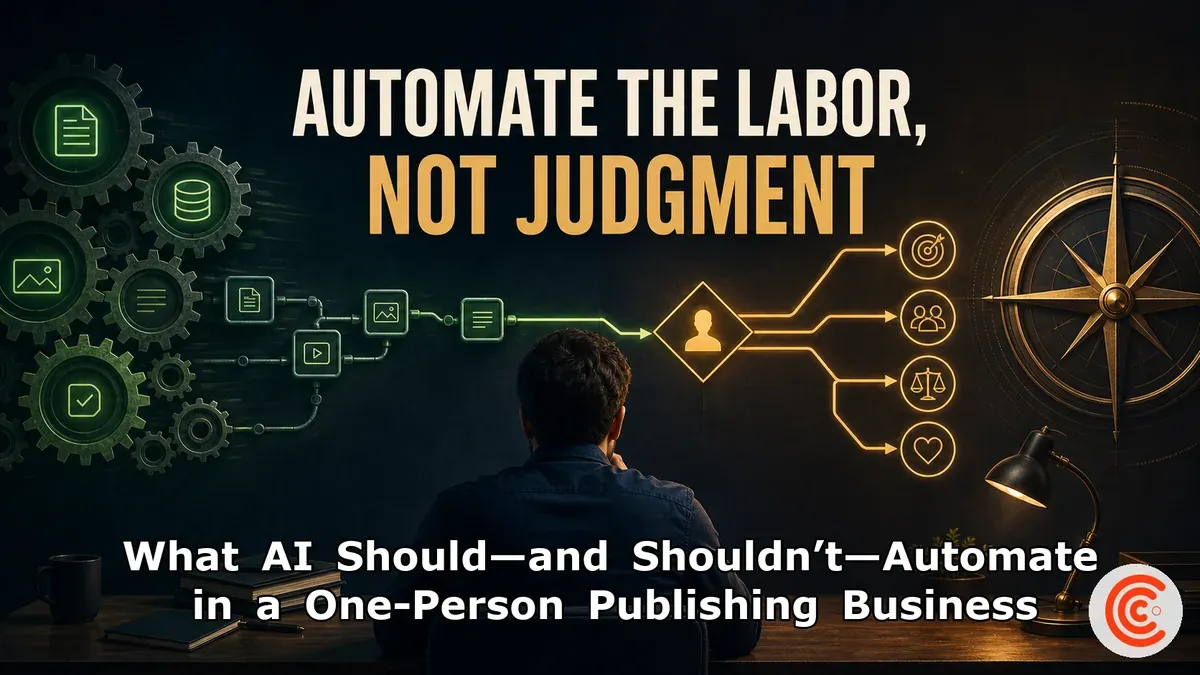
AI is most valuable in my publishing business when it removes mechanical work and makes evidence easier to inspect. It becomes destructive when it chooses the purpose, invents experience, or turns a publication into a quota.
Table of Contents
- The boundary I learned by crossing it
- What I now automate aggressively
- What remains an owner decision
- A practical control system for AI publishing
The boundary I learned by crossing it
A one-person publishing business has an obvious resource problem: one person must research, write, edit, format, source images, manage a website, check analytics, handle email, and eventually sell something. AI appears to solve the staffing problem.
My first instinct was to automate the entire sequence. Scheduled jobs collected topics, drafted articles, generated images, converted formats, uploaded posts, and synchronized status. The system could do in hours what would otherwise consume days.
It also flattened the publication.
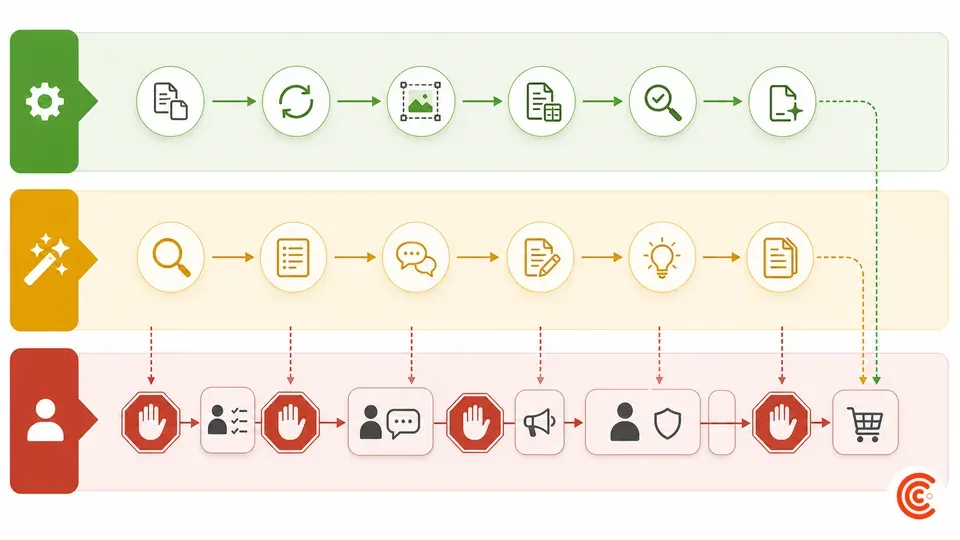
The mistake was treating every step as the same type of work. Some tasks are transformations: convert Markdown to HTML, resize an image, check whether a URL responds, compare a remote status with a local status. Other tasks are judgments: decide whether a topic deserves attention, whether a claim is fair, whether an experience is private, or whether the article is interesting enough to exist.
AI can assist with both. Only the first category should normally execute without a human decision.
The useful boundary is not “AI versus human writing.” It is:
reversible, inspectable labor versus identity-defining judgment
A badly formatted table is easy to fix. A publication that spends six months building the wrong audience is not.
## What I now automate aggressively
File preparation and conversion
The source article can remain Markdown while scripts create the HTML required by another editor or API. This is deterministic and testable. A converter can confirm that headings, tables, image references, and links survived.
Source collection
An agent can find official documentation, gather primary sources, and produce a research packet. The packet is not the article. It gives the owner a smaller evidence set to inspect.
Consistency checks
AI and scripts are good at finding:
- missing frontmatter;
- malformed links;
- inconsistent slugs;
- image references that point to local files;
- public claims without a cited source;
- a remote draft accidentally marked published;
- credentials or private paths about to enter Git.
Image processing
Generated or captured images can be resized, converted to WebP, checked for dimensions, and uploaded automatically. Real screenshots still need manual privacy review because optical character recognition is not a complete privacy system.
Draft creation in external systems
I allow automation to create a Ghost or WordPress draft after the local file passes checks. I do not treat draft creation as publication.
Repetitive operational reporting
An agent can summarize what changed, which checks passed, and which decisions still need a person. This is a better use of automation than producing more prose for its own sake.
| Task | Default automation level | Required evidence |
|---|---|---|
| Markdown-to-HTML conversion | Automatic | Format validation |
| Image resize and WebP conversion | Automatic | Dimension and URL check |
| Official source gathering | Assisted | Human opens material sources |
| Ghost draft upload | Automatic after checks | Remote status remains draft |
| Topic selection | Human-led | Reader problem and original contribution |
| First-person claim | Human-only approval | Real memory, log, screenshot, or measurement |
| Affiliate recommendation | Human-only approval | Actual use, disclosure, approved link |
| Public publishing | Human gate | Final content and privacy review |
What remains an owner decision
Why the article exists
An agent can suggest ten topics. It cannot decide which one represents the business I want to build. That choice determines the future audience, incoming opportunities, and products I can credibly sell.
What actually happened
AI can organize my notes, but it must not produce “I tested,” “I paid,” “I switched,” or “I learned” unless those events are present in evidence I supplied.
This rule also protects the reader from fake product reviews. A comparison built entirely from pricing pages is a documentation comparison, not a hands-on review.
The interesting part
The most memorable element is often a contradiction that no template can guarantee:
- the automation worked and made the product worse;
- the cheaper host was the rational choice because I valued time more than server control;
- deleting a cloud deployment made a private page more useful;
- a successful image upload still produced broken article HTML.
The owner recognizes those moments because they changed a decision.
Privacy
An agent can flag likely secrets, but only I know whether a project name, document title, revenue number, browser tab, or background object should be public. Screenshots receive a manual review at full resolution.
Commercial trust
Affiliate links create a conflict of interest. I should be able to explain why I chose a tool before I know whether it has an affiliate program. If the commission creates the recommendation, the article has reversed the proper order.
My rule is:
- use the product;
- document the decision and limitations;
- compare credible alternatives;
- confirm an official affiliate program;
- insert the approved tracking URL;
- disclose it next to the recommendation.
Ghost has a referral program advertising 30% recurring commission, but its own requirements describe an established audience and expected referral performance. That is not a link I should fake with a generic parameter while waiting for approval.
A practical control system for AI publishing
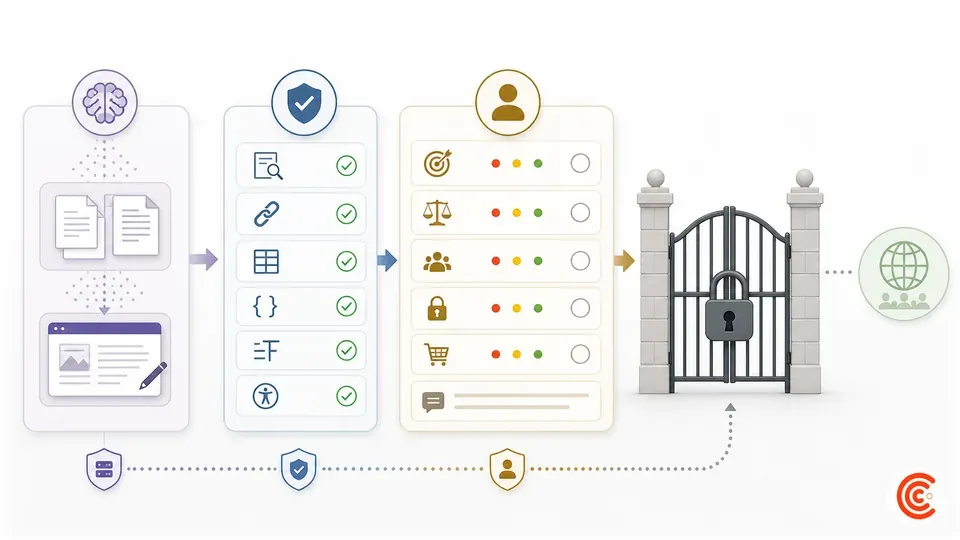
My updated workflow has five gates.
Gate 1: experience
No first-person operating article begins without evidence of an actual event: a build, test, migration, failure, cost, or result.
Gate 2: claims
Current product details use official sources. Personal details use notes and artifacts. Anything uncertain is labeled or removed.
Gate 3: privacy
Screenshots are captured from demonstration data where possible. Secrets, identities, private URLs, local paths, and client or family information never enter the working draft.
Gate 4: remote state
Uploads are checked where they landed. The system confirms draft status, feature assets, and body links rather than trusting the upload command.
Gate 5: publication
The owner reads the rendered article, replaces placeholders, reviews disclosures, and presses publish.
### Tools I use and alternatives
- Ghost for the English publication and API-created drafts.
- PikaPods to operate open-source apps without maintaining the underlying server.
- Cloudflare for DNS and the private local tunnel.
- Claude Code and Codex as file-aware agents.
- Resend for the low-volume transactional email configuration attached to Ghost.
Alternatives depend on the layer. Ghost(Pro) removes most hosting work. A VPS such as DigitalOcean increases control and maintenance. WordPress offers a much larger plugin ecosystem. Tailscale can keep local tools on a private network. Make or n8n can replace code-based workflow orchestration for teams that prefer visual flows.
[AFFILIATE LINK PLACEHOLDER — GHOST(PRO)] Insert only after referral-program approval, with a disclosure that I personally use self-hosted Ghost on PikaPods rather than Ghost(Pro).
[AFFILIATE LINK PLACEHOLDER — DIGITALOCEAN / HOSTINGER / CLOUDWAYS] Reserve for a future hosting comparison after hands-on testing. Do not turn this editorial-boundary article into a hosting listicle.
[AFFILIATE LINK PLACEHOLDER — MAKE] Use only if a future visual-automation workflow is actually built with Make. Its official program currently advertises 35% commission for eligible referral payments during the first 12 months.
Frequently Asked Questions
Does every AI-assisted article need a disclosure?
The appropriate disclosure depends on the platform, law, and degree of automation. My practical rule is to explain AI’s role whenever a reasonable reader would care how the work was produced.
Can AI choose topics from analytics?
It can surface opportunities, but the owner should decide whether the topic fits the publication and whether there is an original contribution.
Why allow automatic draft uploads?
Draft creation is reversible and inspectable. Public publication changes what readers see and therefore remains a separate gate.
Can AI review screenshots for secrets?
It can help, but it should not be the only review. Small text, reflections, browser chrome, and contextual identifiers can escape automated detection.
Is AI-generated imagery acceptable?
It can be, when clearly appropriate and not presented as documentary evidence. For first-hand operational articles, real redacted screenshots usually provide more value.
Key Takeaways
- Automate transformations, checks, and reversible draft operations.
- Keep purpose, personal claims, privacy, recommendations, and public publishing behind an owner gate.
- A first-person sentence needs first-person evidence.
- Affiliate availability should never determine the recommendation.
- The best AI workflow makes human judgment easier to exercise, not easier to skip.
How this was written
This article is based on the editorial controls I changed after operating a high-volume AI publishing system. AI assisted with structure and documentation checks. The automation matrix reflects my current policy, not an industry standard or legal opinion. Screenshot placeholders require manual privacy review.
Comments ()