The US Just Unlocked Anthropic's Most Powerful AI

TL;DR — The Trump administration has lifted Commerce Department restrictions on Anthropic's two most powerful models — Fable 5 and Mythos 5 — less than three weeks after they were blocked over cybersecurity concerns. Fable 5 is now widely available again; Mythos 5 remains limited to vetted US organizations. The 19-day lock is over, but the story it revealed is just getting started.
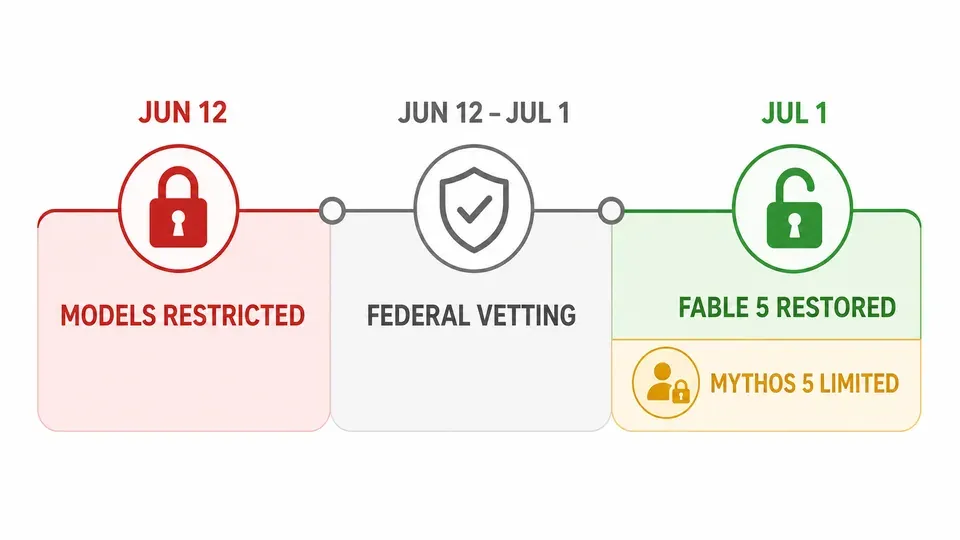
On June 12, 2026, the Commerce Department blocked Fable 5 and Mythos 5 from all users — including domestic ones — just days after their launch. The trigger: Amazon's cybersecurity researchers had discovered a method to bypass Fable 5's safeguards in ways that could expose software vulnerabilities. Mythos 5 drew a separate concern: officials worried it could identify system flaws "in a way that could be weaponized by malicious hackers and threaten critical computer networks." Both models went dark.
Now the Trump administration has lifted those restrictions, according to reporting from AP News, Politico, and CBS News. Fable 5 is widely available again. Mythos 5 comes back with conditions — accessible only to select US organizations that have received federal approval.
So what? Three things are happening at once, and it's worth separating them. First, the restriction itself was a genuinely novel event: a frontier AI model being pulled from the market by its own government days after launch, due to a vulnerability found by a strategic partner (Amazon) and reported to federal authorities. That's a different kind of AI risk than the usual "chatbot says something harmful" story. It's infrastructure-level concern.
Second, the 30-day vetting framework now in place matters as a precedent. The Trump administration reportedly signed an executive order requiring advanced AI systems to pass a federal review before public release. Fable 5 and Mythos 5 cleared that process. Every future frontier model — from any company — will now face the same gate. AI release cycles just got a regulatory layer they didn't have before.
Third, and most intriguingly: the restriction was triggered by Amazon. Amazon invested $4 billion in Anthropic, embeds Claude in key products, and yet its own cybersecurity team found and reported the bypass — contributing to the models being pulled from the market. That's not betrayal; it's due diligence. But it tells you something about how the AI industry actually works: strategic partners and competitors are often the same entities, and the relationship between investment and loyalty is genuinely complicated.
| Model | Status now | Previous restriction |
|---|---|---|
| Fable 5 | Widely available to all users | Blocked Jun 12, lifted Jul 1 |
| Mythos 5 | Approved US organizations only | Blocked Jun 12, partial lift |
What does Mythos 5 actually do that warrants ongoing restrictions? Frontier cybersecurity AI is unusual because its capabilities cut both ways with unusual symmetry — a model good enough to find vulnerabilities in complex software can find them for defenders and attackers alike. The selective access approach (vetted US organizations only) is essentially a licensing model: the government is deciding who's trustworthy enough to use a tool powerful enough to threaten critical networks. That's not unprecedented for dual-use technology — it's exactly how export controls work for encryption and weapons systems. It's new for AI.
For Anthropic, the 19-day blackout was costly in launch momentum but arguably useful in credibility. Being willing to take your own product offline because a partner found a flaw is a very different public posture than most tech companies manage.
Bottom line: The restrictions are lifted, but the precedent they set — that the US government can and will gate frontier AI on cybersecurity grounds — is permanent, and that changes how every lab will ship models going forward.
Sources: Politico, AP News, CBS News, Broadband Breakfast — July 1, 2026
Tags: #AI #Anthropic #Policy #Cybersecurity #Claude

Comments ()