
The Real Cost of My Ghost and WordPress Publishing Stack
The Real Cost of My Ghost and WordPress Publishing Stack
My Ghost host costs only a few dollars per month, and several supporting services remain on free tiers. Hosting is not the expensive part. The real cost is operating two publishing systems, maintaining automation, reviewing AI output, and owning every failure.
Table of Contents
- What the stack actually contains
- Why I chose PikaPods
- The cost table—and the missing number
- When I would choose a different host
What the stack actually contains
I run more than a blog.
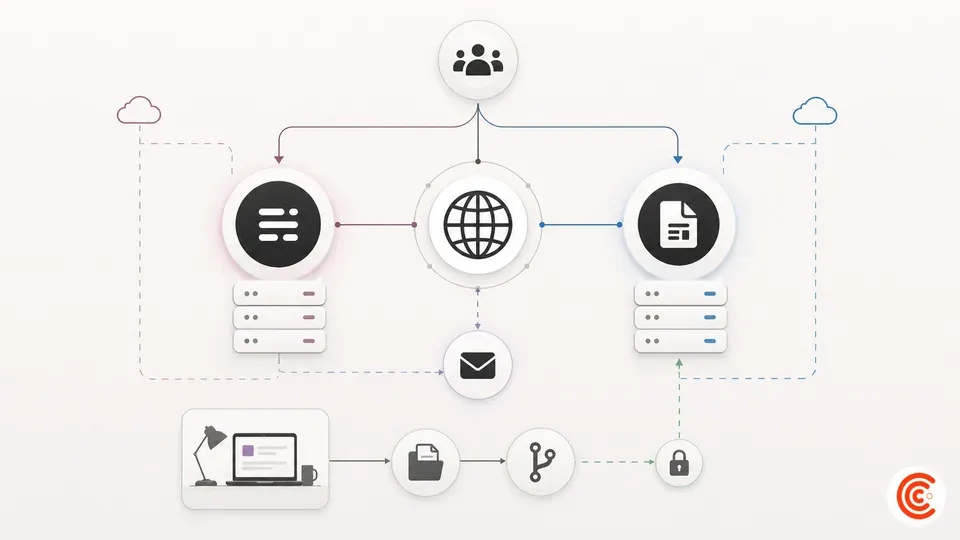
The English publication uses Ghost. A separate community and information site uses WordPress. Markdown drafts and operational files live locally and are synchronized through Git. Cloudflare manages the domain layer and connects one private dashboard back to my computer. Resend provides transactional SMTP for the Ghost installation. AI agents help prepare files and operate publishing scripts.
The public architecture is:
Readers
  ├─ Ghost publication → PikaPods
  └─ WordPress site    → PikaPods

Domain and DNS → Cloudflare
Ghost transactional email → Resend
Draft source and automation → local workspace + Git
Private operations viewer → local server + Cloudflare Named Tunnel
This arrangement grew incrementally. I did not hold a formal vendor selection process and choose the theoretical optimum for each box. I chose tools that allowed one person to make progress without becoming a part-time systems administrator.
That distinction explains PikaPods.
## Why I chose PikaPods
PikaPods hosts open-source applications as isolated “pods.” Its current public catalog includes Ghost from about $3.30 per month and WordPress as a supported application. The broader service starts at $1.80 per month, depending on CPU, memory, and storage.
The appeal was not raw compute value. It was reduced operational work.
PikaPods says it manages configuration, databases, security, and app updates, with updates tested and applied weekly and faster handling for security updates. It supports custom domains and lets users download data through SFTP. It also offers daily encrypted backups to a user’s own S3-compatible storage.
Those features matched my priorities:
- I wanted open-source Ghost rather than a closed publishing platform.
- I did not want to install and patch Ubuntu, NGINX, MySQL, Node.js, and systemd myself.
- I wanted Ghost and WordPress in one hosting account.
- I had already funded the account with prepaid credit.
- I wanted an exit path rather than a proprietary content database.
The tradeoffs are real.
PikaPods currently advertises EU and US locations, not an Asian region. My audience is global, but I operate from Asia and also run a Korean-facing WordPress site. That can add latency compared with a host near Korean readers. I accepted the tradeoff while the projects were small because consolidating operations mattered more than optimizing the last part of response time.
Support and flexibility also differ from a self-managed VPS. A one-click app host makes common operations simple by constraining unusual ones. If I need a custom network topology, nonstandard database configuration, aggressive caching, or server-level observability, I may outgrow the convenience.
Why not Ghost(Pro)?
Ghost(Pro) is the official managed service and funds Ghost development. Current annual-billing prices start at $18 per month for Starter and $29 per month for Publisher. Publisher adds custom themes, paid subscriptions, integrations, and advanced analytics.
Ghost(Pro) is the cleaner recommendation for a creator who wants Ghost without infrastructure decisions and values official support. I chose PikaPods because my early publication was small, I was comfortable connecting SMTP and domains, and the hosting cost was materially lower.
Why not a VPS?
Ghost’s official production guide recommends Ubuntu, NGINX, MySQL 8, a supported Node.js version, systemd, and at least 1 GB of memory. A VPS provides more control, but someone must secure, update, monitor, and back up that stack.
DigitalOcean, Hetzner, and other VPS providers may offer better compute economics. That comparison becomes misleading if the operator’s maintenance time is priced at zero.
The cost table—and the missing number
Here is the honest cost model. It separates verified public prices, my known approximate spend, and values that should be inserted from a redacted billing record before publication.
| Component | Current role | Monthly cost used in this draft |
|---|---|---|
| PikaPods Ghost pod | English publication | About $3.30 |
| PikaPods WordPress pod | Community/information site | [INSERT ROUNDED ACTUAL MONTHLY COST] |
| Resend transactional email | Ghost SMTP | $0 while within the current free allowance |
| Cloudflare DNS/Tunnel | Domains and local private route | $0 on the features currently used |
| Domain registration | Publication domain | About [INSERT ANNUAL COST ÷ 12] |
| Claude subscription or API | Original agent workflow | [INSERT ONLY IF YOU WANT THIS PUBLIC] |
| ChatGPT/Codex plan | Recovery and technical operation | [INSERT ONLY IF YOU WANT THIS PUBLIC] |
| Owner review time | Research, privacy, editorial judgment | Not captured on a provider bill |
Resend’s current free transactional tier includes 3,000 emails per month with a daily limit of 100. That is enough for my current low-volume application email, but it is not a free unlimited newsletter service.
Cloudflare Tunnel is available across Cloudflare plans, and the Free website plan remains $0. I already own and operate the domain, so the relevant incremental tunnel cost is currently zero. Domain registration is still a cost even when the DNS and tunnel are free.
The two AI rows are intentionally optional. Subscription pricing can reveal more about personal usage than readers need, and plans change frequently. If included, they should reflect the actual billing period rather than a remembered list price.
The missing number in nearly every “cheap publishing stack” post is owner time.
In one month, a tiny hosting bill can coexist with:
- hours spent correcting automated drafts;
- image generation and privacy review;
- API integration maintenance;
- plugin and theme decisions;
- remote state verification;
- backup planning;
- analytics setup;
- affiliate applications;
- content that never earns back its production cost.

My current lesson is that a low monthly bill is useful but not sufficient. A stack becomes cheap only when it also reduces the operator’s recurring decisions.
When I would choose a different host
Choose Ghost(Pro) when
- the publication is the business;
- official support matters;
- built-in newsletters, memberships, and analytics justify the price;
- you do not want to manage SMTP or hosting behavior;
- you may qualify for and honestly use Ghost’s referral program.
Choose a VPS when
- you need server-level control;
- you can maintain Linux, database, proxy, SSL, backups, and monitoring;
- several applications can share one server safely;
- predictable higher resource usage makes the economics worthwhile.
DigitalOcean runs both an affiliate program and a separate credit-based referral program. Its public affiliate page currently advertises 10% of referred users’ monthly spend for one year. That makes it commercially attractive for a hosting comparison, but commission should not replace hands-on testing.
Choose managed WordPress hosting when
- WordPress is the primary business;
- support for plugin conflicts, backups, staging, caching, and migrations is worth paying for;
- the audience is concentrated in a region better served by another provider.
Hostinger’s affiliate program currently starts at 40%. Cloudways offers multiple commission structures, including a hybrid option described as an upfront payment plus recurring commission. Both are potential monetization options for a properly tested comparison—not evidence that either is better for my current sites.
Stay with PikaPods when
- supported open-source apps cover the requirement;
- simple resource controls are enough;
- managed updates are more valuable than root access;
- several apps can be consolidated into one operational account;
- EU or US hosting locations are acceptable;
- the ability to export data reduces lock-in concerns.
Affiliate and link placement
- PikaPods — the host I actually use; official non-affiliate link.
- Ghost(Pro) pricing — official comparison link.
- DigitalOcean — VPS and application-platform alternative.
- Hostinger — hosting alternative.
- Cloudways — managed cloud-hosting alternative.
[AFFILIATE LINK PLACEHOLDER — GHOST(PRO)] Replace the Ghost(Pro) link only after referral-program approval. Disclose that my current site is self-hosted through PikaPods, not Ghost(Pro).
[AFFILIATE LINK PLACEHOLDER — DIGITALOCEAN] Replace the alternative link after affiliate approval and a real Ghost or WordPress deployment test.
[AFFILIATE LINK PLACEHOLDER — HOSTINGER] Replace only after testing the relevant hosting product. Do not use a generic high-commission claim as a recommendation.
[AFFILIATE LINK PLACEHOLDER — CLOUDWAYS] Replace only after testing its workflow and selecting the correct approved campaign URL.
PikaPods is intentionally left as a normal official link because I did not find a public PikaPods affiliate program in the official material reviewed for this article.
Frequently Asked Questions
Is PikaPods managed Ghost hosting?
It is a managed open-source application host that offers Ghost as a supported app. It is not Ghost(Pro), the official managed service operated by the Ghost Foundation.
Is the Ghost pod really about $3.30 per month?
PikaPods currently lists Ghost from $3.30 per month. Actual spend depends on configured resources and pricing changes.
Why use Resend if Ghost supports newsletters?
My current configuration uses Resend for low-volume transactional SMTP. Ghost’s official self-hosted newsletter documentation has its own supported bulk-email requirements, so transactional mail and a scaled newsletter should not be treated as the same workload.
Is a VPS always cheaper?
The server bill may be lower per unit of compute, but the comparison must include maintenance, security, backups, monitoring, and operator time.
Can I migrate away from PikaPods?
PikaPods states that users can download their data through SFTP. The practical migration procedure still depends on the application, database, media files, DNS, and acceptable downtime.
Key Takeaways
- PikaPods reduced the infrastructure work required to operate Ghost and WordPress.
- The Ghost pod’s entry price is small compared with the time spent operating the publishing business.
- Ghost(Pro) costs more but removes more infrastructure decisions.
- A VPS increases control and responsibility together.
- Affiliate links belong in tested comparisons, not retroactively manufactured endorsements.
How this was written
This article is based on my current PikaPods-hosted Ghost and WordPress stack. Approximate Ghost cost and supporting services were checked against local operating notes and official pricing. Private billing values remain placeholders for manual insertion or removal. No provider is described as hands-on tested unless I actually use it.
Comments ()