
OpenAI Presence Explained: Why Enterprise Agents Are Becoming Managed Operations, Not Software
OpenAI Presence Explained: Why Enterprise Agents Are Becoming Managed Operations, Not Software
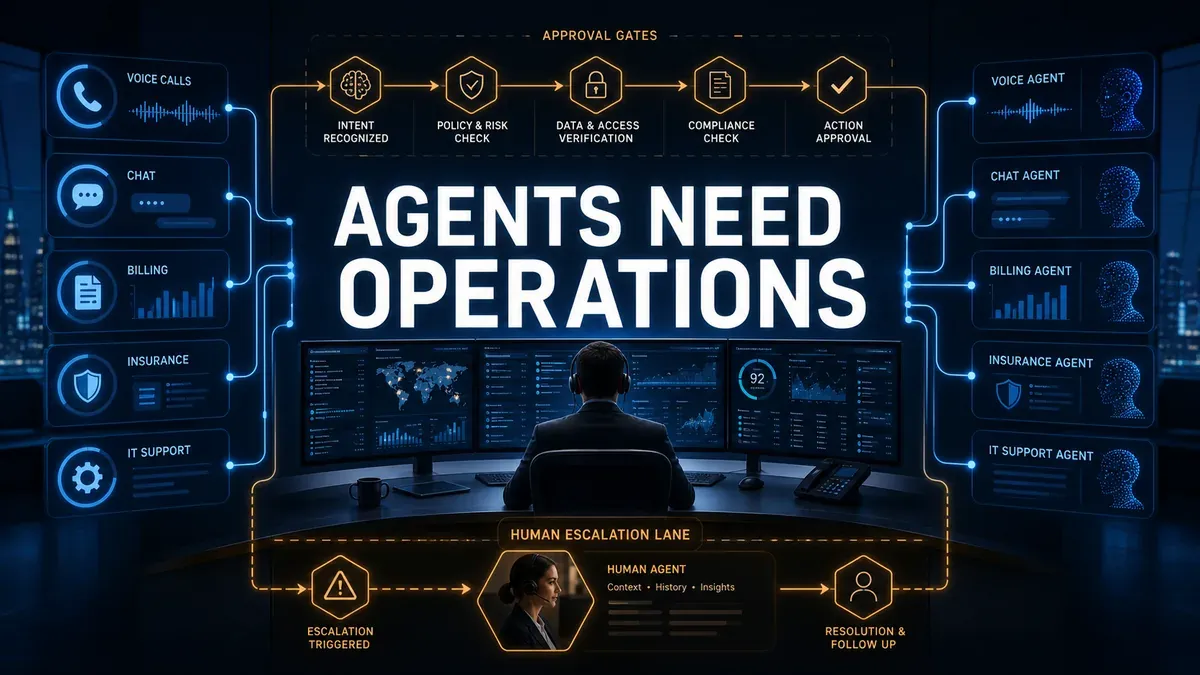
OpenAI Presence is not a self-serve chatbot builder. It is a limited-availability enterprise deployment product that combines models, policies, approved actions, simulations, evaluations, human escalation, and a Codex-assisted improvement loop.
Table of Contents
- What OpenAI Presence actually is
- The operating model behind a production agent
- What the early performance numbers do and do not prove
- A practical decision framework for enterprises
What OpenAI Presence actually is
OpenAI introduced Presence on July 22, 2026 as a deployed product for eligible enterprise customers. It supports voice and chat agents in workflows such as customer support, outbound sales, billing resolution, insurance claims, and internal IT service requests. OpenAI says the product is available through a limited general-availability program led by its Forward Deployed Engineers and selected systems integrators. It is not a self-serve product.
That distinction matters. Most agent announcements are framed as software primitives: a model, an API, a tool-calling interface, or an orchestration framework. Presence is closer to an operating service. The company and OpenAI jointly identify a bounded job, connect the required systems, define permissions and policies, test the agent, launch it, observe failures and escalations, and then manage controlled changes.
The underlying thesis is that an enterprise agent is not finished when it passes a demo. Policies change. Products change. Customers discover new ways to phrase old problems. Fraud patterns evolve. System interfaces break. A production agent therefore behaves less like a static application and more like a continuously operated frontline team.
OpenAI describes six ingredients: policies and standard operating procedures, guardrails, approved actions, simulations, evaluation tools, and a Codex-powered improvement process. The agent receives only the knowledge and system access needed for its specific job. The customer decides which actions are automatic, which require approval, and which trigger a human handoff.
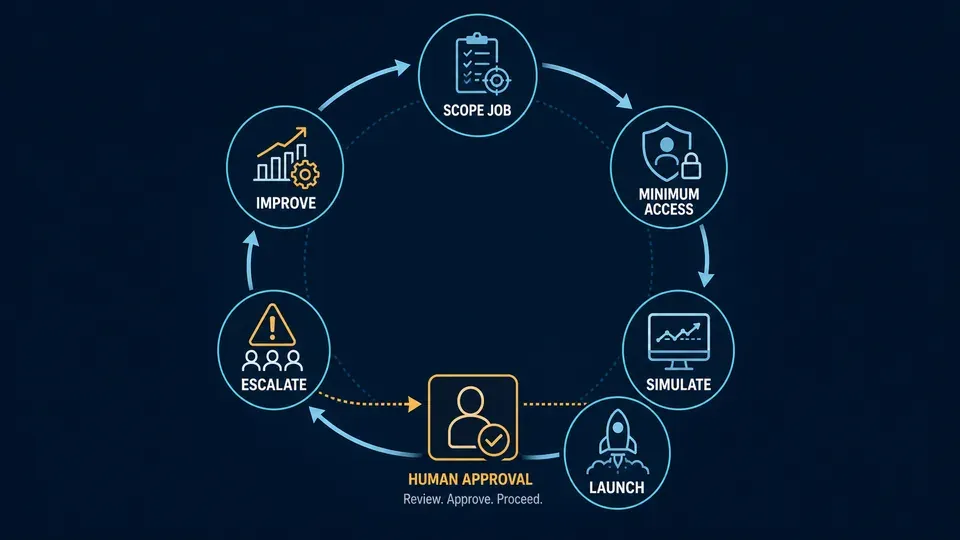
This design aligns with a broader risk-management principle. The US National Institute of Standards and Technology describes AI risk management as an ongoing organizational process rather than a one-time model test. NIST's AI Risk Management Framework emphasizes governance, measurement, management and monitoring across the system lifecycle. Presence packages a commercial version of that operational discipline around OpenAI's models.
The operating model behind a production agent
A useful way to understand Presence is to separate the model from the control system around it.
| Layer | Core question | Presence mechanism |
|---|---|---|
| Model | Can the system understand and reason? | Frontier voice and text models |
| Knowledge | What information may it use? | Job-specific connected knowledge |
| Permissions | What is it allowed to do? | Approved actions and access limits |
| Policy | How should it behave? | SOPs, rules and guardrails |
| Evaluation | Did it reach the right outcome? | Simulations and graders |
| Escalation | When must a person take over? | Defined handoff rules |
| Change control | How does it improve safely? | Codex proposals, tests and approval |
The table shows why comparing Presence only with a contact-center chatbot misses the point. The product's value is not a new chat bubble. It is the attempt to make the whole control stack repeatable.
Before launch, teams simulate common requests, edge cases and higher-risk scenarios. Graders check whether the agent reached the correct outcome, followed policy, used tools correctly and escalated appropriately. Guardrails can interrupt interactions that move outside approved boundaries.
After launch, production sessions and human handoffs become diagnostic data. Codex investigates those signals and proposes changes. Teams test a proposed version against the production version, then approve a controlled rollout. The important word is "approve": OpenAI's description keeps the business in the change-control loop.
This approach also changes procurement. An enterprise is not simply buying tokens. It is buying model access, systems integration, evaluation design, operational support and a mechanism for ongoing adaptation. That can justify higher spending than a raw API deployment, but it also creates deeper vendor dependence.
What the early performance numbers do and do not prove
OpenAI says Presence powers its English-language phone support line at 1-888-GPT-0090. According to the company, the system resolves 75% of inbound issues without human assistance. It also says a Codex-powered improvement loop reduced human handoffs by 15 percentage points in ten days.
Those figures are meaningful because they describe a live support channel rather than a laboratory benchmark. They suggest that a tightly scoped agent with system access can complete a large share of real requests. The 15-point change also supports the idea that post-launch operations matter.
But the figures are not enough to estimate a buyer's return on investment. OpenAI does not publish the call mix, baseline quality distribution, cost per resolution, average handling time, customer satisfaction, error severity or independent audit results on the announcement page. The support line also represents OpenAI's own product, policies and internal expertise. A bank, insurer or public agency will face different identity checks, legal duties, data retention rules and consequences of error.
The correct reading is therefore narrower:
- A production voice agent can resolve many bounded support requests.
- Human handoff rates can improve quickly when failure data feeds a controlled iteration loop.
- The published evidence is vendor-reported and use-case-specific.
- Every buyer still needs its own evaluation set, risk thresholds and unit economics.
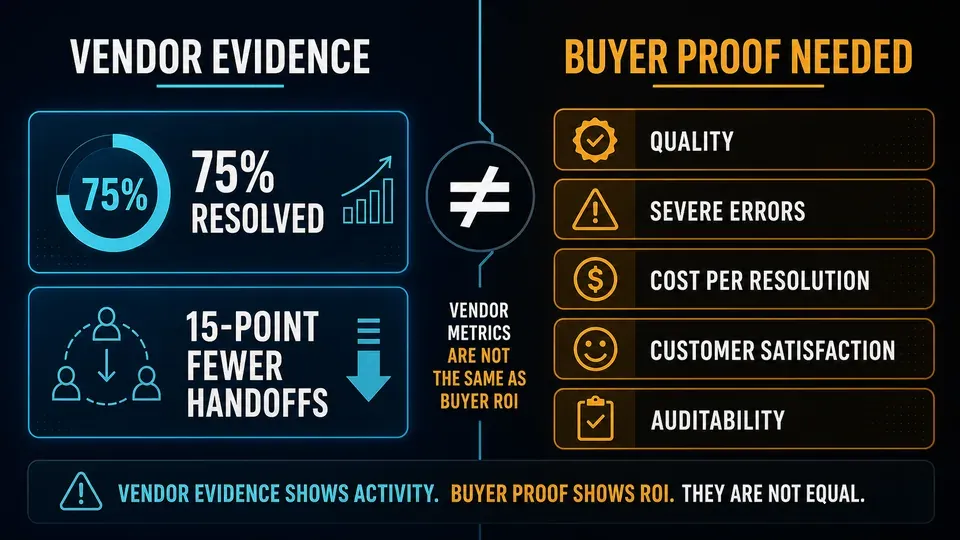
The most important metric may not be containment rate. An agent that keeps 95% of cases away from humans but mishandles one high-impact financial or medical case could be worse than one that escalates more often. Enterprises should measure expected loss, not only automation percentage.
A simple decision formula is:
Net value = labor and speed gains - operating cost - expected error cost - oversight cost
Expected error cost should weight failures by severity. One incorrect password reset is not equivalent to one unauthorized payment or denied insurance claim.
A practical decision framework for enterprises
Presence is most attractive when five conditions are present.
First, the job is narrow enough to define. "Help customers" is too broad. "Resolve billing disputes below a specified amount using these policies and escalate exceptions" is testable.
Second, the required systems have stable interfaces and clear permissions. An agent should not receive broad access simply because integration is easier. Minimum necessary access reduces both accidental and malicious risk.
Third, the company has historical cases for evaluation. Without representative examples, teams cannot measure whether a new version is better. Synthetic simulations help, but production-like cases are essential.
Fourth, the organization can staff escalation. Human handoff is not a failure mode to hide. It is part of the safety architecture. If nobody owns the queue, an escalation policy exists only on paper.
Fifth, management accepts continuous operations. An agent is not a one-quarter implementation project. It needs monitoring, incident review, policy maintenance, access audits and version control.
The following scorecard is a practical starting point:
| Question | Green signal | Red signal |
|---|---|---|
| Is the job bounded? | One clear outcome | Open-ended authority |
| Are actions reversible? | Refund within a limit | Irreversible high-value transfer |
| Can success be measured? | Known resolution criteria | Subjective outcome only |
| Is escalation staffed? | Owned queue and SLA | No accountable team |
| Is access minimal? | Job-specific permissions | Broad shared credentials |
| Is failure data available? | Historical cases and audits | Demo prompts only |
Presence may be important less because it introduces a new model than because it exposes the missing organizational layer around agents. The market spent years asking whether AI could answer. The enterprise question is now whether AI can act under policy, prove what it did, and know when to stop.
Frequently Asked Questions
Is OpenAI Presence available to every company?
No. OpenAI describes it as limited general availability for eligible enterprise customers. Deployments are led by OpenAI Forward Deployed Engineers and selected systems integrators, and the product is not self-serve.
Does Presence replace the OpenAI API?
No. OpenAI says voice customers will continue to have access to frontier models through the API. Presence is a managed deployment product around specific enterprise workflows.
What channels does Presence support?
At launch, OpenAI says it supports real-time voice and chat experiences. Examples include customer support, outbound sales and higher-risk internal workflows.
Does a 75% resolution rate mean humans are no longer needed?
No. The figure comes from OpenAI's own English-language phone support channel. Presence explicitly includes human escalation, and other industries require their own quality, risk and compliance testing.
Key Takeaways
- Presence packages models, access, policy, evaluation, escalation and change control into one enterprise deployment product.
- It is managed and limited-availability, not a self-serve agent builder.
- OpenAI reports 75% autonomous resolution on its support line and a 15-point handoff reduction in ten days.
- Those vendor-reported figures demonstrate feasibility, not universal ROI.
- Enterprises should evaluate severity-weighted errors, oversight and operating cost—not containment rate alone.
How this was written
This analysis was produced with AI assistance and reviewed against OpenAI's July 22, 2026 product announcement and NIST's official AI risk-management resources. Product claims are attributed to OpenAI, while the procurement and operating framework is the author's analysis.


Comments ()