
Japan's Crypto Tax Cut Explained: From 55% to a Flat 20% and the FIEA Switch That Makes It Possible

Japan's Crypto Tax Cut Explained: From 55% to a Flat 20% and the FIEA Switch That Makes It Possible
In mid-July 2026, Japan's parliament gave final approval to a law that reclassifies crypto as a financial instrument under the Financial Instruments and Exchange Act (FIEA) and clears the path to cut the top tax on crypto gains from as high as 55% to a flat 20%. The rule change and the tax change land on different dates, and the "20%" headline hides a two-year wait. Here is exactly what passed, when each piece takes effect, what it means for an investor's actual tax bill, and why it also opens the door to spot Bitcoin ETFs in Japan.
Japan just did something the United States and most of Europe still haven't: it moved crypto out of a payments law and into the same legal box as stocks and bonds. In mid-July 2026, the National Diet gave final approval to legislation shifting crypto oversight from the Payment Services Act (PSA) to the Financial Instruments and Exchange Act (FIEA). That single reclassification is what makes the eye-catching tax cut — from a top rate near 55% down to a flat 20% — legally possible. But the timeline is staggered, the tax break arrives in 2028, and the headline number needs unpacking before anyone reshapes their portfolio around it. This post breaks down what actually changed, runs the numbers on a real gain, and explains the ETF angle that has traders most excited.
Table of Contents
- What Japan Actually Passed
- 55% vs 20%: The Tax Math on a Real Gain
- Why the FIEA Switch Matters More Than the Tax Rate
- The Bitcoin ETF Door Just Opened
What Japan Actually Passed
The reform bundles three separate moves into one law, and confusing them is the fastest way to misread the news.
1. Reclassification. Crypto assets move from the Payment Services Act to the FIEA. Under the PSA, crypto was regulated mainly as a means of payment. Under the FIEA, it is treated as a financial instrument — closer in spirit to a security, though the Financial Services Agency (FSA) is explicit that crypto is a distinct category, not the same as traditional stocks. This is the structural change that everything else hangs on.
2. Tax treatment. Today, crypto gains in Japan are taxed as "miscellaneous income" under the progressive income tax system, where the combined national-plus-local rate can reach roughly 55%. The reform paves the way for a flat 20% separate tax — split 15% national and 5% local — the same style of treatment stocks already enjoy.
3. New guardrails. The law introduces stricter insider-trading rules, expands disclosure requirements for crypto issuers and exchanges, and raises penalties for unregistered operators sharply: maximum prison terms rise from 3 to 10 years, and maximum fines jump from ¥3 million to ¥10 million.
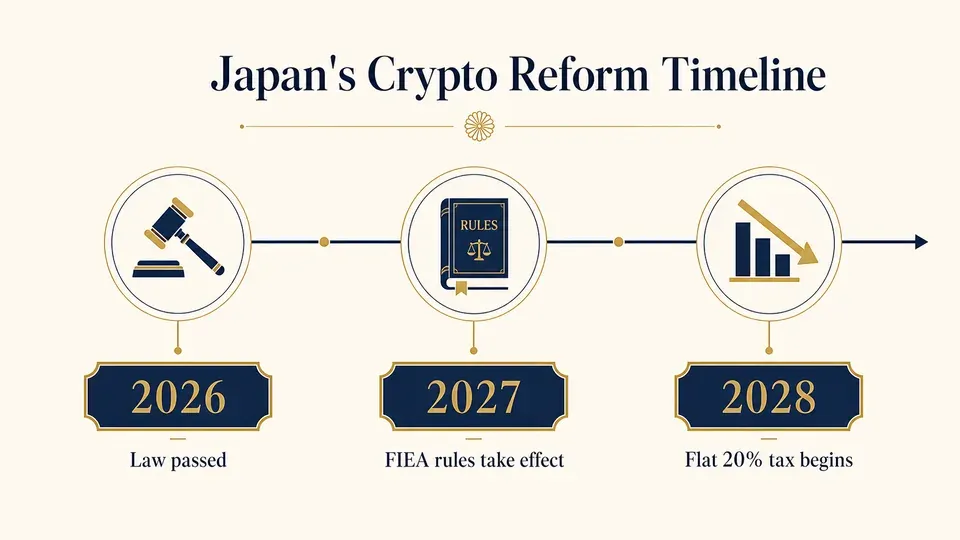
Here's the part most headlines skip — the two changes take effect on different dates:
| Change | What it does | Effective |
|---|---|---|
| FIEA reclassification | Moves crypto under financial-instrument rules, adds disclosure and insider-trading rules | 2027 |
| Flat 20% tax | Replaces up-to-55% progressive rate with a flat separate tax | 2028 |
So the law is passed, but the 20% rate is not something a Japanese investor can use on their 2026 or 2027 gains. The regulatory framework comes first in 2027; the tax cut follows in 2028.
## 55% vs 20%: The Tax Math on a Real Gain
The abstract percentages hide how large the change is. Consider an investor who realizes a ¥10,000,000 crypto gain (roughly a mid-six-figure USD position, depending on the exchange rate).
| Scenario | Rate applied | Tax owed | Kept after tax |
|---|---|---|---|
| Current (top progressive rate) | ~55% | ¥5,500,000 | ¥4,500,000 |
| After reform (flat separate tax) | 20% | ¥2,000,000 | ¥8,000,000 |
| Difference | −35 points | −¥3,500,000 | +¥3,500,000 |
For a top-bracket investor, the same ¥10M gain goes from keeping ¥4.5M to keeping ¥8M. That is not a rounding tweak — it is the difference between crypto being one of Japan's most punitively taxed assets and being taxed like equities.
Two caveats keep this honest. First, not every investor pays the full 55% today; that is the top combined rate, and someone with modest gains and low other income could already be below 20%. The reform helps high earners and large gains the most. Second, a flat separate tax usually comes with its own rules on loss offsetting and carry-forwards — features stock investors rely on. Whether crypto losses can be netted against crypto gains (and carried forward across years) under the new regime is a detail worth watching as the FSA writes implementing rules, because it materially changes the after-tax picture for active traders.
Why the FIEA Switch Matters More Than the Tax Rate
It's tempting to treat this as purely a tax story. It isn't. Moving crypto under the FIEA changes the legal character of the asset class in Japan, and that has knock-on effects the tax cut alone never could.
Under financial-instrument rules, crypto issuers and exchanges face securities-style disclosure obligations, and insider-trading prohibitions now apply. That raises the compliance bar — bad news for fly-by-night token projects, good news for institutions that couldn't touch an asset class governed by a payments law. Institutional allocators generally need an asset to sit inside a recognized financial-regulatory perimeter before mandates allow exposure. The FIEA reclassification builds exactly that perimeter.
This mirrors a broader 2026 pattern of regulators pulling crypto from the fringes into mainstream financial law rather than banning it — the same instinct visible in US debates over stablecoin oversight (see our earlier breakdown of the stablecoin yield debate and the Clarity Act). Japan is arguably going further by regulating the asset itself, not just one corner of it.

## The Bitcoin ETF Door Just Opened
The most market-relevant consequence may be one the law doesn't directly create: spot Bitcoin ETFs. Because ETFs are financial instruments, an asset generally has to live under the FIEA before a Japanese spot crypto ETF can be structured and approved. The reform removes that legal barrier. FSA officials have said Japan will now consider developing a regulatory framework for crypto ETFs — no product is approved yet, but the blocker is gone.
That matters because the US spot Bitcoin ETF launch in 2024 showed how much demand a regulated, brokerage-accessible wrapper can unlock from investors who won't touch a crypto exchange directly. Japan is one of the world's largest pools of household savings, much of it historically parked in cash. A domestic, yen-denominated, tax-advantaged ETF path is a structurally bigger deal for flows than the tax rate on its own.
The honest caveat: "door open" is not "product live." The reclassification takes effect in 2027, the tax cut in 2028, and any ETF framework still has to be written and approved on top of that. This is a multi-year runway, not a next-quarter catalyst.
Frequently Asked Questions (FAQ)
Can I use the 20% crypto tax rate on my 2026 gains? No. The flat 20% tax is targeted to take effect in 2028. The FIEA regulatory framework comes first, in 2027. Until then, the existing progressive treatment (up to ~55%) still applies.
Does this make crypto a "security" in Japan? Not exactly. Crypto moves under the FIEA, but the FSA treats it as a distinct category of financial instrument rather than equating it with traditional securities. It gets securities-style disclosure and insider-trading rules without being reclassified as a stock.
Is a spot Bitcoin ETF now available in Japan? No product is approved yet. The reform removes the legal barrier and the FSA has said it will consider an ETF framework, but that framework still has to be built and approved separately.
Who benefits most from the tax cut? High earners and investors with large realized gains, since 55% is the top combined progressive rate. Someone with small gains and low other income may already be taxed below 20% today.
What happens to unregistered crypto operators? Penalties rise sharply — maximum prison terms go from 3 to 10 years and maximum fines from ¥3 million to ¥10 million — part of the tighter FIEA-era compliance regime.
Key Takeaways
- Japan's parliament gave final approval in mid-July 2026 to move crypto from the Payment Services Act to the FIEA, treating it as a financial instrument.
- The top tax on crypto gains is set to fall from as high as 55% to a flat 20% (15% national + 5% local) — a 35-point cut worth ¥3.5M on a ¥10M gain for a top-bracket investor.
- The changes are staggered: FIEA rules in 2027, the flat tax in 2028. The headline 20% is not usable on near-term gains.
- The FIEA switch matters beyond tax — it brings crypto inside the regulated perimeter, adds disclosure and insider-trading rules, and clears the legal path for spot Bitcoin ETFs in Japan.
How this was written This piece was drafted with AI's research help; a human verified every fact and polished the final wording.
References
- CoinDesk — Japan reclassifies crypto as a financial asset, paves way for tax cuts
- Finance Magnates — Japan Plans 20% Crypto Tax and FIEA Oversight in 2026
- Crypto Times — Japan Is One Vote From Bitcoin ETFs and a 20% Crypto Tax Cap
- Crypto Briefing — Japan reclassifies cryptocurrency as financial assets, NHK reports

Comments ()