
AI Made Protein Evolution 79× More Selective—By Improving the Starting Point, Not Replacing the Lab
AI Made Protein Evolution 79× More Selective—By Improving the Starting Point, Not Replacing the Lab
A Nature study published July 22, 2026 combined AI protein redesign with laboratory evolution. Across four campaigns, redesigned enzyme starting points reached higher-function regions than natural proteins, and one evolved protease achieved more than 79-fold greater selected specificity for ataxin-2 than the best wild-type-derived result.
Table of Contents
- Why protein engineering has a starting-point problem
- How the AI-plus-evolution workflow worked
- What the 79-fold result means
- What this changes—and what it does not
Why protein engineering has a starting-point problem
Directed evolution is one of biotechnology's most powerful ideas. Researchers mutate a protein, select variants that perform a desired function, amplify the winners and repeat. The process can discover solutions that are difficult to design from first principles.
But evolution can spend its budget repairing a weak starting molecule. Natural proteins are adapted to biological functions and environments, not necessarily to a researcher's new target. Laboratory-evolved proteins can also lose stability, expression or specificity as they gain a new activity.
That creates a tradeoff. Computational redesign is often good at improving stability. Experimental evolution is often good at discovering new function. The new Nature study asks whether those tools work better in sequence rather than in competition.
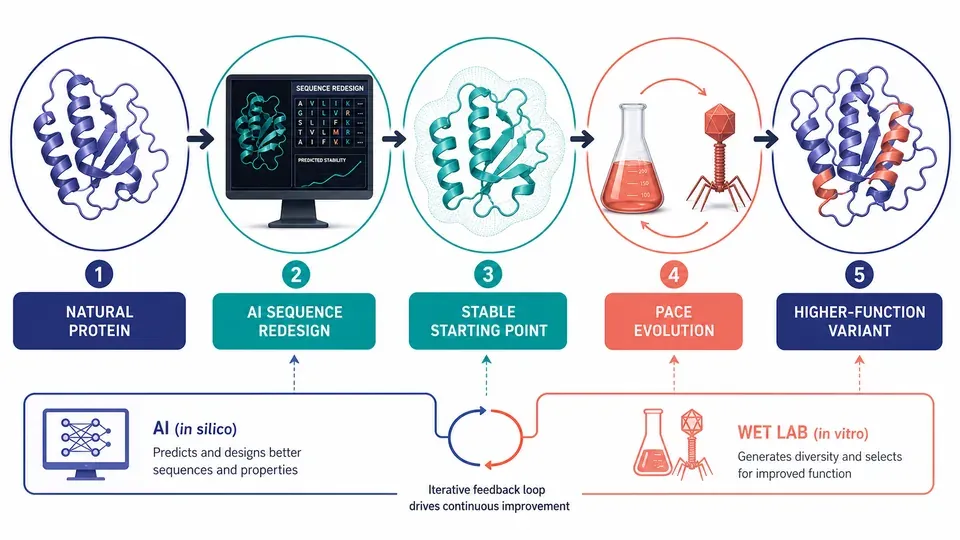
Nicholas Krasnow, Joy Xu, David Liu and colleagues used AI-based protein sequence design to redesign three botulinum neurotoxin proteases. The study used ProteinMPNN, a deep-learning system that proposes amino-acid sequences compatible with a specified protein backbone. The redesigned variants retained full catalytic efficiency while improving properties including stability.
ProteinMPNN itself was introduced in a 2022 Science paper. That work reported 52.4% native sequence recovery on protein backbones, compared with 32.9% for Rosetta in the cited benchmark, and demonstrated that the model could rescue previously failed designs. The 2026 study uses that kind of sequence redesign not as the final product, but as a launchpad for wet-lab evolution.
## How the AI-plus-evolution workflow worked
The researchers compared evolution campaigns that began with redesigned proteases against campaigns that began with the corresponding wild-type proteins. They used phage-assisted continuous evolution, or PACE. PACE can run many generations of mutation, selection and replication with limited manual intervention.
The experimental comparison matters. It would not be enough to show that an AI-redesigned protein looked more stable in a model. The researchers evolved redesigned and natural starting points side by side against new substrate-selection challenges.
Across three distinct redesigned enzymes and four evolution campaigns, redesigned starting points consistently produced proteases with higher activity than the wild-type starting points exposed to the same selection. Some beneficial mutations discovered from the redesigned backgrounds did not function when placed back into the natural enzyme backgrounds.
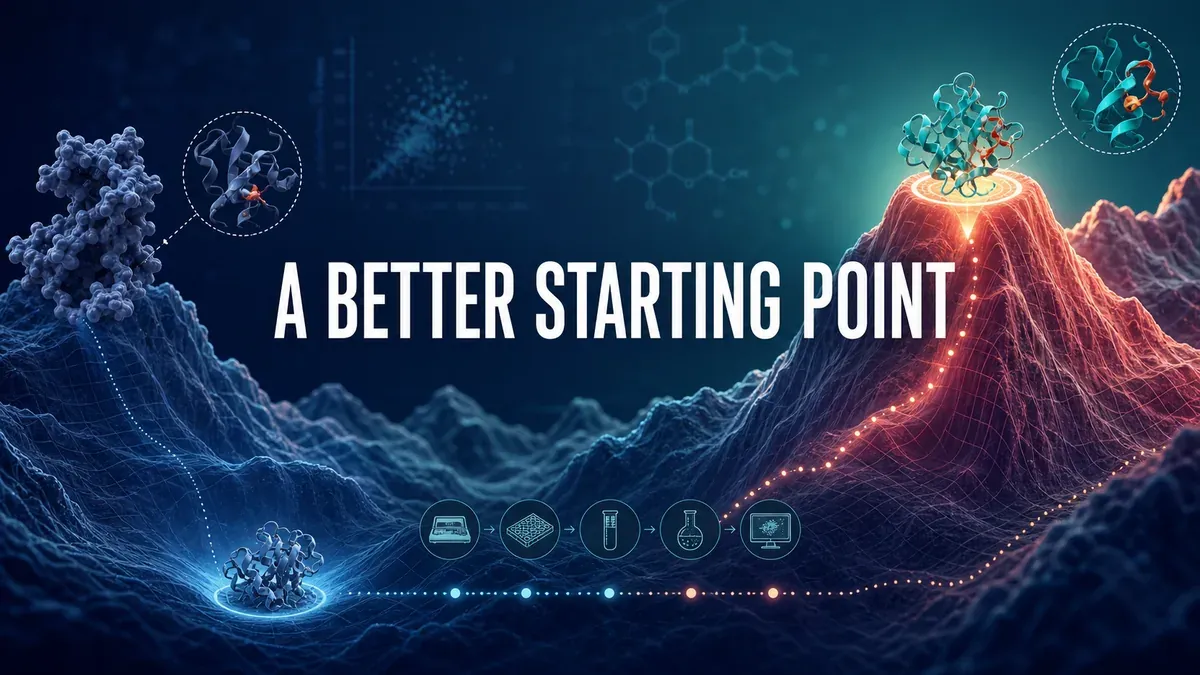
That result supports a fitness-landscape interpretation. Imagine every possible protein sequence as a point in a vast landscape. Height represents useful function. A mutation moves the protein to a neighboring point.
A natural protein may sit on a local peak for its original job but be surrounded by fragile routes toward a new job. An AI redesign can raise stability in the nearby sequence space. That gives subsequent mutations more room to explore before the protein collapses or loses activity.
The study's key insight is therefore not "AI found the final enzyme." It is that AI changed the neighborhood from which evolution began. When redesign improved local fitness, the experimental campaigns adapted faster and accessed functional sequences that were unavailable from the wild-type background.
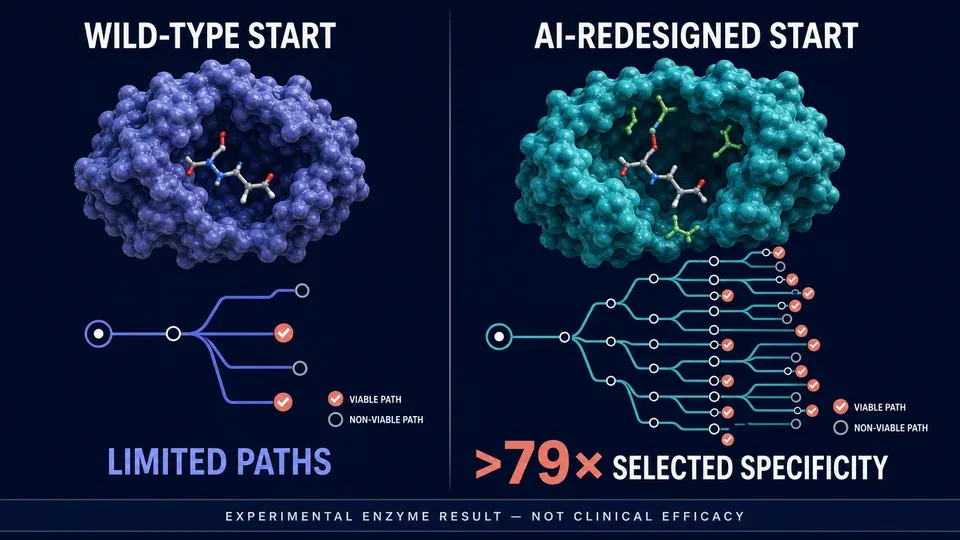
This is a form of option value. A more robust starting protein can tolerate more experiments. It does not tell researchers exactly which mutation will solve the next problem. It increases the number of viable paths they can test.
What the 79-fold result means
The most striking experiment targeted ataxin-2, a protein relevant to disease research. The team evolved botulinum neurotoxin E proteases to cleave ataxin-2 selectively while minimizing cleavage of the protease's native substrate.
The best proteases evolved from the AI-redesigned starting point achieved more than 79-fold greater selected specificity for ataxin-2 than the best-performing variant evolved from wild-type botulinum neurotoxin E. The redesigned-derived proteases also showed higher catalytic efficiency and stability, with no detected native substrate cleavage in the reported best result.
Specificity matters because a protease that cuts both the desired target and unrelated proteins is not a useful precision tool. The experiment was designed to reward the new activity while disfavoring the native one. The 79-fold figure refers to selected specificity in this experimental system.
It does not mean a therapy is 79 times more effective. The paper establishes an enzyme-engineering workflow, not a clinical treatment. There is no claim in the study that an ataxin-2-targeting protease is ready for use in patients. Delivery, immunogenicity, off-target effects, dosing, durability and safety would all require separate investigation.
The study also used botulinum neurotoxin proteases as a model engineering system. That name can sound alarming outside context. The research concerns redesigning protease sequences and substrate specificity in controlled laboratory experiments. The significance lies in the general workflow: stabilize a starting scaffold computationally, then let experimental selection discover new function.
What this changes—and what it does not
The result challenges a common framing in scientific AI. AI is often presented as an alternative to experiments: predict more accurately so the laboratory can do less. This study shows a different division of labor.
AI is used where it is currently strong. ProteinMPNN proposes sequences that support a desired backbone and can improve stability. PACE is used where biology remains strong. Repeated mutation and selection search for function under experimental pressure.
The combination addresses the weaknesses of each method. Computational design can struggle to invent complex new biochemical function directly. Directed evolution can discover function but may start from a scaffold with poor robustness. Redesign improves the scaffold; evolution explores the functional landscape.
A simple comparison illustrates the shift:
| Approach | Strength | Limitation |
|---|---|---|
| Natural starting protein + evolution | Proven biological function | May be fragile for a new target |
| AI redesign alone | Stability and sequence compatibility | New function remains difficult |
| AI redesign + evolution | Robust start plus experimental search | Still requires substantial wet-lab validation |
The workflow could matter in therapeutics, chemical synthesis, diagnostics and environmental biotechnology. Proteases are only one class of enzymes. The authors argue that the principle has broad implications for protein science, but each new scaffold and function will need its own experiments.
There are also commercial considerations. The Nature paper discloses that Krasnow and Liu are inventors on patent applications related to the work. Liu is a cofounder, consultant or equity holder in several biotechnology companies. Those disclosures do not invalidate the results, but they are relevant when assessing translation and licensing.
The research also changes how teams might allocate screening resources. If a redesigned starting point raises the probability that nearby mutations remain functional, researchers may obtain more value from the same number of evolution rounds. That hypothesis should be tested across more protein families, selection systems and target functions.
The most important next questions are practical:
- Does the advantage generalize beyond the three redesigned proteases?
- How often does redesign improve local fitness but reduce access to a different useful region?
- Can researchers predict which redesigned starting point has the highest evolvability before running a campaign?
- How do safety and containment requirements change as design and evolution become easier?
- Can the combined workflow reduce total experimental time and cost at industrial scale?
The paper does not close those questions. It provides a strong controlled demonstration that the starting point can determine which evolutionary paths are reachable.
That is the durable insight. AI did not replace evolution. It gave evolution better material to work with.
Frequently Asked Questions
What is ProteinMPNN?
ProteinMPNN is a deep-learning model for designing amino-acid sequences compatible with a protein backbone. It was described in a 2022 Science paper and is used here to redesign protease starting points.
What is directed evolution?
Directed evolution repeatedly mutates and selects biological molecules for a desired function. The 2026 study used phage-assisted continuous evolution to compare redesigned and wild-type starting proteins.
Did the study create a treatment for an ataxin-2-related disease?
No. It created experimental proteases with improved selected specificity for ataxin-2. Clinical delivery, efficacy and safety were not established.
What does the 79-fold number refer to?
It refers to the selected specificity of the best ataxin-2-cleaving protease evolved from the redesigned starting point compared with the best variant evolved from wild-type botulinum neurotoxin E in the study.
Key Takeaways
- AI redesign and wet-lab evolution solved different parts of the protein-engineering problem.
- Redesigned starting points outperformed wild-type starts across four side-by-side evolution campaigns.
- One redesigned-derived protease achieved more than 79-fold greater selected specificity for ataxin-2.
- The result is an experimental enzyme-engineering advance, not evidence of a ready therapy.
- The deeper lesson is that improving a protein's local fitness landscape can make otherwise inaccessible functions reachable.
How this was written
This article was produced with AI assistance and checked against the open-access Nature paper, the Broad Institute publication record and the original ProteinMPNN paper indexed by PubMed. Clinical implications are deliberately separated from the study's experimental findings.
Comments ()